Key takeaways
- The 25 percent rule is the threshold most Texas carriers use to decide whether a hail-damaged slope gets patched or replaced: roughly a quarter of the slope showing functional damage, scored with a 10 by 10 foot test square.
- Adjusters count functional strikes inside the square. Eight hits in 100 square feet is the common replacement number, and it varies by carrier.
- It is a carrier practice, not a law. The regulation roofing websites cite, 28 TAC 21.1006, is about insurers refusing to write policies on older homes and never mentions hail, slopes or 25 percent.
- Three outcomes: spot repair (often under your deductible), slope replacement (one slope, priced on its own squares), or full replacement (most DFW homes $14,500 to $32,000, with the carrier paying the approved scope minus your deductible).
- The square is scored slope by slope, which is why two houses on the same Plano street get two different letters after the same storm.
- We document every slope and meet your adjuster on the roof. Texas Insurance Code 4102.163 keeps contractors out of the claim itself, and you must pay your own deductible.
The 25 percent rule for roofing in Texas decides whether a carrier patches a hail-damaged slope or replaces it. Adjusters chalk a 10 by 10 foot test square on each slope and count functional strikes. Roughly a quarter of the slope damaged, usually eight or more hits in the square, and the carrier replaces the slope instead of patching it.
it is a carrier practice, not a texas law.
Most roofing websites in Dallas-Fort Worth tell you the 25 percent rule is a Texas Department of Insurance regulation and cite 28 TAC 21.1006. We read the section before updating this post. It is titled “Prohibition Against Declining to Write Residential Property Insurance Based on the Age or Value of the Property,” and it says an insurer cannot refuse to write a homeowners policy just because the house is old or cheap. It never mentions hail, slopes, test squares or 25 percent (28 TAC 21.1006, Cornell LII).
The building code is no help either. The reroofing section DFW cities adopt, 2021 IRC R908, contains no 25 percent threshold and no 12-month window. What it does say matters once a replacement is approved: every existing layer comes off down to the deck, and a new layer cannot go over a roof that already has two (2021 IRC R908, UpCodes).
So the number lives in carrier claim guidelines and adjuster training. That has two consequences. First, State Farm, Allstate, USAA and Farmers can each apply it a little differently, and two adjusters at the same carrier can land on different counts. Second, nobody can make a carrier “follow the 25 percent rule,” because there is no rule to enforce. What you can do is put enough documented damage on the table that the carrier’s own guideline points at replacement.
The 25 percent rule is real on the roof and imaginary in the law books. Treat it as the carrier’s threshold, not your entitlement.
the test square is the whole game.
A test square is a 10 foot by 10 foot area, 100 square feet, chalked onto a slope where the damage looks worst and away from anything that shields the shingles, like an overhanging live oak. Test squares go on each slope, and inside each one the adjuster counts strikes that meet the definition of functional damage. The number of hits needed to replace that slope varies by carrier, and eight is the common figure (InterNACHI, Mastering Roof Inspections: Hail Damage, Part 12).
Functional damage means the shingle will fail sooner because of the hit: a bruise you can feel that has fractured the fiberglass mat underneath, a puncture, or a granule loss spot that exposes the mat. Cosmetic marks, blisters from a hot attic, nail pops and the scuffs from someone walking the roof do not count, and an experienced adjuster will circle a bruise, press it, and skip the rest.
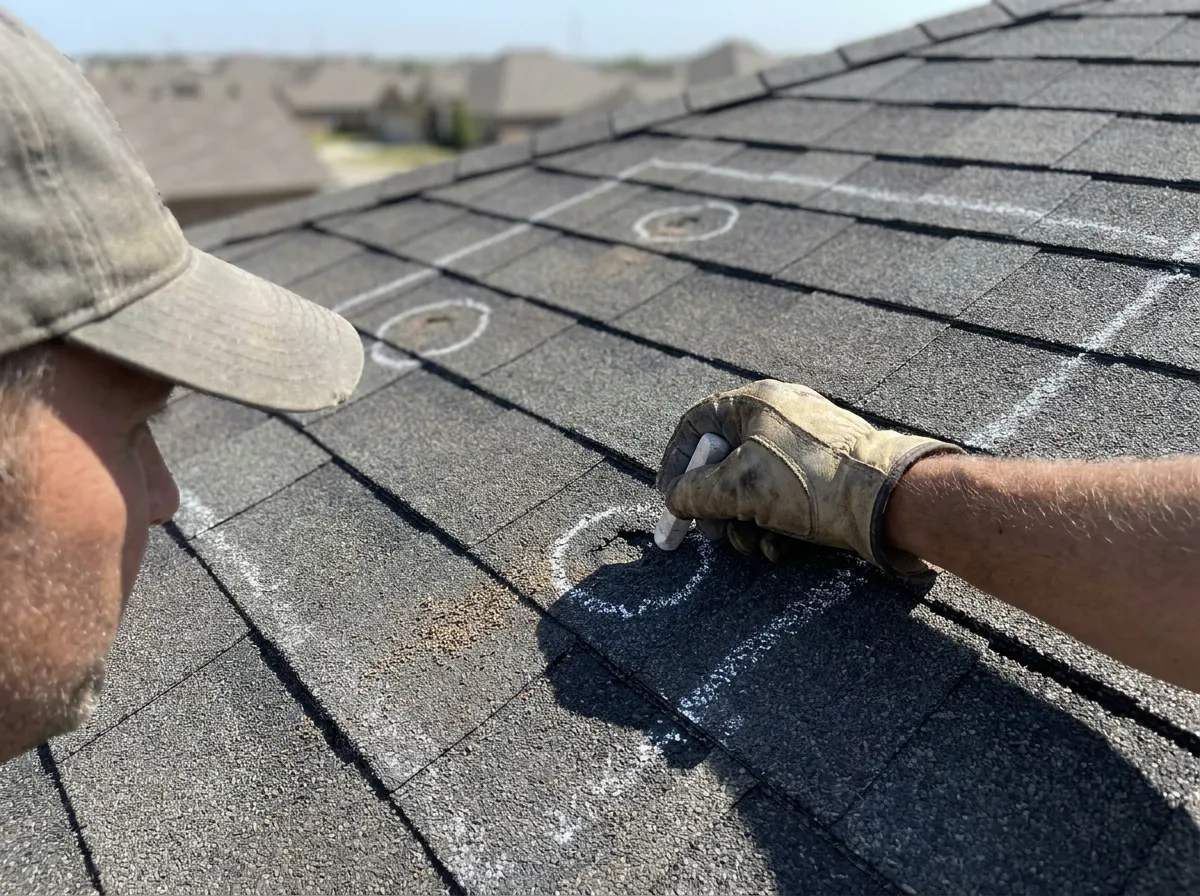
Here is how the count happens on a real inspection. The adjuster runs a flat hand across the shingles, feels for soft spots, circles each one in chalk, and splits a few with a knife to confirm the mat is cracked. Then they walk the soft metals: the roof vents, the gutter lips, the AC condenser fins. Dents in soft metal confirm hail of a given size hit from a given direction, which is what separates fresh hail from a bruise that has been there since 2019.
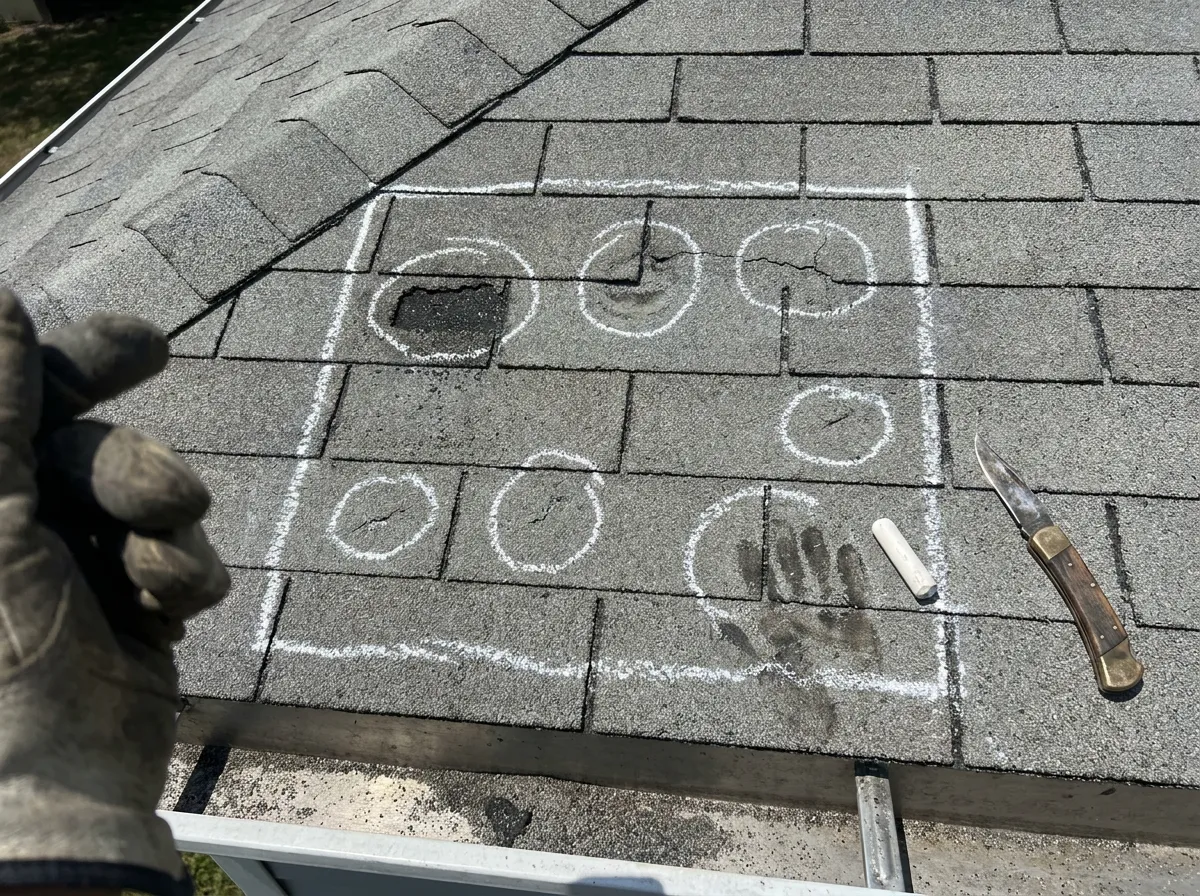 A chalked 10 by 10 square with the functional hits circled. Eight inside the square is the number most North Texas carriers work from.
The square is a sample, and a sample is only as good as where it sits. Move the square six feet and a seven-hit slope can read eleven, or four. That is why our crew lead chalks a square on every slope before the adjuster arrives, photographs each one with the circles visible, and why the adjuster then chalks their own. Two sets of squares that agree close the file. One set that nobody can check does not.
how much hail damage it takes to replace a roof.
The honest answer is “enough functional strikes on enough slopes,” and the count depends on four things you cannot control and one you can.
Hail size and angle. Quarter-size stones can bruise a 15-year-old three-tab and leave a two-year-old Class 4 shingle with little to show. Hail driven sideways by wind hits the windward slope hard and barely touches the lee. On most of the claims we document across Plano, Allen and McKinney, the west and south slopes carry the hits, because that is the direction Collin County’s March through June storms arrive from.
Roof age. A bruise on a 5-year-old architectural shingle is obvious. On an 18-year-old roof that has already lost a third of its granules to the Texas sun, the adjuster has to separate storm damage from wear, and older roofs get scored harder.
Shingle type. A Class 4 impact shingle exists to survive this test. If you have one, expect fewer qualifying hits for the same storm, and read our Class 4 shingle guide before deciding that is a bad thing.
Which adjuster shows up. Sampling plus judgment means variance. It is the reason reinspections exist.
The one you control: documentation. Every slope, every soft metal, the storm date for your address, all photographed before the adjuster’s ladder goes up. The hail damage guide shows the ten signs we photograph.
The money behind this is large. State Farm alone paid out more than $5.6 billion in hail claims in 2025, and Texas led the country at $1.4 billion (State Farm newsroom, April 2026). That is the money the threshold protects, and carriers defend it accordingly.
Slope by slope, the strike counts map to outcomes like this:
- Every slope below the threshold (a few functional hits per square, nothing clustered): spot repair.
- One slope at or over the threshold, the rest clean: slope replacement.
- Two or more slopes at or over the threshold: full replacement on most policies, because the carrier would otherwise be paying to leave the roof in two colors.
three outcomes, and what each one pays.
| Outcome | What the squares show | What the carrier pays for | What it costs in DFW (2026) |
|---|---|---|---|
| Spot repair | Scattered functional hits, under the threshold on every slope | Individual shingles, a pipe boot or vent, dented soft metals | Often lands under your deductible, so the carrier may owe nothing |
| Slope replacement | One slope at or over the threshold, the others clean | Tear-off and replacement of that slope, its underlayment and flashing | Priced on that slope’s squares at the same rates as a full roof: a 7 to 8 square slope in architectural shingles is roughly $2,500 to $4,400 before any matching question |
| Full replacement | Two or more slopes at or over the threshold | Full tear-off to the deck, underlayment, ice and water shield, drip edge, vents, ridge; code items added by supplement | Most DFW homes $14,500 to $32,000. A 2,400 sq ft Plano home in Landmark Pro runs about $22,000, about $24,500 in Class 4 |
Two things change the check regardless of the column. A replacement cost (RCV) policy pays the approved scope minus your deductible, with depreciation held back until the work is done; an actual cash value (ACV) policy subtracts depreciation for good. The ACV vs RCV guide and the depreciation recovery guide walk through both. And the deductible is yours on every outcome: Texas Insurance Code 707.002 says a person insured under a property policy “shall pay any deductible applicable to a first-party claim,” and a contractor offering to eat it is breaking the law (Tex. Ins. Code 707.002).
If you want your own numbers before the adjuster visit, the free roof cost calculator prices your roof area at the same rates in the table, and the Texas roof cost guide breaks a full replacement into its 14 line items.
a representative plano claim the test square flipped.
This is a representative example built from the pattern we see every hail season, not a named customer and not a single job.
A 2,400 square foot two-story off Legacy Drive, west of the Dallas North Tollway. Hip roof, about 30 squares, architectural shingles installed in 2009. Spring hail. The homeowner filed, the first adjuster spent twenty minutes on the roof, chalked one square on the front slope facing north, counted three hits, and wrote a repair: a couple dozen shingles and two pipe boots. The scope came in under the homeowner’s $4,000 deductible (1 percent of a $400,000 dwelling limit), so the carrier owed nothing.
The homeowner called us for a second look. Our crew lead chalked a square on all four slopes. North: 3. East: 4. West: 11. South: 9. The west gutter had a row of dents, the AC fins on the west side were flattened, and the storm report for the address matched the date on the claim. We put it in a photo report, and the homeowner asked the carrier for a reinspection.
The second adjuster met our crew lead on the roof and chalked their own squares. West came in at 10, south at 8. Two of four slopes over the threshold on a hip roof is more than half the roof area, and the carrier wrote the full replacement rather than two mismatched halves. The approved scope matched our estimate, about $22,000 in CertainTeed Landmark Pro. The homeowner paid the $4,000 deductible, the carrier released the recoverable depreciation after the final invoice, and the roof went on in two days.
We did not argue a dollar of it. We could not, legally, and we would not. The squares did the talking.
The first adjuster was right about the north slope. He just never looked at the west one.
why two neighbors get two different letters.
Every spring we get the same call from a cul-de-sac in Twin Creeks or Craig Ranch: “my neighbor got a whole roof and I got a repair, from the same storm.” Five reasons, usually.
Orientation. A storm cell tracking up SH 121 from the southwest hammers the slopes that face it. Your neighbor’s main slope faces west; yours faces north. Same stones, different count.
Age. Your neighbor’s 16-year-old shingles bruised where your 4-year-old ones dimpled and recovered.
Tree cover. The red oak over your south slope took the hail your shingles did not.
Shingle class. Class 4 shingles are built to pass this exact test, which saves your roof and costs you the claim.
Sampling. Two adjusters, two squares, two counts. The threshold is a line, and a sample can land on either side of it by a strike or two.
The fix for the last one is a second set of squares and a reinspection, which the denied claim guide walks through step by step. For the first four there is no fix, and a roofer who promises one is selling you something.
A clean north slope tells you where the storm came from. The west slope still has to be counted.
what we do on a claim, and what texas law stops us doing.
Texas Insurance Code 4102.163 says a contractor “may not act as a public adjuster or advertise to adjust claims for any property for which the contractor is providing or may provide contracting services,” with or without a power of attorney from you (Tex. Ins. Code 4102.163). So any roofer who says they will “handle your claim” is describing either a violation or a sales line.
Here is the line we work on. We document: slope-by-slope photos, chalked squares on every slope, soft metals, the storm date for your address, and a written report your adjuster gets before the inspection. We meet your adjuster on the roof and point at the evidence. After approval we build to the approved scope, and if the first scope left out code items like ice and water shield or ridge vent, we document those for the carrier in a supplement. Filing the claim is yours; our hail damage page covers the inspection side, and whether insurance will pay for a new roof covers the approval side.
What we never do is discuss the money with your carrier, promise an outcome, or touch your deductible. A roofer who offers to waive it, knocks on your door the morning after the storm, or wants a signature before the adjuster has been out is the subject of our storm chaser guide, and you should read it before you sign anything.
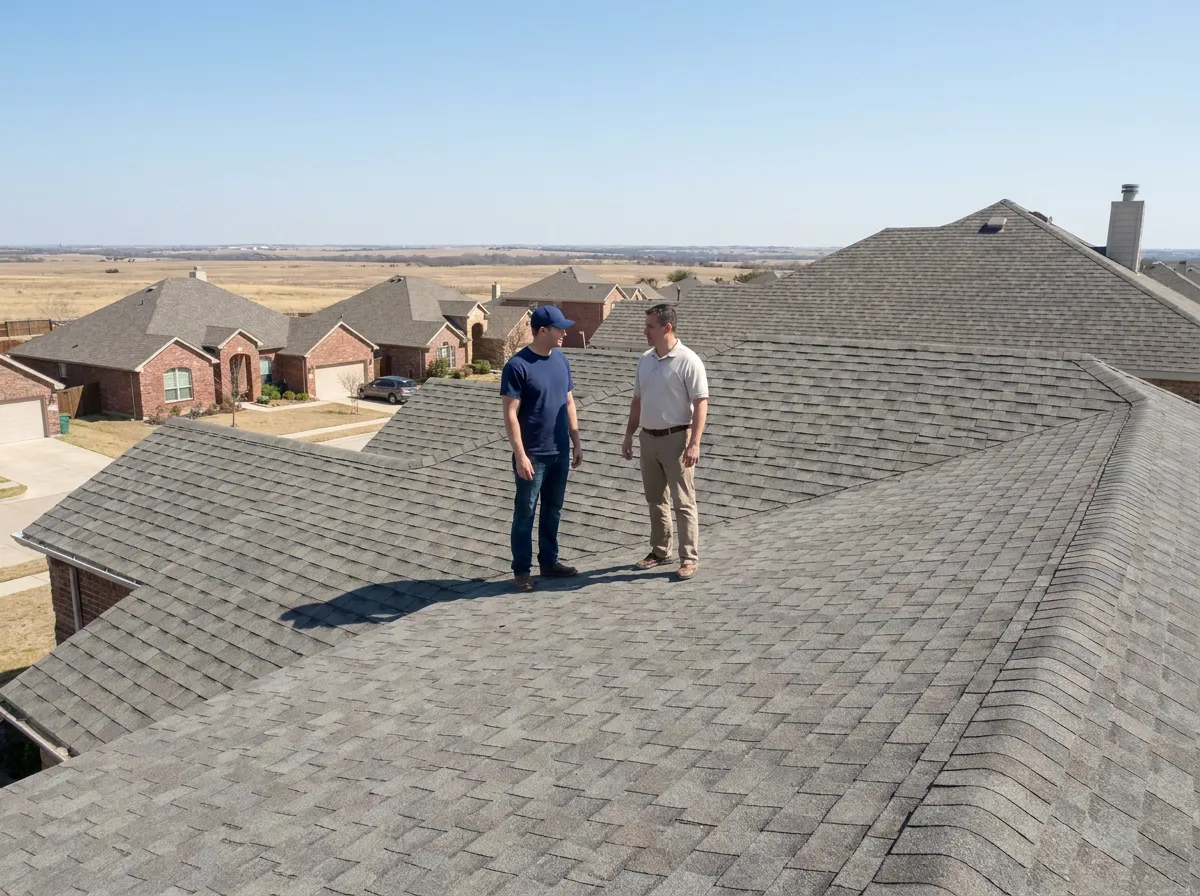 The adjuster meeting. Our crew lead walks every slope with the adjuster and points at the chalk; the adjuster writes the scope.
when the rule says repair but the roof says replace.
Sometimes the squares come back honest and under the threshold, and the carrier writes a repair on a roof that is 17 years old with granules in every gutter. The rule did its job. The roof is still at the end of its life: architectural shingles last 18 to 22 years in DFW heat, 3-tab 12 to 15, and a free inspection will tell you which end of that range yours is on.
At that point the claim stops being the decision and the roof becomes the decision. The repair money is yours to apply to whatever you do, and the question becomes whether patches on a roof with three years left beat putting that money toward a full roof replacement now. The repair vs replacement guide runs that math per year of roof. For the homes we see, the answer flips to replacement somewhere past year 18, and in-house payment plans on qualified projects (a larger deposit, the balance on a schedule we agree together, no bank) exist for exactly that gap.
frequently asked questions.
What is the 25% rule for roofing? It is the threshold most insurance carriers use to decide whether a storm-damaged roof slope gets spot-repaired or replaced. An adjuster chalks a 10 by 10 foot test square on each slope and counts functional hail strikes. When roughly a quarter of the slope shows damage, commonly eight or more strikes in the square, the carrier pays to replace that slope instead of patching it. It is a carrier practice, not a Texas statute.
How many hail hits per test square does it take to replace a roof? Eight functional strikes inside a 100 square foot test square is the number most carriers in North Texas work from, and the threshold varies by company. Only functional damage counts: a bruise that fractures the fiberglass mat, a puncture, or granule loss that exposes the mat. Cosmetic scuffs, blisters and nail pops do not. One qualifying slope usually means a slope replacement; two or more usually means the whole roof.
Is the 25 percent rule a Texas law? No. The regulation most roofing websites cite, 28 TAC 21.1006, is a Texas Department of Insurance rule that stops insurers from refusing to write a policy because a house is old or low in value. It never mentions hail, slopes, test squares or 25 percent. The reroofing section of the building code DFW cities adopt has no 25 percent threshold either. The number lives in carrier claim guidelines.
Will insurance replace the whole roof if only one slope is damaged? Usually not. If one slope crosses the threshold and the other three are clean, most carriers write a slope replacement: tear off and replace that slope only. Once two or more slopes qualify, most carriers write the full roof rather than leave mismatched halves, though the matching language in your policy decides it. Documenting every slope, not just the obvious one, is what moves a claim from one column to the next.
How much hail damage does it take to replace a roof? Enough functional strikes on enough slopes. Below the threshold everywhere, the carrier writes a spot repair that often lands under your deductible. One slope over, a slope replacement. Two or more slopes over, a full replacement, which on most DFW homes runs $14,500 to $32,000 with the carrier paying the approved scope minus your deductible. Hail size, roof age and which direction the storm came from all change the count.
Can my roofer argue the 25 percent rule with my adjuster? No. Texas Insurance Code 4102.163 bars a contractor from acting as a public adjuster on any property it works on. What we can do is document: chalked test squares on every slope, soft-metal damage, the storm date for your address, and a written photo report your adjuster gets before the inspection. We meet the adjuster on the roof and point to the evidence. The claim decision stays between you and your carrier.
If hail hit your roof this season and you are not sure which side of the threshold you are on, the inspection is free: we chalk every slope, photograph the soft metals, and hand you the report whether or not you hire us. Call (214) 326-3106, or run the free roof cost calculator first to see what a full replacement would cost on your roof area. If the claim comes back as a repair and the roof is past its life, in-house payment plans on qualified projects cover the gap.