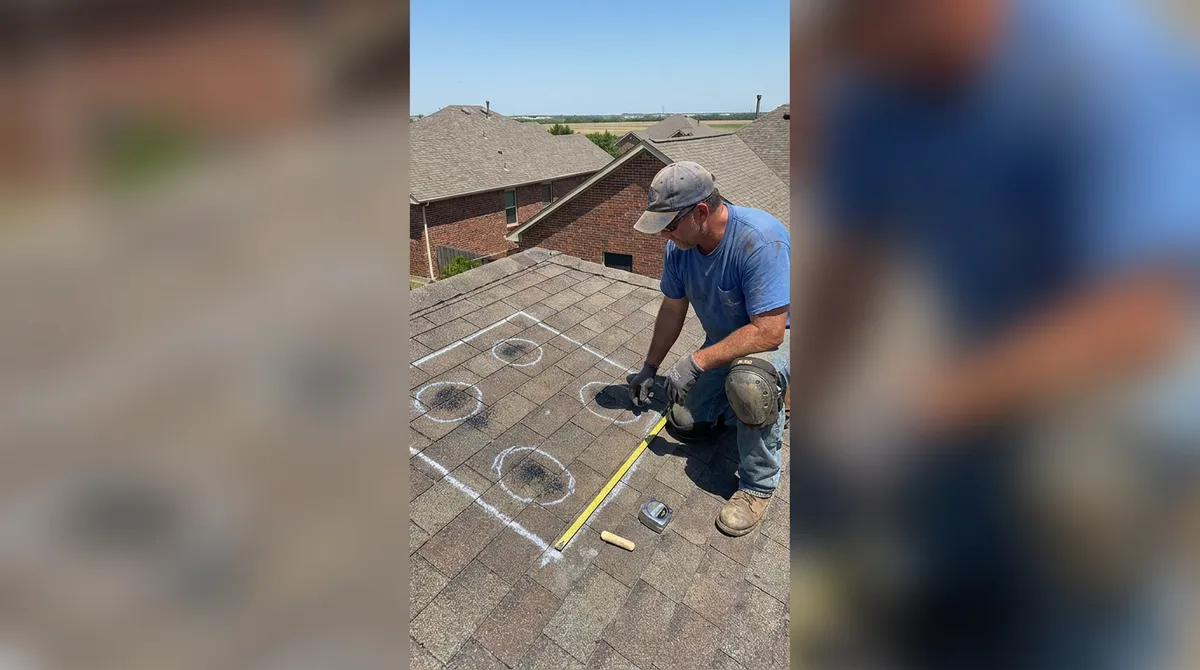
If your Texas carrier denied your roof claim, you have the right to dispute it in writing, request a reinspection with your contractor present, and escalate to the Texas Department of Insurance if the carrier won’t budge. Under Texas Insurance Code Chapter 542, the carrier has 15 business days to acknowledge a dispute and 15 more to accept or reject it after receiving your evidence. Most denials we see in Plano, Frisco, and McKinney get partially or fully overturned once a real roofer climbs the roof with a chalk square, a moisture meter, and photos that match the adjuster’s scope sheet line by line. Here’s the exact playbook we run for homeowners after every hail event.
 Most denial letters use the same three phrases. Once you know what they actually mean, the dispute writes itself.
read the denial letter line by line first.
Before you call anyone, sit down with the denial letter and a highlighter. Texas carriers almost always cite one of four reasons, and your dispute strategy depends entirely on which one shows up in your letter.
| Denial reason on the letter | What it actually means | Your move |
|---|---|---|
| ”Damage is cosmetic only” | Adjuster saw hits but didn’t measure granule loss or mat exposure | Request reinspection with a contractor who can document mat fracture |
| ”Damage is mechanical / foot traffic” | They’re saying a roofer caused the marks, not hail | Get dated weather reports from the storm date plus a second roofer opinion |
| ”Damage is wear and tear / age” | Roof is past its useful life in their eyes | Pull the original install paperwork and shingle warranty |
| ”Insufficient damage to meet deductible” | They counted fewer than 8 hits per test square | Recount on a 10x10 chalk square with photos in all four slopes |
If the letter says “no covered damage was identified,” that’s the easiest denial to flip. It usually means the adjuster spent 12 minutes on the roof, didn’t chalk a test square, and missed the windward slope entirely. We’ve reversed that exact denial on homes in Wylie, Allen, and Highland Park in the last 18 months by simply showing up with photos the first adjuster didn’t take.
Write down the claim number, the date of loss the carrier has on file, and the adjuster’s name and license number. You’ll need all three on every email and certified letter you send from here forward.
get an independent roof inspection within 14 days.
Don’t wait. The longer you sit on a denial, the easier it is for the carrier to argue any new damage came from a later storm. Schedule a free roof inspection in Dallas within two weeks of the denial date. The inspection report needs to include:
- A chalked 10x10 test square on each of the four slopes (north, south, east, west).
- Granule loss measurements with a magnetic sweep or visual count per square foot.
- Mat fracture photos taken with a quarter or business card for scale.
- Soft metal hits on the gutters, downspouts, AC fins, window screens, and roof vents. Soft metals are the tell. If the gutters are dented, the shingles took hits too.
- Moisture readings under the decking if there’s any interior staining.
- A weather report pull from the National Weather Service for the date of loss, showing hail size at your specific zip code.
Roof Raiders runs this exact inspection at no cost when you have an open claim or a recent denial. We document everything to HAAG Engineering standards because that’s the standard most Texas carriers fall back on when they reinspect. You want your photos to match their playbook.
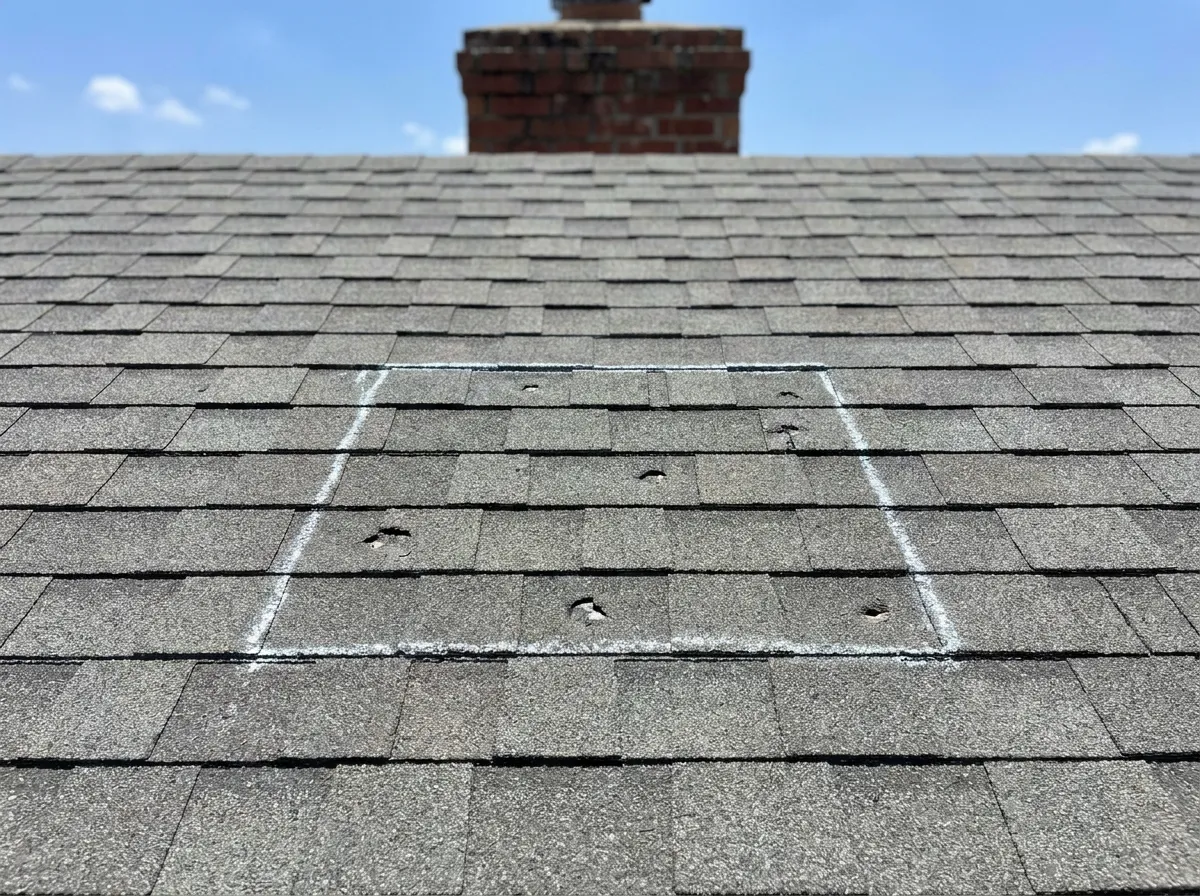 A chalked test square on an asphalt shingle slope helps document every hail hit the first adjuster may have missed.
write the carrier a formal dispute letter, not an email.
Texas Insurance Code requires carriers to respond to written disputes, not phone calls. A casual email to your adjuster won’t trigger the 15-business-day clock. Send a certified letter, return receipt requested, to the claims department address listed on your denial letter.
Your dispute letter should include:
- Your policy number, claim number, and date of loss.
- A clear statement that you are disputing the denial dated [date] and requesting a reinspection under Texas Insurance Code Chapter 542.
- A bulleted list of the specific findings the original adjuster missed, with photo references.
- Your contractor’s HAAG-format inspection report attached as a PDF.
- A request that the reinspection be scheduled within 15 business days and that you and your contractor be present.
- Your phone number and preferred contact times.
Keep it under two pages. Adjusters and supervisors triage by stack height. A 12-page letter with a printout of your shingle warranty stapled to it goes to the bottom of the pile. A clean two-pager with photo callouts gets actioned.
We’ve watched homeowners in Mesquite and Garland get full approvals within 9 business days of sending a clean dispute letter. We’ve also watched neighbors get nowhere for 4 months because they tried to handle it by phone.
show up to the reinspection with your contractor.
This is the part most homeowners skip, and it’s the single biggest reason denials stick. When the carrier sends a second adjuster (sometimes called a reinspector or field re-eval), your roofer needs to be on the roof with them. Not in the driveway. On the roof.
A good reinspection looks like this:
- Your contractor meets the reinspector at the curb 10 minutes early.
- They walk the perimeter together and your contractor points out every soft metal hit.
- They climb together. Your contractor chalks a test square first. The reinspector chalks their own.
- Your contractor takes photos of every hit the reinspector measures and notes.
- After the roof, they walk the interior together and check every ceiling stain, attic deck panel, and bathroom vent.
When two people with cameras are documenting the same hits, the reinspector can’t write “no damage observed” without contradicting their own photo log. This single change in process is why our reversal rate sits well above the DFW average.
When two people with cameras document the same hits, a reinspector cannot write no damage observed without contradicting their own photo log.
know when to file a supplement vs when to escalate.
If the reinspection comes back with a partial approval (say, they’ll pay for the windward slopes but not the leeward), you don’t need to start over. You file a supplement. A supplement is a formal request to add line items to an existing approved scope.
Common supplement items carriers leave off the first scope:
- Ice and water shield in valleys and around penetrations (Texas building code requires it on replacements).
- Drip edge on rakes and eaves (also code).
- Synthetic underlayment vs felt (most modern shingle warranties require synthetic).
- Ridge vent if the existing roof has one.
- Step flashing at sidewalls and chimneys.
- Detach and reset for solar panels, satellite dishes, and lightning protection.
- Code upgrade coverage if your policy includes Ordinance and Law endorsement.
A supplement typically adds $1,800 to $6,400 to a DFW residential scope and gets approved 80% of the time when the line items are tied to local code citations. Plano, Frisco, and Dallas all enforce 2021 IRC with local amendments. If your scope doesn’t include ice and water shield in valleys, that’s an easy supplement.
If the carrier still won’t approve covered hail damage after the reinspection and supplement, you have three escalation paths:
- File a complaint with the Texas Department of Insurance at tdi.texas.gov. TDI complaints get carrier attention within 30 days because the carrier has to respond in writing to the regulator.
- Request an appraisal under your policy’s appraisal clause. Each side picks an appraiser, the two appraisers pick an umpire, and the three of them set the scope and price. Binding on both sides.
- Hire a public adjuster or attorney. Public adjusters take 10% of the eventual settlement. Attorneys typically take 33% to 40% but can pursue bad-faith damages under Texas Insurance Code Chapter 541.
We tell homeowners to try TDI first because it’s free, it’s fast, and it works more often than people expect.
watch the timeline. texas gives you less time than you think.
Texas has a two-year statute of limitations on insurance disputes from the date of denial, but several shorter clocks matter more day to day.
| Clock | Length | What it means |
|---|---|---|
| Carrier acknowledgment of dispute | 15 business days | After they receive your certified dispute letter |
| Carrier decision on dispute | 15 business days | After they receive your evidence |
| Appraisal demand window | Varies by policy, usually 60 to 90 days | After final denial |
| TDI complaint window | 2 years | Practical window is 60 days for fastest action |
| Suit for breach of contract | 2 years | From date of denial under most Texas policies |
The biggest mistake we see is homeowners waiting 8 to 10 months because life gets busy. By the time they call, the original storm photos are gone, the leak has grown, and the next hailstorm has muddied the timeline. If you’re inside 60 days of the denial, you’re in great shape. Beyond 6 months, it gets harder, not impossible.
A fast documentation pass after a denial keeps the storm timeline tight and the photos current.
what it costs if the claim stays denied.
Sometimes the denial is correct. If your roof has 23-year-old 3-tab shingles with no hail signature, no carrier in Texas is going to replace it. In that case, here’s what an out-of-pocket replacement looks like in DFW in 2026:
| Roof type | Square footage range | Typical DFW cost (2026) |
|---|---|---|
| 3-tab asphalt replacement | 1,800 to 2,400 sq ft | $9,800 to $14,500 |
| Architectural asphalt (CertainTeed Landmark) | 1,800 to 2,400 sq ft | $14,200 to $19,800 |
| Impact-resistant Class 4 (CertainTeed NorthGate or Landmark IR) | 1,800 to 2,400 sq ft | $17,500 to $24,000 |
| Standing seam metal | 1,800 to 2,400 sq ft | $32,000 to $48,000 |
Class 4 impact-resistant shingles knock 15% to 28% off most Texas homeowners insurance premiums, which is worth modeling out if your existing roof is past 18 years. Run the math on our free roof cost calculator before you commit.
If you need to spread the cost out, we offer an in-house payment plan on qualified projects. A larger upfront deposit gets the work started and the balance is split over flexible terms depending on the size of the project. Details on our payment plans page.
frequently asked questions.
Can I file a new claim after a denial? You can if a new storm causes new damage. You can’t refile the same claim for the same date of loss after a final denial. That’s why getting the dispute right the first time matters.
Will disputing my claim raise my premium or get me dropped? Disputing a denial does not count as a new claim and does not show up on your CLUE report. Filing multiple claims in a short window can raise premiums or trigger non-renewal in Texas, but a dispute on an existing claim is not a new claim.
Do I have to use the contractor my insurance recommends? No. Texas law gives you the right to choose your own contractor. Texas doesn’t license roofers at the state level, so vet your pick by current insurance certificates and manufacturer credentials instead. Carriers maintain preferred contractor networks because those contractors agree to the carrier’s pricing. That’s often lower than market rate in DFW, which can leave gaps in your scope.
What if my adjuster approved the claim but the check is way too low? That’s an ACV vs RCV issue. Carriers often pay actual cash value first (replacement cost minus depreciation) and release the recoverable depreciation after the work is completed and invoiced. Make sure you understand which check is which before assuming you were shortchanged.
How long does the whole dispute process take in DFW? A clean dispute with a single reinspection typically resolves in 30 to 45 days. A dispute that goes to appraisal or TDI complaint runs 60 to 120 days. Bad-faith litigation runs 9 to 18 months.
Does Roof Raiders handle the insurance paperwork for me? We handle the contractor side of the documentation, photos, scope review, supplement letters, and reinspection attendance. We are not public adjusters and can’t negotiate your settlement directly with the carrier, but we work alongside the homeowner and any public adjuster on every dispute we touch. Learn more about how we work on our about page.
If you got a denial letter from your Texas carrier in the last 60 days, the worst thing you can do is sit on it. Call us at (214) 326-3106 and we’ll get a free hail damage inspection on the books this week, pull your weather report for the date of loss, and walk you through whether the denial is worth fighting. If it is, we’ll show up to the reinspection with you. If it isn’t, we’ll tell you straight and give you a real number on what a storm damage repair or full replacement looks like out of pocket.