Key takeaways
- Most full roof replacements across Dallas-Fort Worth land between $14,500 and $32,000. A basic 2,000 sq ft home in architectural shingles starts at $8,400 to $13,200.
- Three things set the price, in this order: roof area (about 1.2 to 1.3 times your home's square footage), pitch and complexity, and the shingle tier.
- Installed rates per square foot of roof: architectural $3.50 to $5.50, Class 4 impact $5.50 to $6.50, designer $7 to $11, standing seam metal $12 to $22.
- Decking at $70 to $100 a sheet and code items (synthetic underlayment, ice and water shield, ridge vent) are the usual gap between a low bid and a complete one.
- Permits run $95 to $300 depending on the county. Insurance pays only for storm damage, never for age.
- The cheapest window to replace is November through February, before hail season books the crews.
how much does a new roof cost in dallas?
A new roof in Dallas costs $8,400 to $13,200 for a typical 2,000 square foot home in architectural shingles, and most full replacements across DFW land between $14,500 and $32,000 once you price the homes we actually see: 2,400 to 3,500 square feet, steeper pitches, decking repairs, and a Landmark Pro or Class 4 shingle instead of the builder-grade tier. Three things move your number more than anything else: roof area (not house area), pitch and complexity, and the shingle tier you pick. Everything below is the pricing we quote today across Dallas, Plano, and Frisco, laid out so you can read any bid on your kitchen table and know whether it is fair.
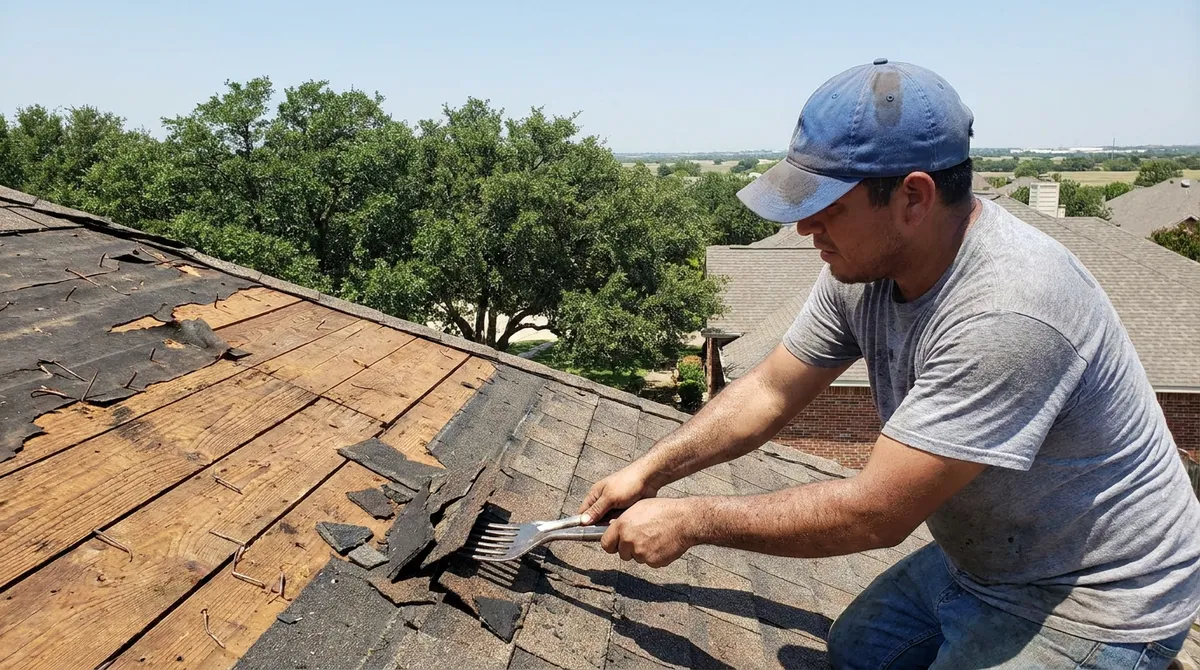 Tear-off and dry-in on a roughly 28-square North Texas home, with soft decking spots exposed under the old shingles.
dallas roof cost by home size (the table everyone skips).
Roofs are priced by roof area, and roof area is bigger than your house. Pitch, overhangs, and cutting waste add up, and across the DFW homes we measure a roof runs about 1.2 to 1.3 times the home’s square footage. A 2,000 sq ft home carries roughly 2,400 sq ft of roof, which is 24 “squares” (one square is 100 sq ft of roof surface). That is the unit every roofer in Texas prices in.
Here is where 2026 pricing sits for a full tear-off and replace in DFW, using the same per-square-foot rates that power our roof cost calculator: architectural shingles at $3.50 to $5.50 per square foot of roof, Class 4 impact shingles at $5.50 to $6.50, designer shingles at $7 to $11, and standing seam metal at $12 to $22. Installed, with underlayment and labor.
| Home size | Roof area (approx.) | Architectural shingle | Class 4 impact | Designer (Landmark Pro, Presidential) | Standing seam metal |
|---|---|---|---|---|---|
| 1,500 sq ft | ~1,800 sq ft (18 sq) | $6,300 to $9,900 | $9,900 to $11,700 | $12,600 to $19,800 | $21,600 to $39,600 |
| 2,000 sq ft | ~2,400 sq ft (24 sq) | $8,400 to $13,200 | $13,200 to $15,600 | $16,800 to $26,400 | $28,800 to $52,800 |
| 2,500 sq ft | ~3,000 sq ft (30 sq) | $10,500 to $16,500 | $16,500 to $19,500 | $21,000 to $33,000 | $36,000 to $66,000 |
| 3,000 sq ft | ~3,600 sq ft (36 sq) | $12,600 to $19,800 | $19,800 to $23,400 | $25,200 to $39,600 | $43,200 to $79,200 |
| 3,500+ sq ft | ~4,200 sq ft (42 sq) | $14,700 to $23,100 | $23,100 to $27,300 | $29,400 to $46,200 | $50,400 to $92,400 |
Two things to notice. The architectural column is the starting number, a simple pitch and clean decking. And the reason our typical invoice range is $14,500 to $32,000 rather than the $8,400 in the 2,000 sq ft row is that the average DFW replacement we do is a bigger, steeper, two-story roof going to a Landmark Pro or Class 4 tier, often with a few sheets of decking. The table is the floor. The next section is what lifts you off it.
For a national yardstick, NerdWallet puts a roof replacement at $9,500 on average with a range of about $5,800 to $46,000, or $4 to $11 per square foot. Homewyse estimates basic mid-range asphalt at $5.09 to $6.66 per square foot as of May 2026. DFW architectural pricing sits at or a little under those national numbers on the base tier. Where Dallas homes get expensive is pitch and hail-driven scope, not the shingle itself.
why the same house gets three different bids.
If you collect three estimates on the same Plano house and they land at $16,200, $19,800, and $24,500, the contractors are not pricing three different roofs. They are pricing three different scopes. Five variables explain almost every gap.
Pitch. Anything over an 8/12 slope means harnesses, slower footing, and more waste. Our calculator adds 5 percent for moderate pitch, 10 percent for steep, and 15 percent for the 10/12 and 12/12 roofs common in Keller and Frisco custom builds. A $16,000 base roof becomes $18,400 on a steep two-story with nothing else changing.
Complexity. Every valley past the third adds $50 to $100. A chimney needs $250 to $600 to reflash, or $800 to $2,500 if the cricket has to be rebuilt. Each skylight adds $150 to $350 to reflash or $600 to $2,500 to replace while the roof is open. Dormers, dead valleys, and multiple roof planes all take time, and time is the price.
Decking. This is the line that breaks budgets, so we singled it out below. Budget $70 to $100 per sheet of OSB or plywood the tear-off exposes as rotten, delaminated, or split.
Code items your last roof did not have. Synthetic underlayment instead of felt. Ice and water shield in every valley and around every penetration. Balanced ventilation, usually a continuous ridge vent at $8 to $18 per linear foot, which on a typical roof runs $600 to $2,000. A roof installed in 2006 skipped most of this. Yours will not.
Permits and disposal. Every DFW city permits a reroof. The fee runs about $95 to $250 in Collin County, $125 to $300 in Dallas County, $110 to $275 in Tarrant, and $95 to $260 in Denton. Dump fees ride on top. A bid that shows neither is a bid that will show both later.
The cheapest estimate on the table is almost never the cheapest roof. It is the estimate with the most line items missing.
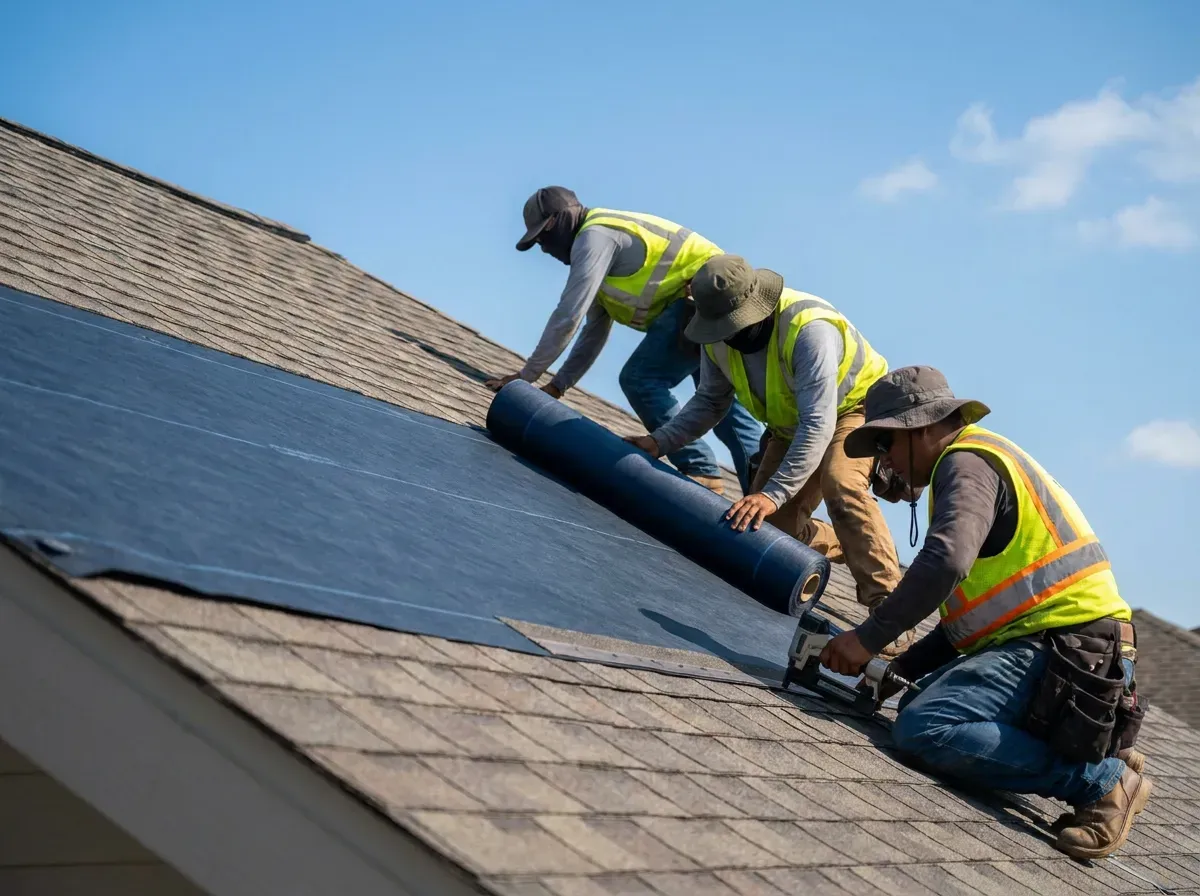 Synthetic underlayment and ice and water shield going down before a single shingle. This is the code layer most 2000s roofs never got.
what a roof costs by dfw county.
Permits in North Texas are issued by the city, not the county, but the county line is still the cleanest way to group what a replacement costs, because housing stock, pitch, and permit fees cluster by county. The ranges below come straight from the home-size table above, applied to the homes we actually see in each county, with permit fees from the same county schedule our roof cost calculator uses.
| County (cities we work most) | Typical home we see | Architectural shingle | Class 4 impact | Permit fee | Permit turnaround |
|---|---|---|---|---|---|
| Collin (Plano, Frisco, McKinney, Allen) | 2,500 to 3,500 sq ft two-story, 2000s and newer, steep pitches common | $10,500 to $23,100 | $16,500 to $27,300 | $95 to $250 | 1 to 3 business days in Plano, often same day in Frisco |
| Dallas (Dallas, Richardson, Garland) | 1,500 to 2,500 sq ft, 1960s to 1990s stock, more decking repair | $6,300 to $16,500 | $9,900 to $19,500 | $125 to $300 | A few business days for a residential reroof |
| Tarrant (Fort Worth, Arlington, Keller, North Richland Hills) | 1,500 to 3,000 sq ft mix, Keller customs add 10 to 15 percent for pitch | $6,300 to $19,800 | $9,900 to $23,400 | $110 to $275 | Varies by city, inspections usually land within a few business days |
| Denton (Denton, Lewisville, Flower Mound, Little Elm) | 2,000 to 3,000 sq ft, 1990s to 2010s | $8,400 to $19,800 | $13,200 to $23,400 | $95 to $260 | A couple of business days |
Read the table as a floor and a ceiling, not a quote. A Collin County bid lands high because the houses are big and steep, not because Plano roofers charge more per square. A Dallas County bid lands low on the shingle line and then climbs on decking, because a 1972 Lakewood roof hides more rot than a 2012 Frisco roof. Same rates, different houses.
decking is the line that turns $16,500 into $19,800.
Most Dallas homes built before 2002 were sheathed in 1x6 or 1x8 plank, not plywood or OSB. Older Lakewood, M Streets, and Casa Linda homes especially. When the old shingles come off, we find splits, rot at the eaves, and gaps wider than current code allows, and none of it is visible from the ground.
A typical 1990s Plano or Frisco home needs three to seven sheets. A 1960s plank-decked Lakewood house can need $1,800 to $3,400 in deck work. The honest way to handle it is a published per-sheet rate on the contract before tear-off starts, so the number is known even when the count is not.
Here is the thing. A bid with zero decking allowance is not cheaper. It is hiding $1,500 to $3,000 that arrives as a change order mid-tear-off, when you have no roof and no bargaining position. Ask every bidder one question before you compare prices: “What is your per-sheet decking rate, and is it on the contract?”
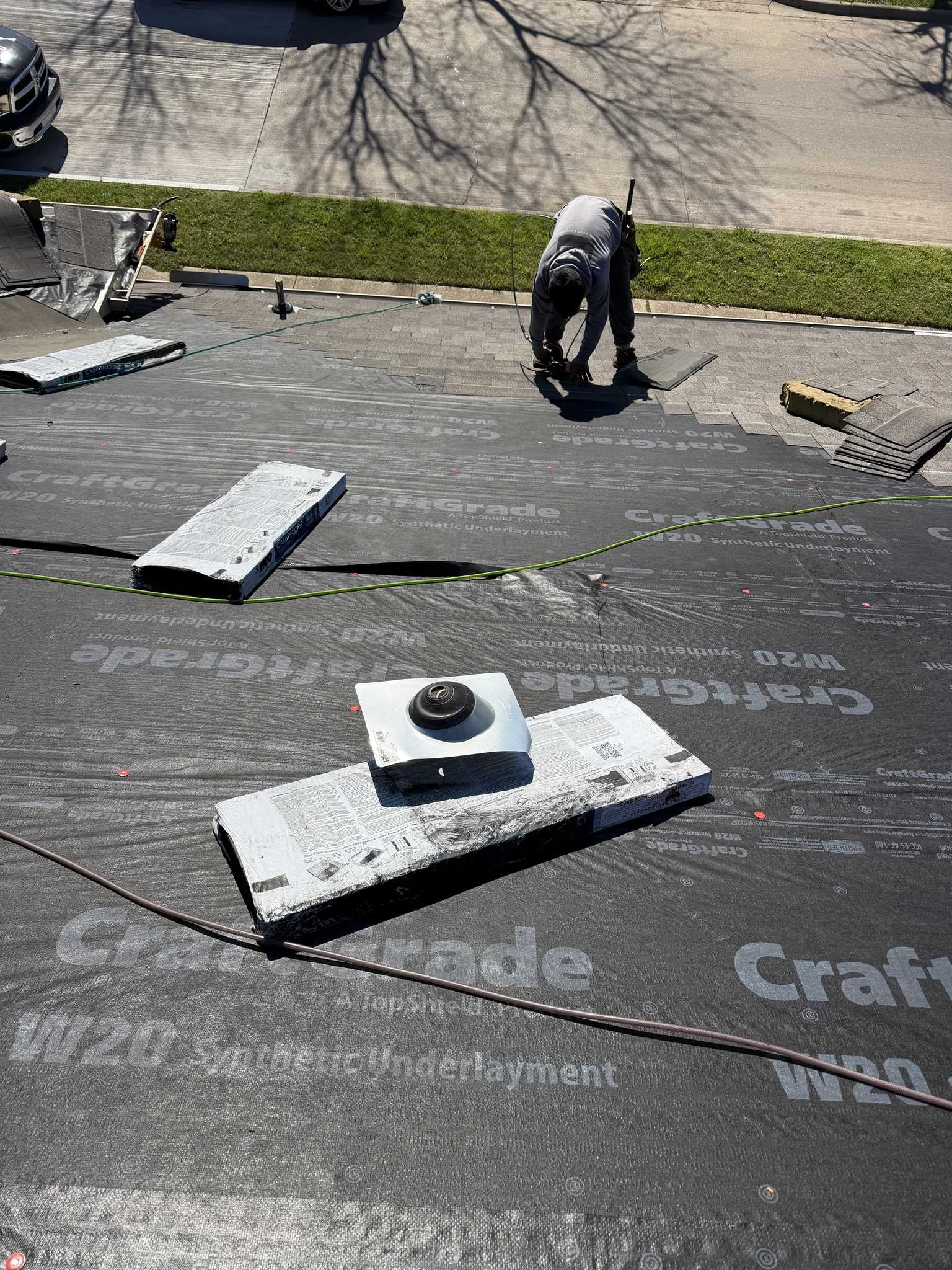 Decking inspection after tear-off. Soft sheets get swapped at the contract rate before anything goes back on.
the shingle tier is a $3,000 to $12,000 decision.
Most homeowners get pitched two shingles because the salesperson carries two samples. There are four tiers worth knowing, and the price delta per square matters more than the marketing names. On a 26-square roof (a 2,400 sq ft single-story with normal pitch and waste), here is what each step up costs against a base Landmark.
| Tier | What it buys you | Delta vs. Landmark, per square | On a 26-square roof |
|---|---|---|---|
| CertainTeed Landmark | 110 mph wind rating, lifetime limited warranty | Baseline | Baseline |
| Landmark Pro | 130 mph, heavier mat, StreakFighter algae resistance, better warranty tier | +$35 to $55 | +$900 to $1,430 |
| Class 4 impact (Landmark IR, NorthGate) | UL 2218 Class 4 hail rating, 130 mph, qualifies for the Texas windstorm premium discount | +$65 to $110 | +$1,690 to $2,860 |
| Presidential / Presidential TL | Shake-look profile, 110 to 130 mph, top warranty tier | +$140 to $220 | +$3,640 to $5,720 |
One correction we make on nearly every first call: Landmark and Landmark Pro are not Class 4 shingles. The impact rating lives in the IR and NorthGate lines. If a bid promises an insurance discount on a Landmark Pro roof, someone is confused or selling.
The Class 4 math is worth doing. Most Texas carriers discount the windstorm portion of a premium 5 to 28 percent for a UL 2218 Class 4 roof, which typically recovers the upgrade inside four to seven years. On a house that has taken hail in two of the last three springs, that is the tier we recommend before anyone asks. The full breakdown is in our Class 4 shingles guide, and if you are weighing metal instead, metal vs. shingle in Dallas heat runs that comparison.
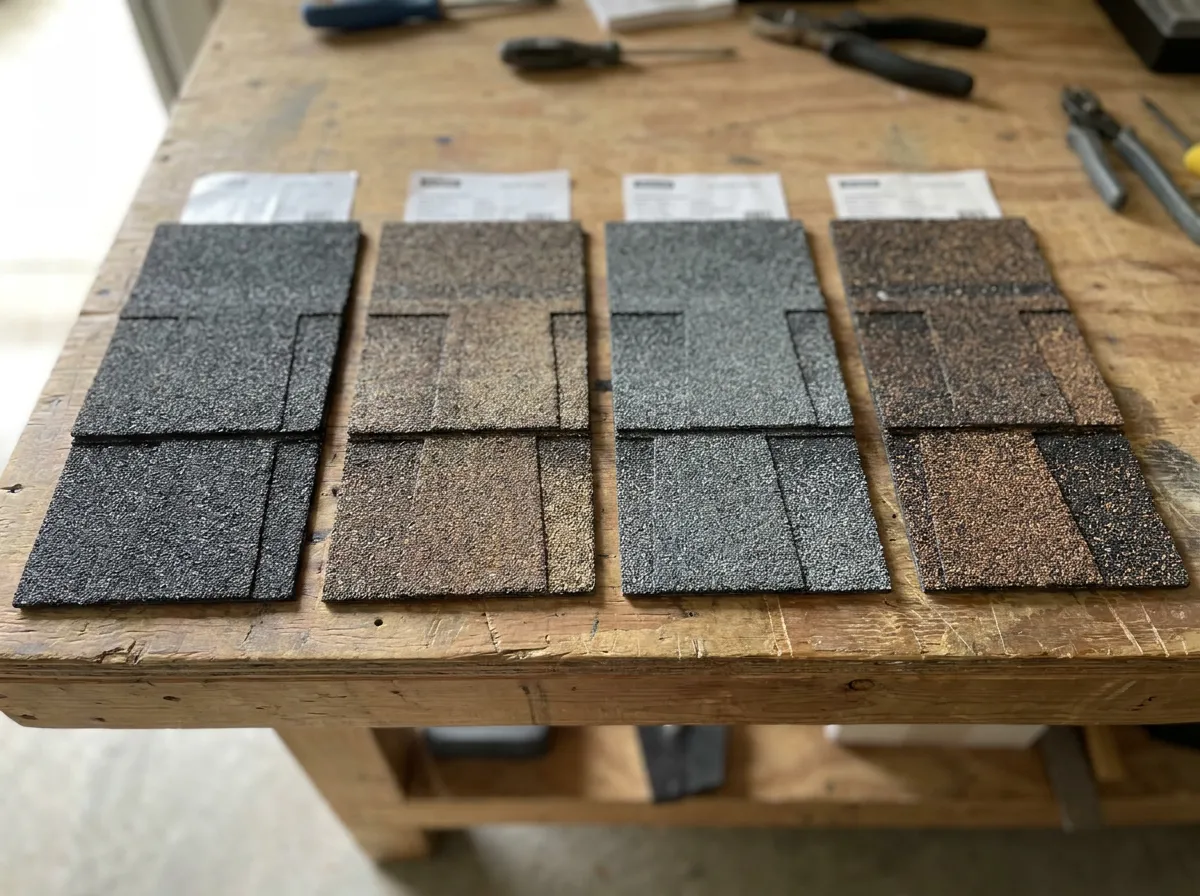 The four tiers on a driveway in afternoon light, which is the only honest way to pick a color.
the 14 line items that belong on every dallas bid.
The Texas Department of Insurance tells homeowners to get at least three bids, on company letterhead with a phone number and an address, and to keep every agreement and warranty term. Good advice. It only works if the three bids are describing the same job, so hold each one against this list:
- Tear-off of existing layers, priced per square, more for two-layer roofs
- Decking replacement rate per sheet, on the contract
- Underlayment type and brand (synthetic, not 15 lb felt)
- Ice and water shield at eaves, valleys, and penetrations
- Drip edge on eaves and rakes, new, not reused
- Shingle brand, line, color, and the warranty tier that will actually be registered
- Ridge vent linear footage, or the alternative ventilation plan
- Pipe boots, vents, and flashing counts and materials
- Step and counter flashing at every wall and chimney
- Gutter detach and reset if applicable
- Detached structures (garage, shed, patio cover) as separate lines
- Permit cost and who pulls it
- Cleanup, magnetic sweep, and dump fees
- Workmanship warranty length, in writing
Two or more of these missing means the bid is either inexperienced or incomplete on purpose. Either way, the low number is not real.
Bottom line: compare scopes, then compare prices. Never the other way around.
how long the roof you are pricing will actually last.
Price per year is the number that matters, and it changes the tier decision. In DFW a three-tab roof lasts 12 to 15 years, an architectural roof 18 to 22, a Class 4 impact roof 20 to 25, and standing seam metal 40 or more. Those are shorter than the national charts, and our guide on how long a roof lasts in Texas explains why heat, hail and attic temperature take the difference.
Run the math on a 26-square roof. The Class 4 upgrade over Landmark is $1,690 to $2,860 from the tier table above. Spread over the extra years of life and the windstorm discount most Texas carriers give a UL 2218 Class 4 roof, it is usually the cheapest shingle on the table per year of service. Three-tab is the most expensive, because you buy it twice.
insurance rewrites the math, but only for storm damage.
Texas is the hail capital of the country. The Insurance Information Institute counts 902 major hail events in Texas in 2025, more than any other state, and State Farm alone paid $5.6 billion in hail claims in 2025, with Texas leading at $1.4 billion. A large share of the roofs we replace are covered claims, which changes the cost conversation completely.
Three rules from the Texas Department of Insurance’s own guidance on insurance and your roof:
- Age is not a claim. In TDI’s words, your insurance company “won’t pay for a new roof just because it’s old or worn out.” Storm damage is covered. Wear is yours.
- Replacement cost vs. actual cash value decides your check. Replacement cost coverage pays “up to the full cost to repair your roof at current prices.” Actual cash value pays “less if the roof is older or showing wear,” and TDI warns that “as roofs age, some companies will switch to actual cash value.” Read your declarations page before the next storm, because a 17-year-old roof on an ACV policy can produce a $4,800 check against an $18,500 job.
- Your deductible is yours. TDI is blunt: “It’s illegal for contractors to waive your deductible or help you avoid paying it,” and your carrier can ask for proof you paid it, like a canceled check or a copy of your payment plan. Any roofer offering to “eat” the deductible is offering to break the law with your name on the paperwork.
Then there is the threshold that decides repair versus replacement. Texas rules under 28 TAC 21.1006 let carriers require roughly 25 percent of a slope to be storm damaged before they approve replacing it rather than patching it, scored on a 10 by 10 foot test square. That single rule is why one neighbor gets a new roof and the other gets a denial letter after the same storm. We wrote the whole thing up in our Texas 25 percent rule guide, and the filing sequence from first photo to depreciation release is in how to file a roof insurance claim in Texas.
On a covered claim, the “cost” of your new roof is your deductible, typically 1 to 2 percent of dwelling coverage, so $3,000 to $7,500 on most DFW homes. Everything in the tables above becomes the carrier’s number to argue about, and what matters is whether the scope they wrote includes the 14 line items or quietly skipped four of them.
is $30,000 too much for a roof? and when is it cheapest?
Straight answer. For a 2,000 sq ft single-story in architectural shingles on a normal pitch, $30,000 is roughly double what it should be. For a 3,500 sq ft two-story on a 10/12 pitch with four valleys, two chimneys, Landmark Pro or Class 4 shingles, and six sheets of decking, $30,000 is a normal Tuesday. The number is meaningless without the roof area, the pitch, and the tier printed next to it.
As for timing: hail season runs March through June, and after a big event every crew in North Texas is booked for months. If you are replacing on your own schedule rather than a storm’s, late fall through winter is when scheduling is loosest and pricing is most negotiable. November through February installs are routine here as long as the crew works a dry, above-freezing window and holds tear-off when the radar says otherwise. Waiting for spring to “see what the storms do” usually means competing with the storms for a crew.
how a roof raiders estimate is built.
Everything above is how we price, and we put it in writing before you sign anything. A free inspection first: every slope photographed, the attic checked, decking probed, and if a storm is involved, the NOAA hail swath pulled for your address. Then a fixed written estimate with all 14 line items, a per-sheet decking rate on the contract, and the shingle tier and warranty level named.
Our scope on every full roof replacement is the same: full tear-off to bare deck (no layovers, which void most manufacturer warranties anyway), synthetic underlayment across the deck, ice and water shield in every valley and 36 inches up from the eaves, new drip edge, new flashings and pipe boots, ridge ventilation to code, and a triple magnetic sweep before the trailer leaves. We are CertainTeed ShingleMaster certified, which puts us in the top 3 percent of US roofers and lets us register the 5-Star warranty most contractors cannot.
On payment: a covered claim means your out-of-pocket is your deductible. For retail replacements we take cash or offer an in-house payment plan on qualified projects, with a larger upfront deposit and the balance split on a schedule we agree on together. No bank and no third party.
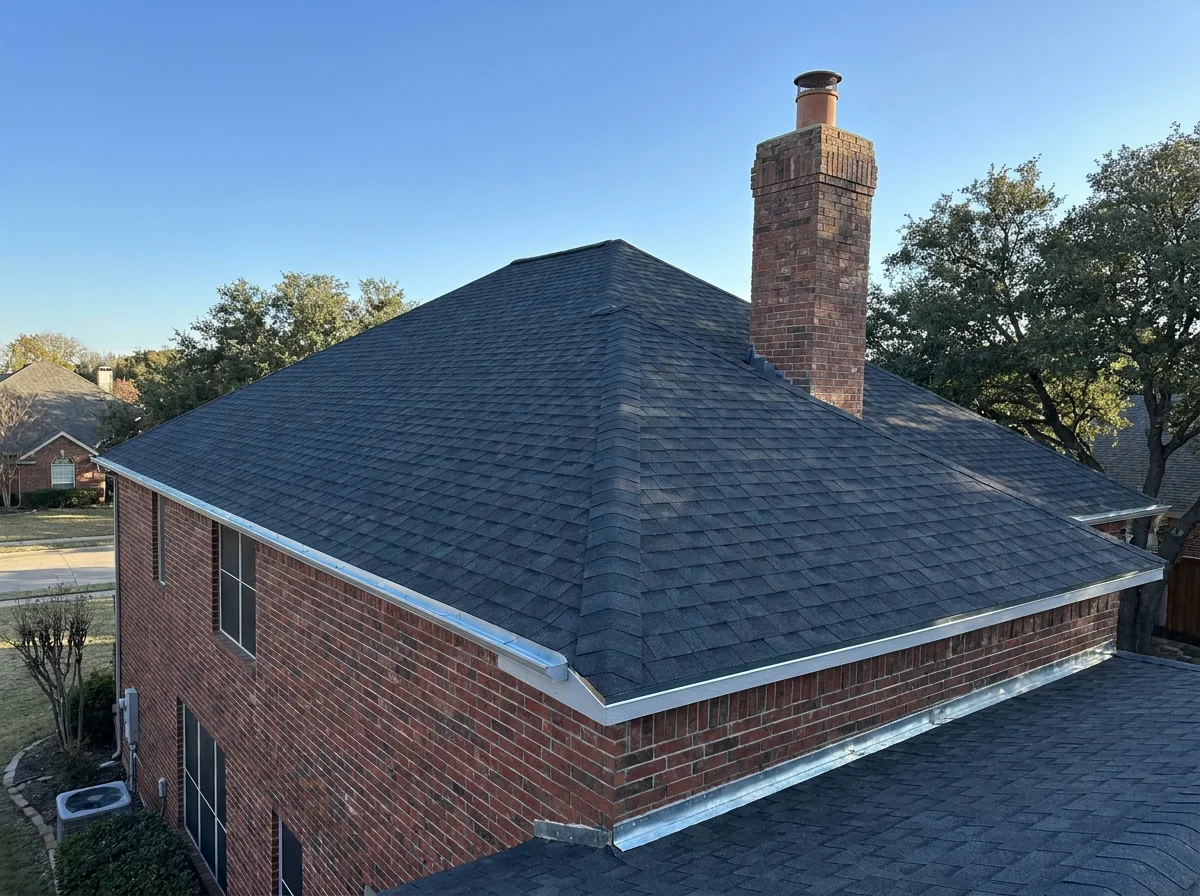 A finished Landmark Pro replacement in Plano. One day of tear-off to ridge cap on a single-story of this size.
Same scope on every bid we write. If a competitor’s number is lower, ask them which of the 14 lines they left out.
Want a number before anyone climbs a ladder? Run your address through the free roof cost calculator for a satellite-measured range in about a minute, then call (214) 326-3106 and Sara or Mahmoud will schedule the free inspection. Not sure the roof is done yet? Start with signs your roof needs replacement and how long a roof lasts in Texas.
frequently asked questions.
How much does a new roof cost in Dallas in 2026? $8,400 to $13,200 for a 2,000 sq ft home in architectural shingles, $13,200 to $15,600 in Class 4, and $16,800 to $26,400 in a designer tier. Most full replacements we do land between $14,500 and $32,000.
How much does a 1,200 sq ft roof cost? What about 2,000 sq ft? By roof area, at $3.50 to $5.50 per square foot: 1,200 sq ft runs $4,200 to $6,600 and 2,000 sq ft runs $7,000 to $11,000, before pitch and decking.
Is $30,000 too much for a roof? For a 2,000 sq ft single-story in architectural shingles, yes, by about double. For a steep 3,500 sq ft two-story in Landmark Pro or Class 4 with decking work, it is normal.
What is the 25 percent rule for roofing in Texas? Under 28 TAC 21.1006, carriers can require roughly 25 percent of a slope to be storm damaged, scored on a 10 by 10 foot test square, before approving replacement over spot repair.
Does homeowners insurance pay for a new roof in Texas? Only for covered storm damage, never for age. Replacement cost policies pay the full job minus your deductible; actual cash value policies also subtract depreciation. Contractors cannot legally waive the deductible.
What is the cheapest time of year to replace a roof in Dallas? November through February. Hail season (March through June) books every crew for months, and winter installs are routine in a dry, above-freezing window.
Do I need a permit to replace a roof in Dallas? Yes, in every DFW city, at roughly $95 to $300 by county. On our jobs it is a line item on the estimate, not a later change order.