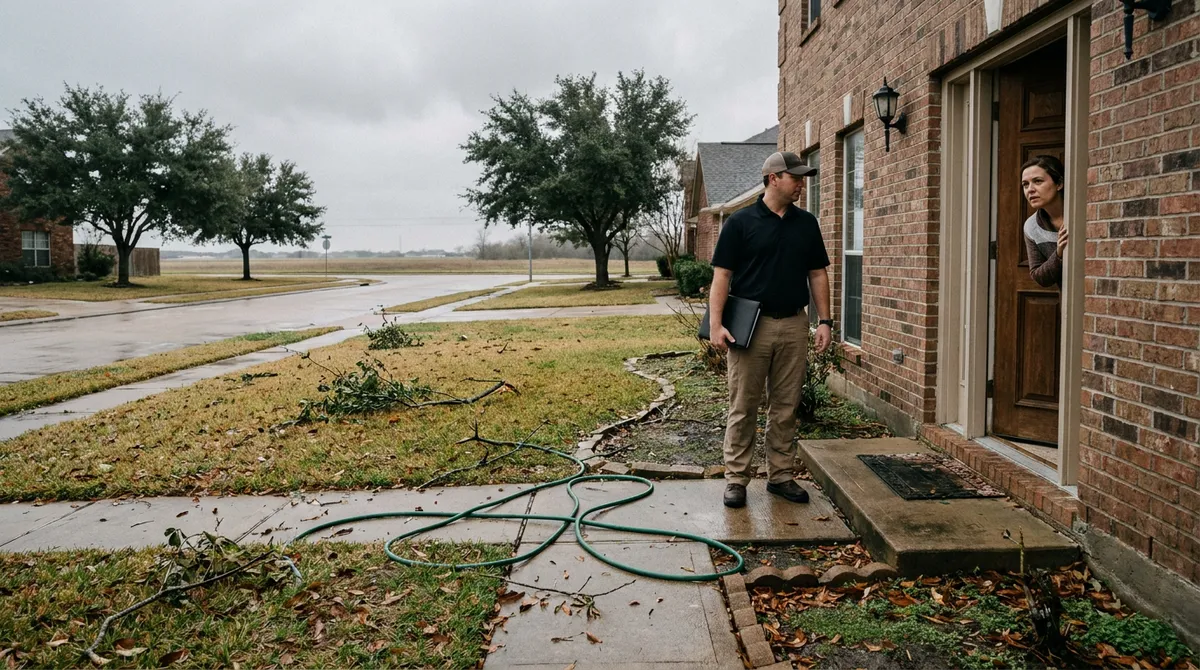
A storm chaser contractor is an out-of-area roofer who floods Dallas after hail events, signs as many jobs as possible in 30 to 60 days, then leaves town before warranties get tested. You can spot one by checking three things in the first five minutes: where their truck is plated, whether they’re asking you to sign an AOB or contingency form on the doorstep, and whether they can give you a permanent local address you could drive to tomorrow. If two of those three come back wrong, close the door.
After the May 28, 2023 hailstorm and the April 9, 2024 round that hammered Plano, Frisco, and North Dallas, we walked roofs in neighborhoods where six out-of-state crews had already knocked. Half the homeowners who signed with them are now calling us to fix leaks the original “contractor” won’t return phone calls about. Here’s how to tell the difference before you sign anything.
what a storm chaser actually is.
A storm chaser isn’t always a scammer in the legal sense. Some are licensed roofers from Florida, Colorado, Oklahoma, or the Carolinas who follow weather radar and set up temporary operations in whatever metro just got hit. They rent a UPS Store mailbox, slap a Dallas address on a contract, and run door-to-door sales crews on commission.
The problem isn’t where they’re from. It’s what happens 18 months later when your ridge cap lifts, your valley leaks, or your insurance carrier denies a supplement claim and there’s nobody to call. Texas requires no state roofing license, which means anyone with a ladder and a contract template can legally sign a homeowner. That’s why the burden of vetting falls entirely on you.
A real local roofer has a physical office you can drive to, a phone number that’s been answering for more than one hail season, and a name that shows up in Google reviews from neighborhoods you recognize. Roof Raiders & Co. has been HQ’d in Plano since 2022, and our hail damage roof repair in Dallas crews live in the same ZIP codes they work in.
red flag 1: out-of-state plates and rental trucks.
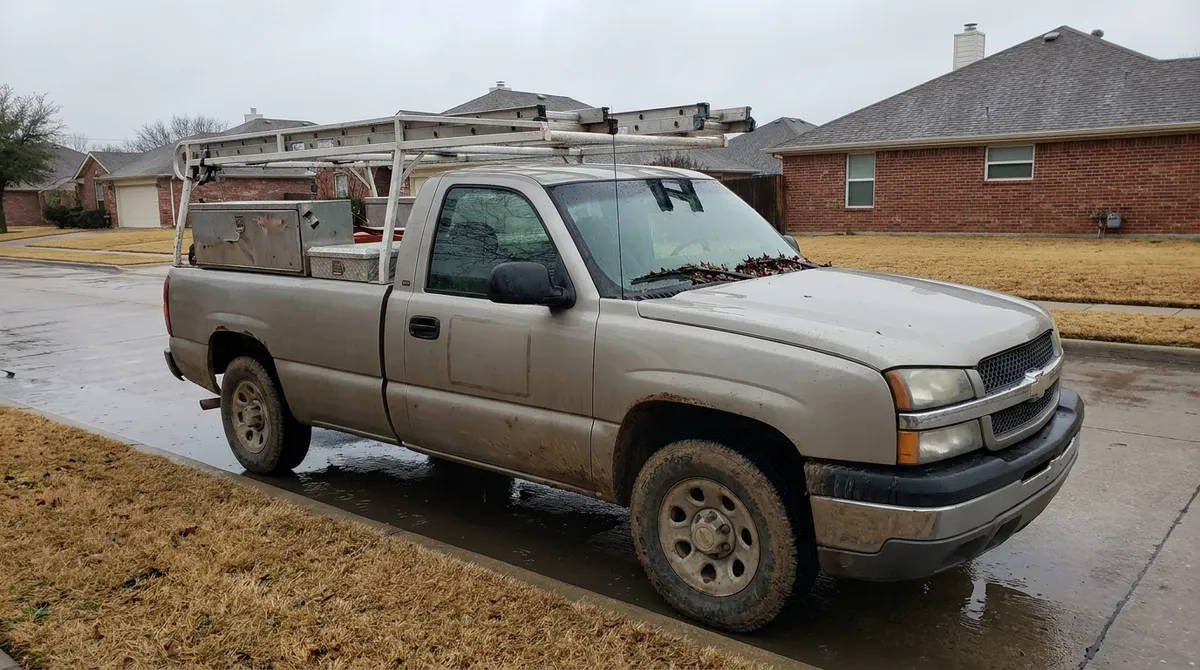
Walk to the curb when a roofer knocks. Look at the license plate. If it’s Colorado, Florida, Oklahoma, Louisiana, Georgia, or the Carolinas, you’re talking to a chaser. If it’s a rented box truck or a Home Depot tool rental in the bed, same answer.
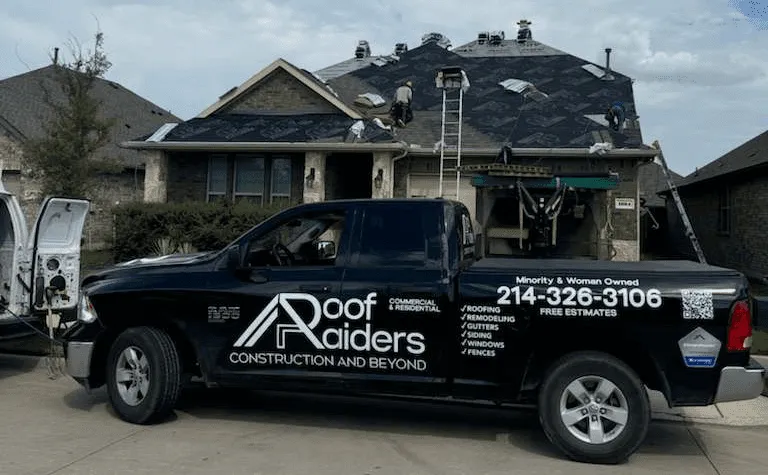
Real Dallas roofers drive trucks plated in Texas, wrapped or magnet-signed with a local phone number that matches their Google Business Profile. Our crew trucks roll out of our Plano yard every morning with 214 and 469 area codes on the doors, and the lead foreman on your job has been with us since 2023 or earlier.
| What you see | What it usually means |
|---|---|
| FL, CO, OK, LA, GA, NC, SC plates | Storm chaser following hail metros |
| Unmarked white truck, no signage | Door-to-door sales rep, not a roofer |
| Rented box truck or U-Haul | No local fleet, no local crew |
| TX plates, wrapped truck, 214/469/972 phone | Local company with skin in the game |
red flag 2: the doorstep contingency or AOB.
This is the single biggest tell. A storm chaser will hand you a clipboard within 10 minutes of knocking and ask you to sign either a contingency agreement or an Assignment of Benefits (AOB) form. Both documents lock you into using them as your contractor before you’ve gotten a single competing bid, before your insurance adjuster has even inspected the roof, and sometimes before you’ve seen their insurance certificates or manufacturer credentials.
A contingency agreement says “I’ll use you if my insurance approves the claim.” That sounds harmless. It isn’t. Most contain a 20% to 25% cancellation fee buried in the fine print if you change your mind, which is enforceable in Texas courts.
An AOB is worse. It assigns your insurance benefits directly to the contractor, meaning they negotiate your claim, receive your checks, and you lose control of the process. Texas tightened AOB rules in 2019 under SB 2107, but enforcement is spotty and homeowners still sign them every week.

Real roofers don’t ask for paperwork on the doorstep. We schedule a free inspection, document damage with photos and a drone report, give you a written scope and estimate, and let you decide on your own timeline. No clipboard ambush.
red flag 3: pressure to sign today.
“This price is only good today.” “I’ve got a crew in the neighborhood this week only.” “Materials are going up Monday.” “Your adjuster is coming Thursday so we need to sign by Wednesday.”
All four of these are pressure scripts taught in storm-chaser sales training. They work because hail damage feels urgent, especially after a storm like June 17, 2024, when North Dallas saw baseball-sized stones and homeowners watched water spot their ceilings in real time.
Here’s the truth: your roof is not going to fail in the next 48 hours from existing hail damage. Tarping a leak takes an hour and any honest roofer will do it free while you decide. Roofing material prices move quarterly, not daily. And your insurance claim has a statute of limitations measured in years, not days.
A good rule: if you feel rushed, you’re being sold. Real roofers give you the estimate and walk away. We follow up once, maybe twice, then stop. You call us when you’re ready.
red flag 4: no physical office you can visit.
Pull up the contractor’s address on Google Maps and switch to Street View. What do you see?
- A real office, warehouse, or yard with signage: legitimate.
- A UPS Store, Regus virtual office, or residential house: chaser.
- No address listed at all, only a P.O. box: chaser.
- An address in a different state: definitely chaser.
We sit in an office in Plano off Custer Road. You can drive there, walk in, meet Mahmoud or me, and look at sample shingles in person. The same is true for any roofer that plans to be around in 2030. If they can’t show you a place where they keep ladders, materials, and paperwork, they don’t have one.
red flag 5: vague or missing credentials.
Ask for four things in writing. A real roofer hands them over without hesitation. A chaser fumbles or changes the subject.
- General liability insurance certificate with at least $1M per occurrence, naming you as certificate holder.
- Workers’ comp coverage (Texas doesn’t require it, which is why this question matters; if a worker falls on your roof and the contractor has no comp, your homeowner’s policy gets the claim).
- Manufacturer certification. CertainTeed ShingleMaster, GAF Master Elite, or Owens Corning Platinum Preferred. These require background checks, financial review, and crew training. Roof Raiders is a CertainTeed ShingleMaster, which is the top 3% of CertainTeed-credentialed contractors nationally.
- Local references from the last 12 months with addresses in DFW neighborhoods you can drive past.
| Credential | What it proves |
|---|---|
| CertainTeed ShingleMaster | Top 3% certified, extended warranty eligible |
| GAF Master Elite | Top 2% GAF certified |
| 3+ years of Google reviews from DFW neighborhoods | Real local footprint |
| OSHA 10 or 30 certification | Crew safety training |
| Goldman Sachs 10KSB Preferred Vendor | Vetted financials and operations |
If a contractor can’t produce certificates within 24 hours, they don’t have them.
red flag 6: bid is way under or way over.
For a typical 2,400 to 3,200 sq ft Plano or North Dallas home with a 3/12 to 6/12 pitch, a full asphalt shingle roof replacement in Dallas priced through insurance typically runs $14,000 to $26,000 in 2026 dollars depending on shingle line (CertainTeed Landmark vs Landmark Pro vs Presidential), decking condition, and accessories.
A chaser bid will often come in two flavors:
- The lowball ($8,000 to $11,000 retail). They’re skipping starter strip, drip edge, ice and water shield in valleys, or using a 3-tab shingle instead of architectural. Your warranty is void from day one and the roof leaks by year five.
- The padded insurance maximizer. They write a scope that ranges $35,000 to $50,000 trying to bill your carrier for items that don’t exist on your roof. The adjuster catches it, the supplement gets denied, and you’re left fighting your insurance company.
A real estimate sits in the realistic range for your home, breaks out materials by SKU, lists labor separately, and matches the adjuster’s scope within 10% to 15% (which is what a legitimate supplement looks like).
red flag 7: subcontracted crews with no English-speaking foreman on site.
Subcontracting itself isn’t a red flag. Most volume roofers in DFW use sub crews, and many of the best installers in Texas are Spanish-speaking. The red flag is no English-speaking foreman or company rep on your property during the tear-off and dry-in.
If something goes wrong (decking is rotten, the original underlayment was wrong, your skylight flashing is shot), the crew needs to call someone with authority to make a decision. If that person is in a different state or doesn’t pick up, your roof sits open overnight, and the storm that’s forecast for tomorrow gets through the deck.
We assign a bilingual project manager to every job, and one of our two lead foremen is on site during tear-off and dry-in for every Dallas and Plano job. You have their cell. You can text them a photo and get an answer in 10 minutes.
what to do if you already signed with one.
If a chaser already has your signature, don’t panic. You have options.
- Read the contract for a cancellation window. Texas requires a three-day right of rescission on most home solicitation contracts under Business & Commerce Code 601. If you signed at your home and the contractor came to you (not the other way around), you usually have three business days to cancel in writing.
- If the three days passed, check the contingency clause for cancellation fees and consult a real estate or consumer attorney. Many of these clauses are unenforceable when the work hasn’t started.
- If they’ve cashed an insurance check, notify your carrier in writing immediately. Your carrier’s SIU (Special Investigations Unit) handles contractor fraud and can help reverse payments.
- File complaints with the Texas Attorney General’s Consumer Protection Division and the BBB. Both create a paper trail if you end up in court.
We’ve helped homeowners in Dallas and Plano untangle bad chaser contracts more than a few times. Call us before you do anything irreversible.
how to vet a real local roofer in 15 minutes.
Here’s the checklist. If a contractor passes all eight, you’re probably safe.
- Texas plates on the truck, local area code on the phone.
- Physical office visible on Google Street View.
- 3+ years of consistent Google reviews from DFW neighborhoods.
- Manufacturer certification (ShingleMaster, Master Elite, or Platinum Preferred).
- Insurance certificates delivered within 24 hours.
- Written estimate with material SKUs, labor, and accessories itemized.
- No AOB, no doorstep contingency.
- On-site project manager during tear-off and dry-in.
If you want a sanity check on a bid you’ve already received, our free roof cost calculator gives you a realistic 2026 DFW range in 60 seconds. And our team is happy to walk a roof you’re worried about with no pressure, no contingency, no clipboard. That’s how storm damage roof repair in Dallas should start.
frequently asked questions.
Is it illegal for an out-of-state contractor to work in Texas? No. Texas doesn’t license roofers at the state level, so any contractor from any state can legally sign a Texas homeowner. The question isn’t legality, it’s whether they’ll be around when your warranty matters.
What is the average cost of a roof replacement in Dallas after hail damage? For a 2,400 to 3,200 sq ft home with asphalt architectural shingles, insurance-funded replacements typically run $14,000 to $26,000 in 2026, with your out-of-pocket cost capped at your deductible plus any non-recoverable depreciation.
How long should I wait to file an insurance claim after a hailstorm? Most Texas carriers require notice within one year of the loss date for hail, but don’t wait. File within 30 to 60 days, get an independent roof inspection first, and let the adjuster come second.
What is a contingency agreement and should I sign one? It’s a contract that obligates you to use a specific contractor if your insurance approves the claim. Most include 20% to 25% cancellation fees. Don’t sign one on the doorstep. Get 2 to 3 estimates first, then commit.
How do I check if a roofer is really local? Drive to their address. Search their phone number on Google. Read their reviews and look for DFW neighborhood names. Ask for current general liability and workers’ comp certificates. A real local company has 3+ years of consistent footprint in the metro.
If you got hit by the April 9, 2024 hailstorm, the June 17, 2024 round, or any of the smaller events since, and you want a roofer who’ll still be picking up the phone in 2030, give us a call. We’ll walk your roof, document the damage, write a clean scope your carrier can approve, and never knock on your door unannounced. Call Sara or Mahmoud directly at (214) 326-3106 or read more about our family-owned story on our about page.