Key takeaways
- The order that works: pin the storm date, get a free roofer inspection with test-square photos, open the claim with the claims line (not your agent), have your roofer on the roof with the adjuster, review the scope of loss and supplement what was missed, then complete the work and invoice for the depreciation. Undisputed claims close in 30 to 90 days; disputed ones take 90 to 180.
- Deadlines: most Texas policies give you one year from the date of loss, some shortened it to 180 days, and filing more than 90 days out invites a causation fight. Once you file, the carrier has 15 days to acknowledge the claim and 15 business days after receiving everything to approve or deny it.
- The field adjuster is scheduled within 5 to 15 business days, works from a checklist on a 12-stop day, and sends a scope of loss 2 to 10 days after the visit. The items most often left off (ridge cap, drip edge, step flashing, pipe boots, decking) can leave $2,800 to $6,400 off an average 28 square roof.
- RCV vs ACV: a replacement cost policy pays the full cost in two checks, ACV up front and recoverable depreciation after the work is invoiced. An actual cash value policy pays the depreciated amount only, which on an 18 year old roof can be 30 to 40 cents on the dollar.
- Your deductible is always your responsibility. On a $22,000 roof with a $3,000 deductible and $8,000 depreciation, the first check is $11,000, the second is $8,000, and the carrier's total is $19,000.
In this guide:
- How to get insurance to pay for a roof replacement in Texas
- Start with the damage date, not the claim
- Get a free roof inspection before you file
- Call your carrier and open the claim
- Schedule your roofer on the same day as the adjuster
- Understand ACV, RCV, and depreciation before you sign anything
- Review the scope of loss and supplement what’s missing
- Sign the contract, schedule the build, and collect the depreciation
- What to do if your claim gets denied or underpaid
- Frequently asked questions
Here’s the short version. To file a roof insurance claim in Texas, you call your carrier, schedule an adjuster inspection, get an insured roofer on the roof the same day as the adjuster, sign a contingency agreement (not a contract), review the scope of loss, and collect two checks: ACV up front and depreciation after the work is done. The full process takes 30 to 90 days if nothing gets disputed, and 90 to 180 days if it does. I’m writing this because my husband Mahmoud and I have walked roughly 1,400 Dallas homeowners through this exact process since we started Roof Raiders in 2022, and almost every one of them said the same thing on the first call: “I have no idea what I’m supposed to do.”
how to get insurance to pay for a roof replacement in texas.
If you searched that exact phrase, here is the direct answer. Insurance pays for a roof replacement in Texas when three things are true: the damage came from a covered peril (hail or wind, not age), the damage crosses the threshold your carrier uses to approve replacement instead of repair, and the claim is documented well enough that the adjuster cannot reclassify it as wear and tear. You do not “convince” a carrier to pay. You give the adjuster a file that makes replacement the only defensible scope. If you are still on the earlier question of whether your policy covers a new roof at all, start with our guide on whether insurance will pay for a new roof in Texas.
In order, that means:
- Pin the storm date and pull the hail or wind report for your zip code.
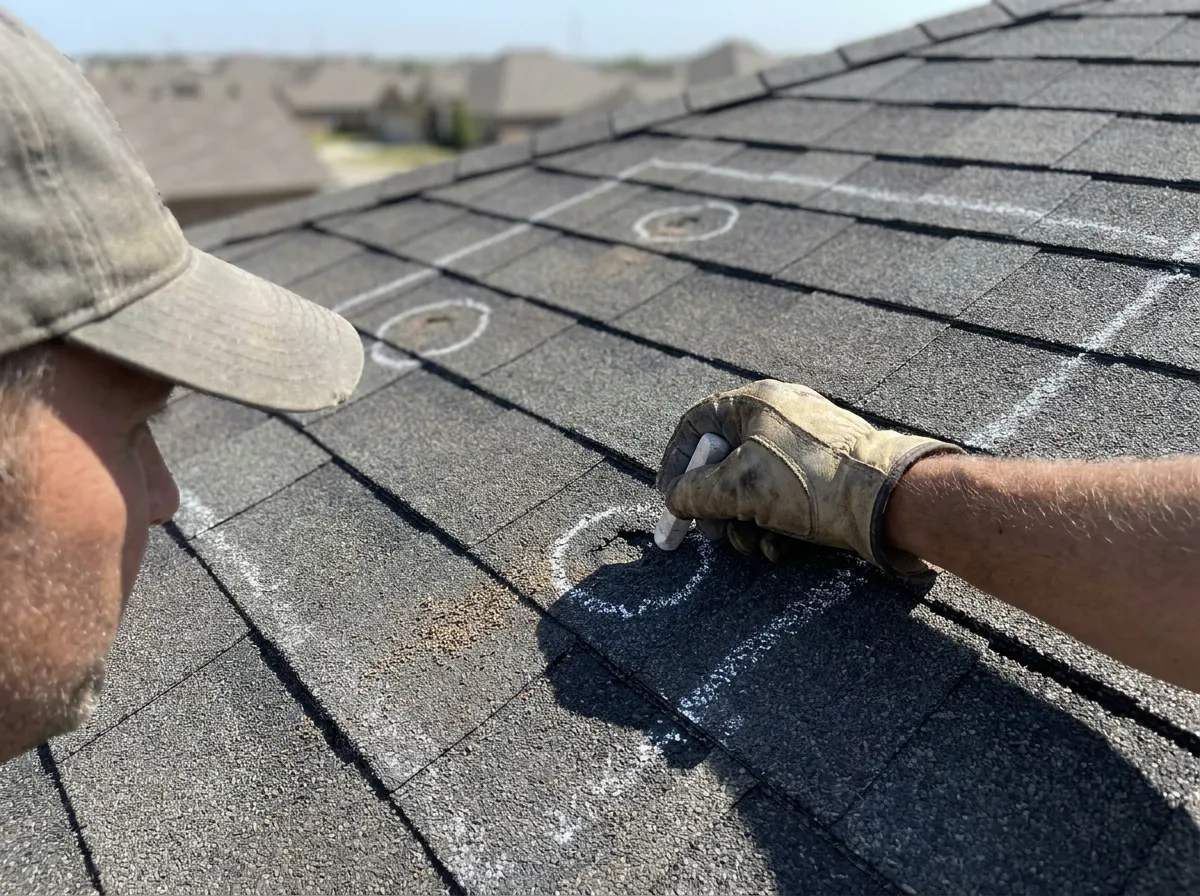
- Get a free roofer inspection with slope-by-slope photos and test squares before you call the claims line. Carriers in most of Texas look for 8 or more hail hits per 10 by 10 foot square.
- Open the claim with the claims line, not your agent.
- Have your roofer on the roof with the adjuster. This is the step that decides most claims.
- Review the scope of loss and supplement the items adjusters miss most: ridge cap, drip edge, step flashing, pipe boots, decking, and code upgrades.
- Complete the work and invoice the carrier for the recoverable depreciation.
Two things that stop a claim cold: a roof the policy only covers at actual cash value (check your declarations page for a roof surface schedule if the roof is past 15 years), and a claim filed before the damage is documented. Each of the steps above gets its own section below.
start with the damage date, not the claim.
Before you pick up the phone, write down the storm date. This sounds obvious, but Texas carriers will deny claims filed against the wrong storm, and the four DFW hail events most of our 2024 and 2025 claims trace back to are May 28 2023, April 9 2024, May 23 2024, and June 17 2024. If your roof took damage on a date you can’t pin down, your adjuster will guess, and they almost always guess in the carrier’s favor.
Pull up the Interactive Hail Maps site, type in your address, and screenshot the hail swath that hit your zip code. We’ve done this for homes from Preston Hollow down to Oak Cliff and the maps consistently show hail sizes within a half inch of what NOAA logged. That screenshot becomes evidence number one in your claim file. Our Texas hail season guide covers when DFW hail is most likely, which helps when you are trying to narrow down a date.

A few things to gather before the call:
- Date of loss (the storm date, not the day you noticed damage)
- Policy number and carrier phone number (both on your declarations page)
- Photos of damage from the ground (gutters, downspouts, AC fins, mailbox, fence)
- Your roof’s age and last replacement date if you know it
Don’t climb up there yourself. We’ve had two clients in Dallas fall through soft decking the week after a storm because they wanted to “just take a quick look.” Adjusters don’t expect homeowner photos from the roof.
get a free roof inspection before you file.
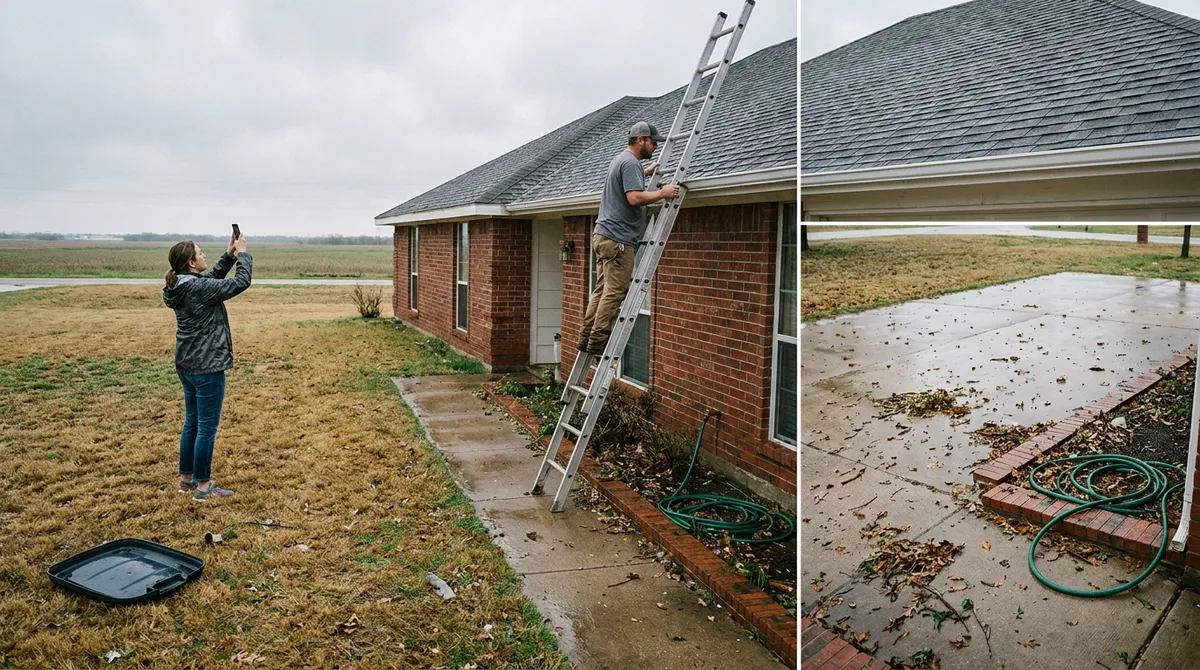
This is the step most homeowners skip, and it’s the one that decides whether your claim gets approved or denied. Call a local roofer who actually climbs the roof, takes 40 to 60 photos, and gives you a written opinion in writing. Not a sales pitch. A written opinion. If you want a preview of what they are checking for, read how to tell if hail damaged your roof in Dallas first.
What you’re looking for from the inspection:
| What the roofer should document | Why it matters for your claim |
|---|---|
| Hail hits per test square (10 ft x 10 ft) | Carriers require 8+ hits per square in most of Texas |
| Soft metals damaged (gutters, vents, AC) | Confirms storm date and hail size |
| Granule loss in valleys and downspouts | Shows accelerated wear from impact |
| Mat exposure or fiberglass showing | Functional damage, not cosmetic |
| Decking condition through attic | Determines if full replacement is needed |
If the roofer says “you’ve got a claim” without going on the roof, find a different roofer. Our hail damage roof inspection in Dallas is free and we won’t tell you to file if there’s nothing legitimate to file. Filing a claim that gets denied still counts against your loss history and can raise your premium at renewal.
call your carrier and open the claim.
Once you’ve got photos, a storm date, and a written inspection saying there’s damage, call the claims line on your policy. Not the agent who sold you the policy. The claims line. They’re separate departments and the agent can’t open a claim for you in most cases.
Here’s what to say, almost word for word: “I’d like to open a claim for hail damage to my roof from the storm on [date]. I’ve had the roof inspected and there’s documented damage. What’s my next step?”
The carrier will assign a claim number, give you a desk adjuster, and schedule a field adjuster (the one who actually comes out) within 5 to 15 business days. Texas Insurance Code Article 542 requires carriers to acknowledge a claim within 15 days and approve or deny within 15 business days of receiving all requested information. If they drag past 60 days total, you have grounds for bad faith.
A few things not to say on that call:
- “My roof is old.” (Even if it is. Let the adjuster determine condition.)
- “I’m not sure it’s that bad.” (You already had it inspected. It’s bad enough.)
- “My neighbor got a new roof.” (Irrelevant and makes you sound like a copycat claim.)
Write down the claim number, the desk adjuster’s name and direct line, and the date the field adjuster is scheduled. Email yourself a recap of the call within an hour so you have a timestamp.
schedule your roofer on the same day as the adjuster.
This is the single most important step in this whole guide, and it’s the one that separates a claim that gets approved on day one from a claim that drags on for four months.
When the adjuster confirms their inspection date, immediately call your roofer and ask them to be there at the same time. A good roofer will show up with a ladder, a chalk wheel, soft-soled boots, and an iPad full of inspection photos from your earlier visit. They’ll walk the roof with the adjuster, point out every hit, and make sure nothing gets missed.
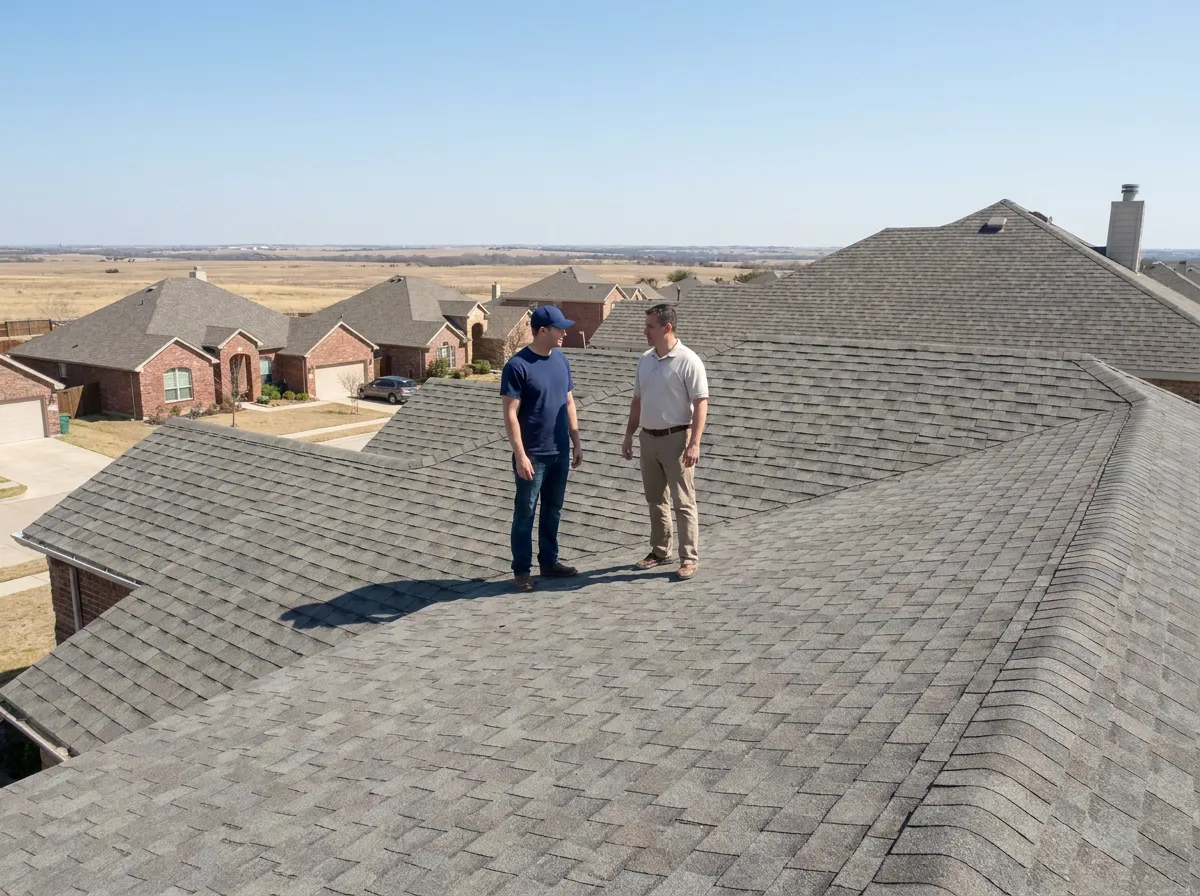
The adjuster is one person looking at one roof on a 12-stop day. They’re tired, they’re hot, and they’re working from a checklist. Without a roofer up there pointing things out, the typical missed items are:
- Ridge cap (often counted as part of field shingles instead of separately)
- Drip edge (Texas now requires drip edge per the 2021 IRC)
- Step flashing at chimneys and walls
- Pipe boots and turtle vents (cracked from impact)
- R&R of solar attic fans, satellite dishes, lightning protection
- Decking if any planks are rotted or damaged
A scope written without these items can leave $2,800 to $6,400 on the table on an average 28 square Dallas roof. We supplement around 70% of claims for missed line items. It’s not adversarial, it’s standard.
understand ACV, RCV, and depreciation before you sign anything.
Every Texas homeowner policy is one of two types, and you need to know which one you have before the adjuster shows up.
| Policy type | What you get | What it means |
|---|---|---|
| RCV (Replacement Cost Value) | Full cost to replace, minus deductible | You get the full check eventually, in two parts |
| ACV (Actual Cash Value) | Depreciated value only, minus deductible | You only get the depreciated amount, period |
If you have ACV, your 18 year old roof might only get you 30 to 40 cents on the dollar of the replacement cost. A $22,000 roof might pay out $7,500. Most newer DFW policies (post 2020) are RCV, but if you’re in a home you bought before 2015 and never updated coverage, double check. We wrote a full breakdown of ACV vs RCV policies if you want the deeper dive.
On an RCV policy, the math works like this on a $22,000 roof with a $3,000 deductible and $8,000 in depreciation:
- Initial check (ACV): $22,000 - $3,000 deductible - $8,000 depreciation = $11,000
- Recoverable depreciation check: $8,000 paid after work is complete and invoiced
- Total carrier pays: $19,000 (the deductible is your responsibility)
This is also the stage where storm chasers circle. Walk away from any roofer with out-of-state license plates, no verifiable local address you can drive to, or pressure to sign a full construction contract before the adjuster has even seen the roof. A legitimate local company has an office, current insurance certificates, and no problem letting the claim process play out at your pace.
review the scope of loss and supplement what’s missing.
Two to ten days after the adjuster’s visit, you’ll get a document called the scope of loss (sometimes called the estimate or the Xactimate report). It lists every line item the adjuster approved with quantities and prices.
Forward this to your roofer the day you get it. They’ll compare it line by line against what they saw on the roof and what’s required by code. If anything’s missing, they’ll write a supplement request with photos, code citations, and Xactimate pricing pulled from the same database the carrier uses.
If the scope approves a partial repair instead of a full replacement, read our explainer on the Texas 25 percent rule before you accept it.
Common supplements we file for Dallas claims:
- Code upgrade for ice and water shield at eaves and valleys (Texas IRC R905.1.2)
- Synthetic underlayment instead of 15 lb felt
- 6-nail pattern vs 4-nail in high wind zones (most of DFW after 2021)
- Starter strip on eaves and rakes
- Detach and reset for solar panels, satellite dishes, lightning rods
Supplements take 7 to 30 days to get approved depending on the carrier. State Farm and Allstate tend to be fast. Farmers and USAA are slower. Texas Fair Plan is the slowest by a wide margin. Be patient and let your roofer do their job.
sign the contract, schedule the build, and collect the depreciation.
Once the supplement is approved and the final scope matches what your roof actually needs, then you sign a real contract with a real price. Not before. This is where the contingency agreement you signed earlier comes off and a fixed-price construction contract takes its place.
A few things to look for in that contract:
- Manufacturer and shingle line specified by name (we use CertainTeed Landmark Pro and Northgate Climateflex for hail zones)
- Color confirmed in writing with a physical sample shown to you
- Every warranty term spelled out in writing, never a verbal promise
- Manufacturer warranty registration included (ShingleMaster contractors can register the full SureStart Plus warranty)
- Payment schedule that matches the insurance disbursement (no large deposit)
- Permit pull responsibility (city of Dallas requires a permit for any reroof)
Build day usually happens 2 to 6 weeks after contract signing depending on shingle availability and weather. A standard 28 square Dallas tear-off and replacement takes one day with a 7 to 10 person crew, or two days if there’s significant decking work. We document the build with timestamped photos every two hours so the carrier can verify scope completion.
After completion, your roofer sends a final invoice to your carrier showing the work matches the approved scope. The carrier releases the recoverable depreciation check within 14 to 30 days. That check goes to you, then to the roofer. Don’t endorse it over without first confirming the math matches your contract. If that check stalls or comes up short, our guide to recovering your depreciation covers how to get it released.
what to do if your claim gets denied or underpaid.
About one in five Dallas claims we work on get denied or significantly underpaid on the first scope. That’s not the end of the road. We wrote a longer guide on what to do when a Texas roof claim is denied; the short version follows.
Your options, in order of escalation:
- Reinspection. Request a second adjuster, often a field manager. Free, takes 2 to 4 weeks. Works about 40% of the time.
- Independent appraisal. Invoke the appraisal clause in your policy. You pick an appraiser, the carrier picks one, and they agree on an umpire. Binding decision. Costs $500 to $2,000 per side. Works about 75% of the time.
- Public adjuster. Regulated by TDI and allowed to represent you on the claim itself, something a roofing contractor cannot do in Texas. Charges 10 to 15% of the settlement. Useful for claims over $40,000 or when the carrier is being unreasonable.
- Attorney. Texas Insurance Code Chapter 541 allows recovery of attorney’s fees and up to 18% statutory interest on bad faith claims. Last resort, but it works.
If you went through a major event like the June 17 2024 storm and your claim was denied because the carrier said it was “wear and tear,” push back hard. NOAA storm data, hail maps, and a properly documented roof inspection should override a desk adjuster’s opinion. Our inspection documentation has backed reversed denials from every major Texas carrier including State Farm, Allstate, Farmers, USAA, Liberty Mutual, and Texas Farm Bureau.
frequently asked questions.
How do I get insurance to pay for a roof replacement in Texas? Document the storm damage with dated photos and a written roofer inspection, open the claim with your carrier’s claims line, meet the adjuster with your roofer on the roof, review the scope of loss, supplement what was missed, complete the work, and invoice the carrier for the recoverable depreciation. Damage from a covered peril that crosses the carrier’s replacement threshold is what gets a full roof approved.
What qualifies a roof to be covered by insurance? Sudden damage from a covered peril, most often hail or wind, on a roof the policy still insures. Carriers in most of Texas look for 8 or more hail hits per 10 by 10 foot test square, or wind creasing and missing shingles across a slope. Wear, age, and installation defects are excluded, and an older roof may only be covered at actual cash value.
What should you not say to a roof insurance adjuster? Do not volunteer that the roof is old, that you are not sure the damage is bad, or that you are filing because a neighbor got a new roof. Let the inspection photos and the adjuster’s own test squares establish the damage. Answer questions honestly and briefly, and have your roofer on the roof at the same time.
How do I pay for a roof when I cannot afford it? If a storm caused the damage, an approved claim covers everything except your deductible. If the roof simply wore out, the options are cash or our in-house payment plan on qualified projects, where a larger upfront deposit gets the work started and the balance is split over flexible terms depending on the size of the project. Details on our payment plans page.
How long do I have to file a roof insurance claim in Texas? Most Texas policies give you one year from the date of loss, but some shortened it to 180 days starting in 2017. Check your policy declarations page under “duties after loss.” File as soon as you have damage documented. Waiting more than 90 days makes carriers suspicious and gives them grounds to question causation.
Will filing a claim raise my insurance premium? A single approved claim for a named storm event (hail, wind, hurricane) usually doesn’t raise your individual premium, because Texas carriers rate by zip code rather than individual claims for catastrophic events. Your zip code’s overall loss ratio is what drives renewal pricing. Filing two or more claims in a 3 year period can move you into a higher risk tier or trigger non-renewal.
Can my insurance drop me for filing a hail claim? They can non-renew you, but they can’t drop you mid-term for filing a legitimate weather claim. Texas Insurance Code 551.104 requires 60 days written notice for non-renewal and prohibits non-renewal solely based on weather-related claims. If you get a non-renewal notice after a hail claim, you have the right to ask for written justification.
Do I need three estimates before filing a claim? No. That’s a myth carried over from auto insurance. For a roof claim, one written inspection from an insured Texas roofing contractor is enough to open the claim. The carrier’s adjuster determines the final scope and pricing, not your roofer’s estimate.
What if my roof is over 15 years old? Texas carriers have started writing ACV-only endorsements for roofs older than 15 years on some policies. Read your declarations page for a “roof surface schedule” or “actual cash value loss settlement for roof” endorsement. If you have one, you’ll only get depreciated value, not full replacement cost, regardless of damage severity.
Can Roof Raiders meet my adjuster? Yes. We do it on every insurance claim, no extra cost. Call us as soon as you have an adjuster appointment scheduled and we’ll match the time. Most weeks one of our senior foremen is on a roof with State Farm, Allstate, Farmers, and USAA adjusters across DFW.
If you’re staring at a damaged roof and a policy you’ve never read, you don’t have to figure this out alone. Call us at (214) 326-3106 and we’ll come out, walk the roof, give you a written inspection, and tell you honestly whether it’s worth filing. If it is, we’ll be there with the adjuster. If it isn’t, we’ll tell you that too and you’ll save yourself a claim on your loss history. Either way, the inspection is free and there’s no pressure to file.