
Recoverable depreciation is the slice of your roof claim that your insurance carrier holds back until the work is actually finished. If your roof was approved for $24,800 and you got a first check for $16,200, that missing $8,600 isn’t lost money. It’s depreciation, and on a replacement cost value policy in Texas, you get it back once you complete the repair and send the carrier proof. The catch is that almost nobody explains the paperwork, the deadlines, or the line items that get short-paid along the way. I’ve watched homeowners in Plano and Frisco leave four and five figures on the table because they thought the first check was the whole check. Here’s how to actually collect what you’re owed.
what recoverable depreciation actually means on a texas policy.
When a Texas adjuster writes your roof claim, the estimate has three numbers that matter. Replacement Cost Value (RCV) is what it costs today to put a new roof on your house with like kind and quality materials. Actual Cash Value (ACV) is RCV minus depreciation, which accounts for the age and wear of the old roof. Recoverable depreciation is the gap between those two numbers, and it’s the portion the carrier agrees to release once the roof is replaced.
A typical insurance estimate summary page from a hail claim, where the depreciation column is the money released after the work is done.
If you carry an ACV-only policy, none of this applies. Your check is final, and the depreciation is gone. That’s why I tell every homeowner during an inspection to pull their declarations page and look for the phrase “replacement cost” under Coverage A. If it says “actual cash value” instead, you need to know that before you sign anything. Our ACV vs RCV breakdown covers how to tell which policy you have and what each one pays.
the two checks you should expect.
Most carriers in Texas issue claim payments in two stages. The first check arrives within a few weeks of the adjuster’s site visit. The second check, the depreciation release, arrives after you submit proof that the work is complete.
| stage | what it covers | typical timing |
|---|---|---|
| first check (ACV) | RCV minus depreciation, minus your deductible | 2 to 4 weeks after approval |
| second check (depreciation) | the held-back depreciation amount | 7 to 21 days after invoice submission |
| supplements | line items the original estimate missed | 30 to 60 days after submission |
The first check is made out to you and your lienholder if you have a loan on the house. The lienholder endorsement is where a lot of homeowners get stuck for three to six weeks, which is one reason we coordinate that paperwork directly when we handle a roof replacement in Dallas. If you’re juggling a lienholder hold on a $22,000 check while a tarp flaps over your bedroom, the stress adds up fast.
why your acv check is almost always short.
Even when the carrier approves a full roof, the first estimate rarely captures everything the job actually costs. After the May 28, 2023 hail event across Collin County, I reviewed dozens of original scopes from claims in Plano, Frisco, and McKinney. The same line items kept showing up missing.
Common short-pays I see on first estimates:
- Decking replacement at code minimum. Texas building code requires solid decking under shingles. If your home was built before 1995 and has 1x6 plank decking, the adjuster may not have included re-decking even though it’s required.
- Drip edge on eaves and rakes. Required by IRC R905.2.8.5, often left off older estimates.
- Ice and water shield in valleys and around penetrations. Carriers sometimes write only synthetic underlayment.
- Ridge vent when a power vent or turbine is being replaced with a continuous ridge system.
- Detach and reset for solar panels, satellite dishes, or holiday light clips.
- Code upgrade coverage if your policy includes Ordinance or Law (Coverage D).
- Steep charge on any roof pitch above 6:12. A lot of Highland Park and Southlake homes hit 9:12 or 12:12 and the labor multiplier matters.
- Two-story or three-story height charges, which apply on most homes in Prosper and Frisco built after 2010.
Every one of these is a legitimate supplement, which is a written request for the carrier to add the missing line items to the scope and reissue payment. Supplements are normal. A carrier expects them. The mistake homeowners make is assuming the first estimate is the final estimate.
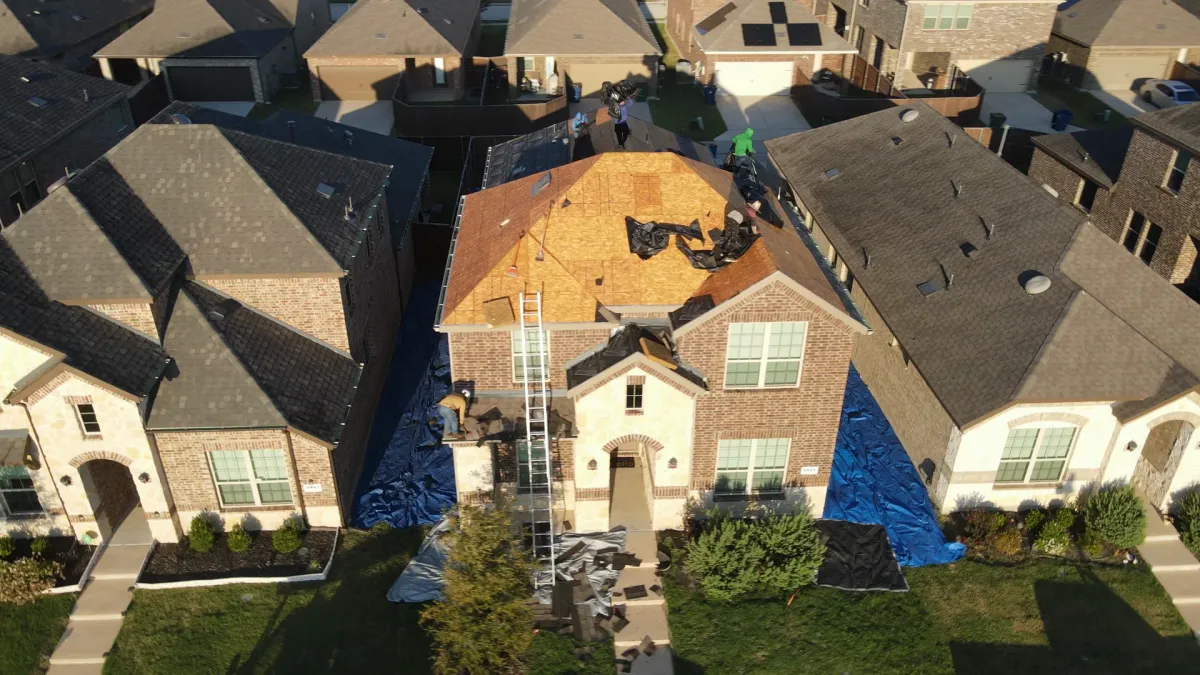 On older homes the original estimate can miss decking replacement, which a supplement adds back to the approved scope.
the paperwork that actually releases your depreciation.
After the roof is installed, the carrier needs three things to release the depreciation check. Send all three together. Don’t drip them.
- A final invoice on contractor letterhead showing the total amount billed, the work performed, and the date of completion.
- A Certificate of Completion signed by the homeowner confirming the work is done.
- Photos of the finished roof, the dump load tickets, and the materials delivery receipt if the carrier asks.
Some carriers also want a W-9 from the contractor and proof of permit close-out from the city. Plano, Frisco, McKinney, and Allen all require permits for full reroofs, and the final inspection card from the city is the cleanest proof you can send.
Submit everything by email to your adjuster and by upload through the carrier’s claim portal. Double-submit. I’ve seen depreciation checks delayed 45 days because the adjuster’s email inbox was full and nobody followed up.
the deadline nobody talks about.
This is the part that costs homeowners the most money. Almost every replacement cost policy in Texas has a time limit to recover depreciation, and it’s buried in the policy language. The standard is 180 days from the date of loss, but I’ve seen carriers write 365 days, and one regional carrier writes only 120 days.
If you don’t replace the roof and submit the depreciation paperwork inside that window, the carrier keeps the money. Legally. Permanently.
After the April 9, 2024 hail across Tarrant County, we picked up a homeowner in Keller whose claim was approved in May 2024 with $11,400 in recoverable depreciation. She got two contractor bids, hated both, and let it sit. By the time she called us in late November, her 180-day window had closed three weeks earlier. The carrier refused to reopen it. That $11,400 stayed with the insurance company.
The depreciation clock starts on the date of loss, not the date of the first check, so track it from day one.
If you’re inside 90 days of your deadline and the work hasn’t started, call your carrier and request a written extension. Most will grant 60 to 90 more days if you have a signed contractor agreement and a scheduled install date. Get the extension in writing.
what happens when the carrier underpays your depreciation.
Sometimes the math on the depreciation release doesn’t line up with what you were promised. This usually happens for one of three reasons.
The carrier applies non-recoverable depreciation to certain line items. Things like gutters, paint, and some accessories may be depreciated on a non-recoverable basis depending on policy language. That portion stays with the carrier even after the work is done.
The final invoice is less than the approved RCV. If your roof was approved at $24,800 and your contractor billed $19,500, the carrier will only release depreciation up to the actual invoice amount. This is why a cheap bid can cost you thousands in lost depreciation. The carrier won’t pay you more than you actually spent.
The supplement was processed against the wrong loss date. If you had two storms in the same year, like the May 23, 2024 and June 17, 2024 events that hit parts of Dallas back to back, claim payments can get crossed up. Confirm every check references the correct claim number.
If you believe the depreciation release is short, you have the right to request a detailed payment ledger showing exactly what was paid against each line item. Carriers are required to provide this under Texas Insurance Code Chapter 542. We pull these ledgers for clients during hail damage roof repair in Dallas any time the math looks off, and we’ve recovered short-paid depreciation on roughly one in five claims we audit.
how contractor choice changes your depreciation outcome.
The contractor you hire affects your depreciation collection in three concrete ways.
First, the invoice amount has to match or exceed your approved RCV for you to collect the full depreciation. A contractor who underbids the carrier scope is leaving your money behind. The right move is matching the carrier’s scope line by line, not undercutting it.
Second, the contractor handles supplement documentation. A roofer who doesn’t photograph decking conditions, take measurements of valleys and penetrations, or document code requirements can’t support a supplement when one is needed. We photograph every job at tear-off, mid-install, and completion specifically so the supplement paperwork is bulletproof.
Third, the contractor needs to be able to work with your carrier’s payment timing. Some shops require full payment at completion regardless of when the depreciation check arrives. Others, including us, structure the contract so the depreciation release goes straight to the final balance. If you’re cash tight, the difference is whether you’re floating $8,000 for 30 days or not.
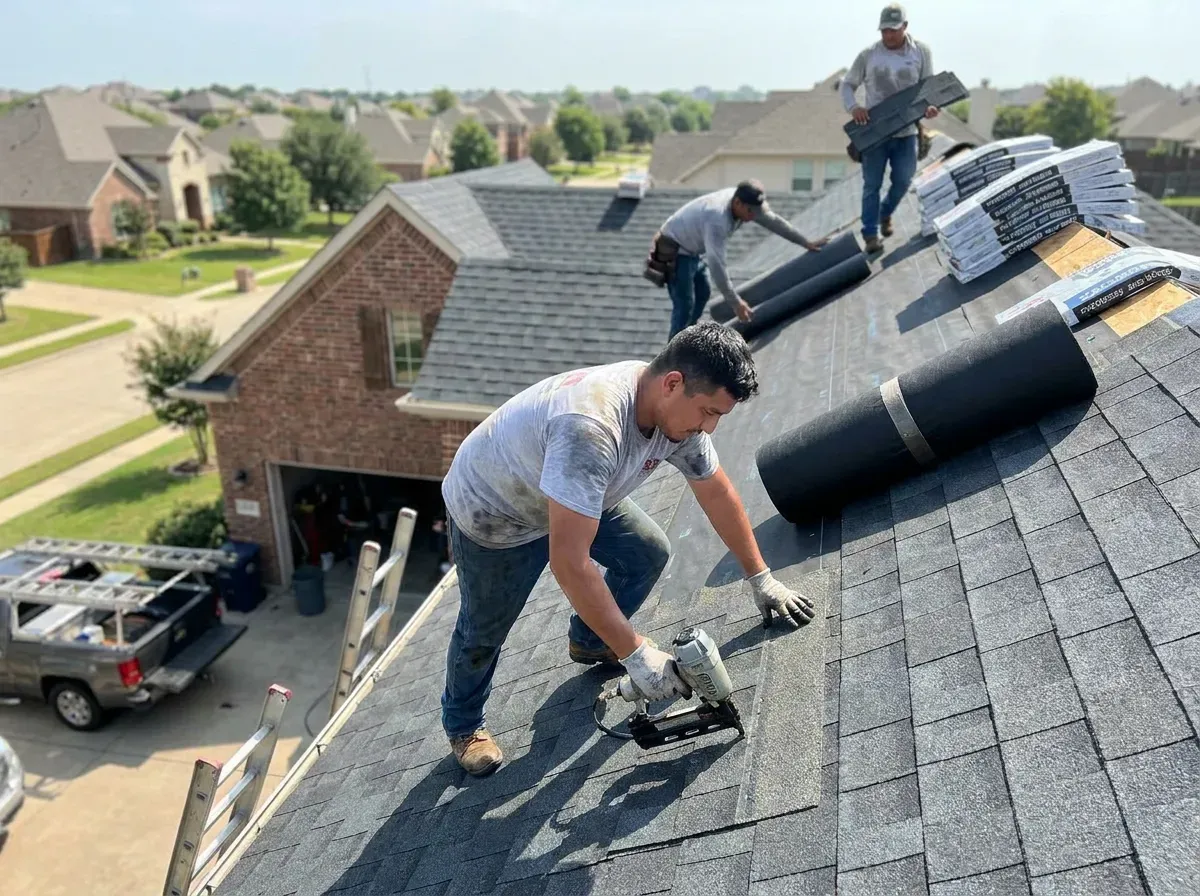 A CertainTeed Landmark Pro install, where the shingle SKU and warranty paperwork both go in the depreciation submission packet.
frequently asked questions.
Is recoverable depreciation taxable income in Texas? No. Insurance claim proceeds, including depreciation recovery, are not taxable income because they reimburse you for a loss. Talk to your CPA about basis adjustments if you’re selling the home soon.
Can I keep the depreciation if I do the work myself? Generally no. Carriers require proof that the work was actually performed and typically require an invoice from a professional roofing contractor. Some carriers allow homeowner labor credit at a reduced rate, but you’ll lose most of the depreciation.
What if my lienholder is holding the first check? Your lienholder will require a contractor agreement, a W-9, and sometimes a disbursement schedule with site inspections at 25%, 50%, and 100% completion. Start that paperwork the day the first check arrives.
Does filing a supplement extend my depreciation deadline? Not automatically. The depreciation deadline runs from the date of loss regardless of supplement activity. If supplements are still being processed near your deadline, request a written extension.
What if I sell the house before collecting depreciation? You generally lose the recoverable portion because you no longer have an insurable interest in the property. Some carriers allow assignment to the buyer at closing if it’s negotiated into the contract.
How long does the depreciation check take to arrive after I submit the invoice? Texas Insurance Code requires payment within 60 days of receiving acceptable proof of loss, but most carriers issue depreciation checks within 7 to 21 days of receiving a complete invoice packet.
If you’ve got an open claim and you’re not sure whether your ACV check covered everything, send us a copy of the carrier’s estimate and we’ll mark up the line items that look short. No charge for the review. Call us at (214) 326-3106 or run your numbers through our free roof cost calculator first to see how the approved RCV compares to current DFW pricing. We’d rather you collect every dollar you’re owed than learn about the 180-day deadline the hard way.