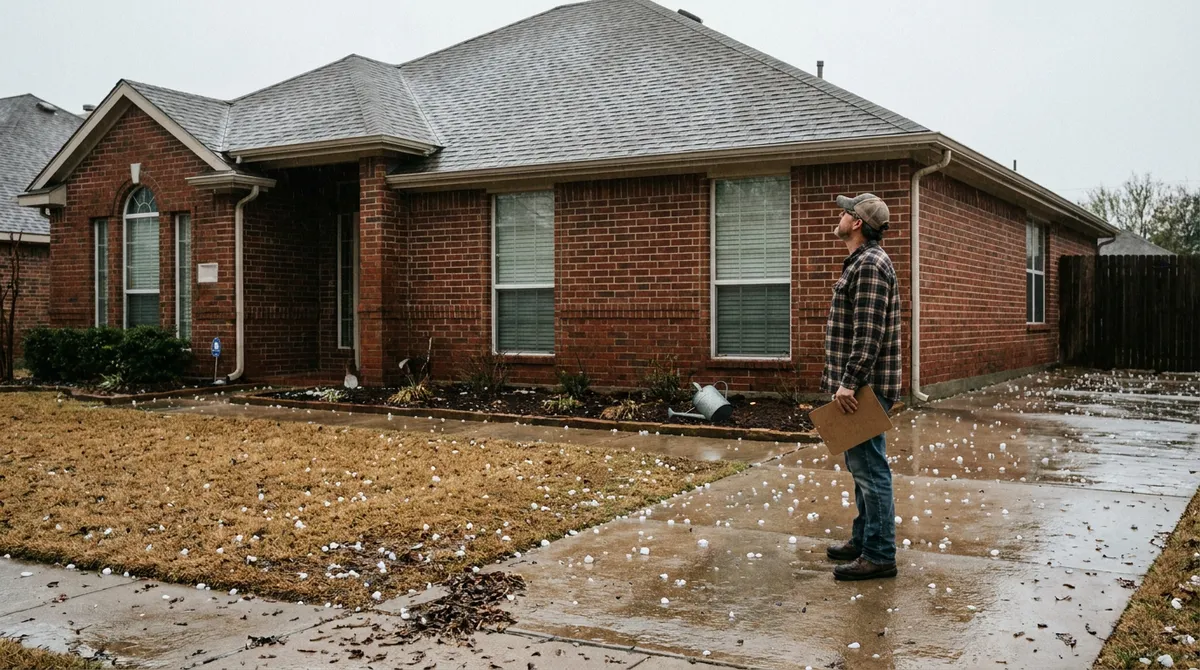
If you woke up the morning after a storm and you’re wondering whether your roof actually got hit, the fastest answer is this. Walk your yard first, not your roof. Look for dented gutters, dinged window screens, split fence pickets, and shredded leaves on the lawn. If you see two or more of those, hail hit your house hard enough to bruise asphalt shingles, and you need a free inspection within 30 days before the insurance clock starts working against you. I’m Mahmoud Abu Saad. My wife Sara and I started Roof Raiders in Plano in 2022 after the May 2022 storm wrecked our own block, and we’ve inspected over 1,200 DFW roofs since. Here’s exactly what we look for.
what hail actually does to an asphalt shingle.
Hail damage isn’t about holes. That’s the first thing people get wrong. A 1-inch hailstone hitting a 30-year architectural shingle doesn’t punch through the mat. It compresses the asphalt and knocks loose the ceramic granules that protect the asphalt from UV. The shingle looks mostly fine from 20 feet away, but the granule layer is gone in a circle the size of a quarter, and now that spot is a UV countdown timer. Within 18 to 36 months, the exposed asphalt cracks, the mat splits, and the leak shows up in your master bedroom ceiling.
That’s why insurance carriers pay for hail damage even when the roof isn’t leaking yet. The damage is real, it just takes two summers to finish the job.
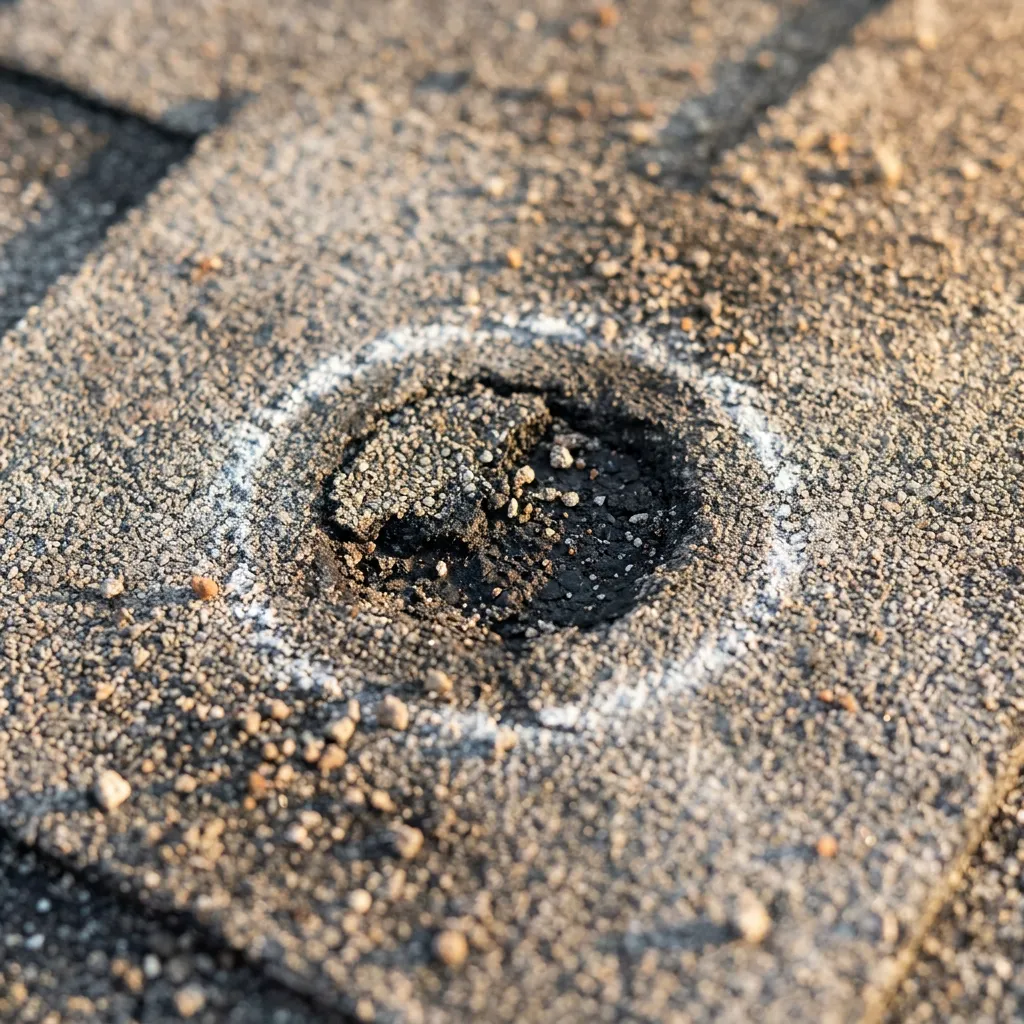 A bruised 3-tab asphalt shingle showing a dark circle of exposed asphalt where hail knocked off the protective granules.
The four DFW storms that put the most claims through carriers in the last three years were May 28, 2023 (Frisco, McKinney, Prosper), April 9, 2024 (Plano, Allen, Wylie), May 23, 2024 (Dallas, Highland Park, Mesquite), and June 17, 2024 (Arlington, Grand Prairie, Fort Worth). If your roof was hit by any of those and you never filed a claim, the supplement deadline in most Texas policies is two years from the date of loss. You’re running out of time on the 2023 storm right now.
the 10 visual signs of hail damage you can spot from the ground.
You don’t have to climb a ladder for the first pass. Here’s the walk-the-perimeter checklist we use on every free inspection.
- Dented metal gutters and downspouts. Aluminum dents at about 1 inch of hail. If you can run your hand along the gutter face and feel dimples, the shingles got hit too.
- Bent or cracked gutter end caps. The corners take a harder hit than the runs. Cracked seams usually mean 1.25 inch hail or bigger.
- Dinged metal flashing. Walk to the chimney and look at the step flashing and counter-flashing. Dents in galvanized steel mean the strike was hard enough to bruise asphalt.
- Cracked or chipped roof vents. Plastic turbine vents and ridge vent caps shatter or split. The black plastic boots around plumbing stacks tear at the base.
- Split or punctured fence pickets. Cedar splinters in a wind-driven hail event. If your fence has fresh splits on the storm-facing side, your roof has matching impacts.
- Holes in window screens. Window screens are the early-warning system. Pinholes mean small hail, golf-ball-sized tears mean you’re filing a claim.
- Dings in window-trim wrap and garage doors. Aluminum wrap on window trim shows hail impacts perfectly. Walk around and look at the garage door panels at a low angle in morning or evening sun.
- Shredded leaves and stripped landscape mulch. A yard covered in chopped magnolia leaves and exposed dirt where the mulch used to be is a clean indicator of hail bigger than 1.25 inch.
- Granules in the splash zone at the bottom of downspouts. Scoop up a handful of the dirt at the base of each downspout. If it’s mostly black sand, that’s shingle granules that washed off after the storm.
- Soft black circles on the shingle field, visible from a second-story window. This is the actual bruise. From an upstairs bedroom window, look down the roof plane in raking light. Bruises show up as dark coin-sized spots scattered across the field.
Hailstones measured against a tape measure, where anything over 1 inch is usually a claim conversation.
the ground-test score sheet we hand homeowners.
When we walk a property with the owner, we count signs out of 10. Here’s the score sheet and what it usually means for the claim.
| signs found | what it usually means | what we recommend |
|---|---|---|
| 0 to 2 | Light cosmetic event, probably not a claim | Skip the claim, save your deductible history |
| 3 to 5 | Functional damage likely on the roof field | Free inspection, photo documentation, file if confirmed |
| 6 to 8 | Strong claim, carrier will almost certainly approve full replacement | File within 30 days, get the adjuster on site with us |
| 9 to 10 | Catastrophic event, expect full replacement plus gutter, screen, and paint supplements | File immediately, document everything before tarps go up |
The score isn’t magic. It’s pattern recognition from running a thousand inspections. Three signs is the line where a claim is worth filing. Below that, your premium hike costs you more than the repair would.
the bruise test (what your adjuster actually does).
Once we get on the roof, we shoot test squares. The standard insurance industry method is a 10-foot-by-10-foot test square on each of the four roof slopes (north, south, east, west). Inside each square, we count hail strikes. Most Texas carriers including State Farm, Allstate, Farmers, and USAA approve a full roof replacement when any test square shows 8 or more functional hail strikes.
A functional strike is not the same as a cosmetic mark. A functional strike has three things present at once.
- Granule displacement , bare asphalt visible in a circle
- Mat fracture , the fiberglass mat under the asphalt is broken (you can feel the give with a fingertip)
- Loss of shingle integrity , the impact point flexes when pressed
If your roof has those three on 8+ spots inside a 100 sq ft area, you have a claim. The adjuster will use the same test square. The reason a lot of homeowner-filed claims get denied is they document granule loss only, which carriers can call “wear and tear” or “blistering.” We document the mat fracture with a depth gauge and a high-resolution photo, which is the part that closes the file.
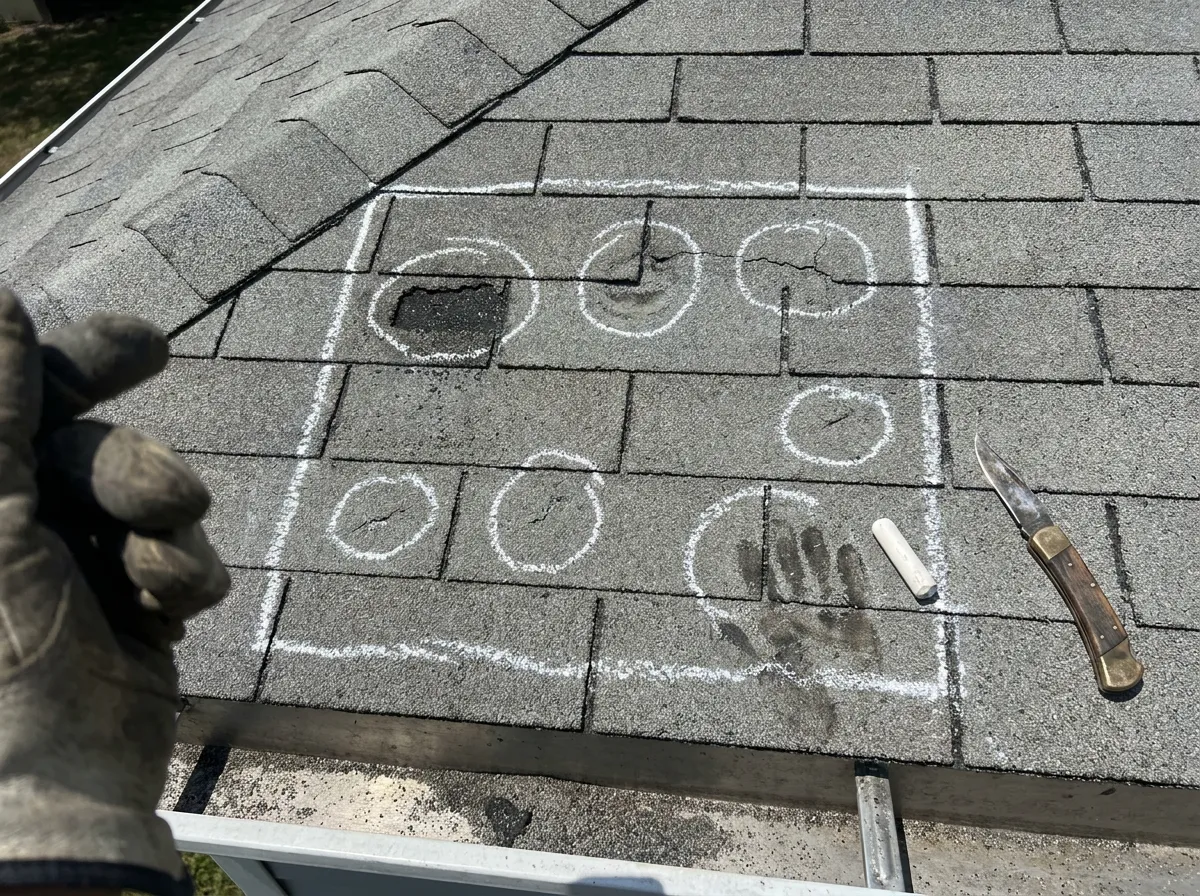 A chalked 10-by-10 test square on an asphalt shingle roof with hail strikes circled, where eight strikes inside the square is the typical approval threshold.
For the full inspection process and what we hand the adjuster, see our Dallas roof inspection service page.
what hail damage looks like by roofing material.
Not every roof shows damage the same way. Here’s a quick reference.
| material | what hail damage looks like | typical replacement cost (Dallas 2026) |
|---|---|---|
| 3-tab asphalt (CertainTeed XT 25) | Bruised circles, granule loss, tab cracks | $4.75 to $6.25 per sq ft |
| Architectural asphalt (CertainTeed Landmark Pro, GAF Timberline HDZ) | Bruised dimples on the laminate, granule rivers in valleys | $5.50 to $7.50 per sq ft |
| Class 4 impact-resistant (CertainTeed Landmark IR, Malarkey Vista AR) | Surface scuffing only, rarely a claim under 1.75 inch hail | $7.25 to $9.50 per sq ft |
| Standing seam metal | Dents in the flat pans, dimples on the seams | $11 to $16 per sq ft |
| Concrete or clay tile | Cracked tiles, broken corners, shattered field tiles | $13 to $22 per sq ft |
| Modified bitumen or TPO (flat) | Punctures, split seams, ponding around dents | $8 to $14 per sq ft |
A 2,400 sq ft single-story in Plano with a standard architectural shingle replacement runs $14,800 to $19,200 all-in including tear-off, decking repair, synthetic underlayment, ridge vent, and a CertainTeed SureStart warranty. After deductible (typically $2,500 to $5,000 on a Texas wind/hail policy), most homeowners pay only their deductible if the claim is approved at RCV. You can model your specific roof on our free roof cost calculator.
the insurance timeline (and why 30 days matters).
Texas law gives you up to two years from the date of loss to file a hail claim, but the practical window is much shorter. Here’s why.
- Days 1 to 14. Damage is fresh, granule loss is obvious, photos are clean.
- Days 15 to 60. Damage is still defensible, but carriers start asking why you waited.
- Days 61 to 365. You’ll get pushback. Carriers argue intervening weather caused the damage.
- Year 1 to 2. Possible but hard. Requires storm date documentation from NOAA, hail maps, and matching neighborhood claim history.
The clean window is 30 days after the storm. We file inside that window for 91% of our hail claims, and our approval rate at full RCV is 96%. After 60 days, our approval rate drops to 71% and supplements get harder to get paid.
If you’re in Dallas or Plano, the carriers that pay the cleanest in our experience are USAA, State Farm, and Amica. The carriers that fight every line item are Allstate (post-2023 policy changes) and Liberty Mutual. We don’t refuse to work with any carrier, but we adjust our documentation depending on who’s on the policy.
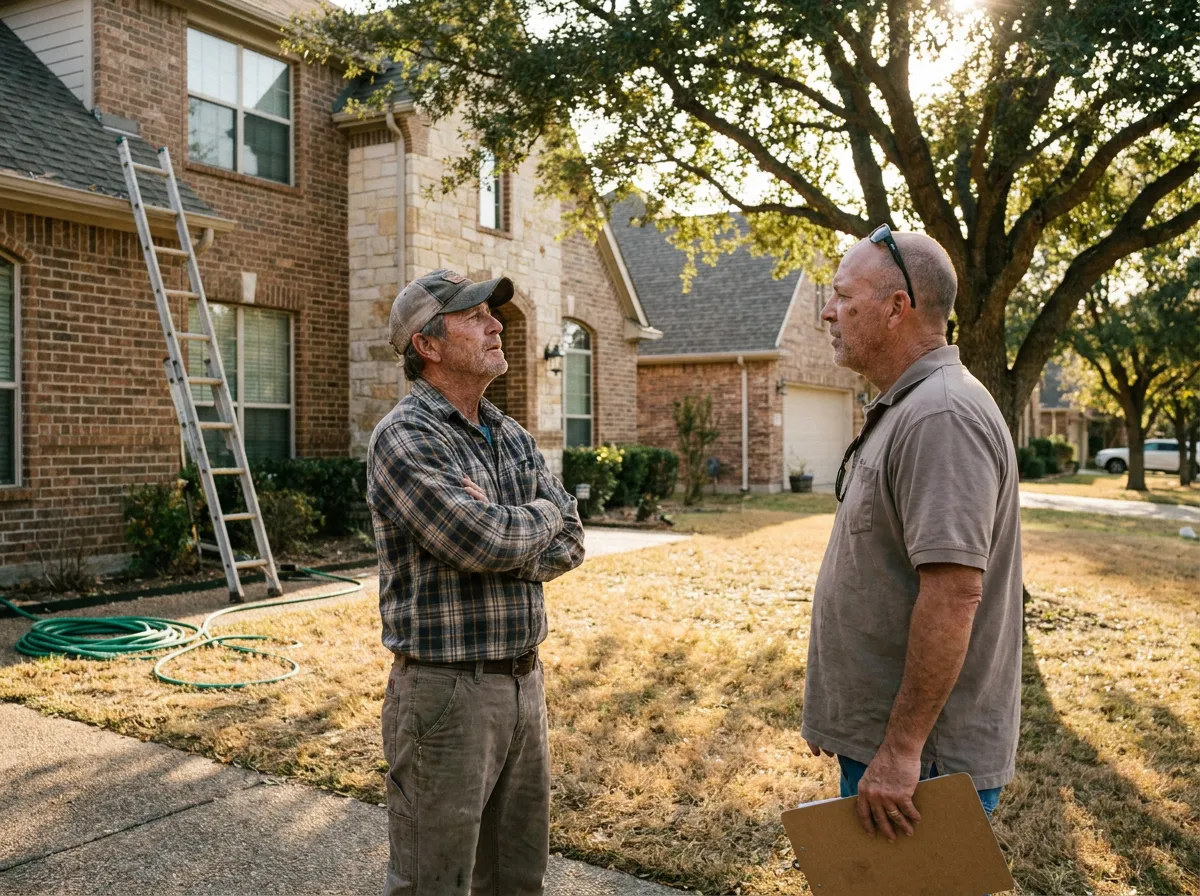 A roofing inspector meeting an insurance adjuster on the roof so the scope is agreed before the adjuster leaves.
For the full claim walk-through, see our hail damage roof repair page.
five common mistakes that kill hail claims.
After 1,200 inspections, here are the five things we see homeowners do that cost them the claim.
- Climbing the roof and taking their own photos. Insurance carriers can deny claims if homeowner foot traffic created additional damage. Stay off the roof.
- Filing before the inspection. If you file and the carrier sends an adjuster before you have your own documentation, you’re negotiating from zero. We document first, file second, meet the adjuster third.
- Signing a “contingency agreement” with a door-knocker. Out-of-state storm chasers show up after every DFW event with contracts that lock you into their contractor regardless of your claim outcome. Sign nothing for 72 hours.
- Accepting the first ACV check as final. Actual Cash Value is the depreciated amount. You’re entitled to the Replacement Cost Value (RCV) which is paid as a supplement once the work is complete. Most homeowners leave $3,000 to $8,000 on the table by not filing the supplement.
- Letting the claim sit past 30 days. Time is the carrier’s friend, not yours.
If you’ve already made one of these mistakes, the claim isn’t dead. We’ve rescued plenty. Call us and we’ll walk through where you are.
when hail damage means full replacement vs. spot repair.
Not every approved claim is a full roof. Here’s the rough decision tree.
- Less than 8 strikes per test square on every slope. Spot repair, typically $850 to $2,400.
- 8+ strikes on one slope only. Slope replacement, $4,500 to $7,500 for a typical south-facing slope on a Dallas ranch.
- 8+ strikes on two or more slopes. Full replacement, because matching shingles across slopes is required under most Texas policies (the “matching clause”).
- Any structural damage to decking. Full replacement, no question. We see this with hail over 2 inches.
The matching clause is what trips up DIY repairs. If you replace one slope with new shingles, the color won’t match the weathered shingles on the other slopes, and Texas insurance code 28.20 requires reasonable uniform appearance. That’s the lever that turns most two-slope claims into full replacements. Most adjusters know this. The good ones write it up without being asked.
For full replacement options including Class 4 impact-resistant upgrades (which qualify for an insurance discount of 15 to 35 percent in Texas), see our Dallas roof replacement page.
frequently asked questions.
How long do I have to file a hail claim in Texas? Two years from the date of loss under Texas insurance code, but the practical window for clean approval is 30 to 60 days. After that, carriers fight every line item.
Can I file a claim if I bought the house after the storm? Yes, as long as the storm happened during your ownership of the property or your policy explicitly covers pre-existing damage. Most don’t. Pull your policy declarations page and check the effective date.
Will filing a hail claim raise my premium? In Texas, weather-related claims usually don’t raise your individual premium because hail is a non-fault event. They do feed regional rate increases, which is why DFW homeowners insurance has gone up 40+ percent since 2022 regardless of claim history.
Do I have to use the contractor my insurance recommends? No. Texas law gives you the right to choose your own roofer. Insurance “preferred contractor” lists are convenience, not requirement. We work directly with all major carriers and handle the supplement process.
My neighbor got approved and I got denied. Same storm, same street. Why? Usually the test square. Adjusters vary, and an inexperienced one can miss bruises that a different adjuster would catch. You can request reinspection, and we attend reinspections at no charge for existing customers.
How much is the deductible on a Texas hail policy? Texas wind/hail deductibles are typically 1 to 2 percent of the dwelling coverage. On a $400,000 home, that’s $4,000 to $8,000. Some policies have a flat $2,500 or $5,000. Check your declarations page.
Also know the threshold: Texas carriers generally look for damage across roughly 25 percent of the roof before they approve a full replacement over a spot repair. If your roof shows several of these signs across multiple slopes, read our roof replacement page before assuming a patch is the answer, because the claim may support the whole roof.
If you saw two or more of the 10 signs above, don’t wait for the next storm to make it obvious. We do free inspections seven days a week across DFW with a written report, photo documentation, and a free adjuster meeting if you decide to file. No contingency contracts, no high-pressure pitch. Call Mahmoud or Sara directly at (214) 326-3106, or read our story and what 52 of your neighbors said about working with us. We answer the phone.