Flat roof repair in Dallas is a diagnosis problem before it’s a roofing problem. Most of the calls we take in Plano, Frisco, Richardson, and Dallas come from owners who’ve already had two crews up there with a bucket of mastic and a guess. We’re Roof Raiders & Co., a family-owned roofer headquartered on Legacy Drive in Plano. Since 2022 we’ve registered every roof we install with CertainTeed at the highest tier our ShingleMaster certification unlocks, ranking us in the top 3 percent of US roofers. Mahmoud Abu Saad and Sara Bannat run Roof Raiders, read why we started. What follows is how we actually decide what your flat roof needs, with the numbers we use to draw the line.
spot repair vs recoat vs full replace, the decision tree.
Before we touch the membrane, we run an infrared scan and a capacitance moisture survey so we’re working from data, not guesses. Then we line the readings up against four thresholds. Those four numbers drive the path. Here’s the matrix we use on every flat roof we walk in Dallas.
| Reading | Spot repair | Recoat | Full replace |
|---|---|---|---|
| Membrane age | Any age, isolated failure | 8 to 18 years, structurally sound | 20+ years or shot |
| Wet insulation area (IR scan) | Under 25 percent | Under 10 percent | Over 30 percent |
| Deck moisture content | Under 18 percent | Under 14 percent | Over 22 percent |
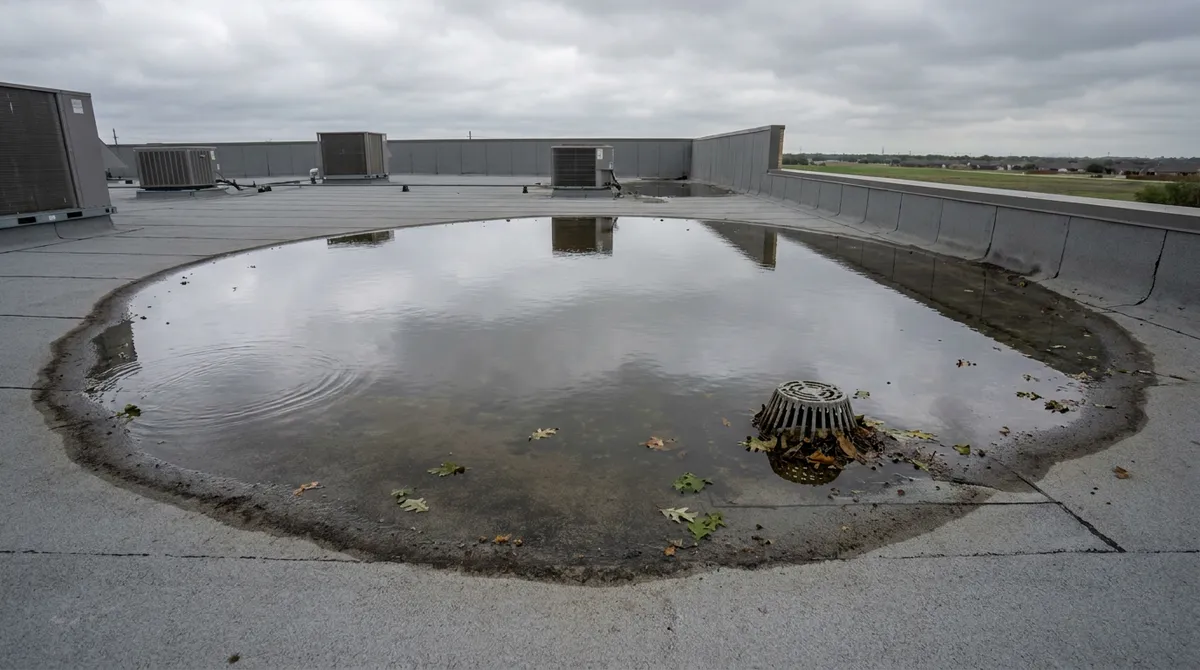
| Ponding depth + duration | Drains within 48 hours | No chronic ponding | Standing past 72 hours |
| Seam condition | Localized failure | 90 percent sound | Systemic failure |
If three of five rows land in the same column, that’s your path. If they split, we walk you through the tradeoff in dollars and remaining service life so you make the call with the data in front of you. We’ve walked roofs where the IR scan came back at 9 percent wet area on an 11-year-old TPO, the seams were 95 percent sound, and a silicone recoat bought the owner another decade for under $20,000. We’ve also walked roofs where the previous crew had patched the same T-joint four times and the deck below read 38 percent moisture, which is a tear-off conversation no matter how the membrane looks from above.
Call (214) 326-3106 for a free inspection.
ponding water and the 48 hour rule.
Manufacturer warranties from GAF, Carlisle, Firestone, and Johns Manville void coverage anywhere water sits longer than 48 hours after a rain event. That’s not fine print, that’s the first exclusion on the certificate. In Dallas we see three causes for ponding past 48 hours, and each has a different fix.
Clogged drains and scuppers. The cheapest fix. Pull the strainer, clear the bowl, jet the drain line, confirm flow. Often $300 to $700 per drain on a service visit.
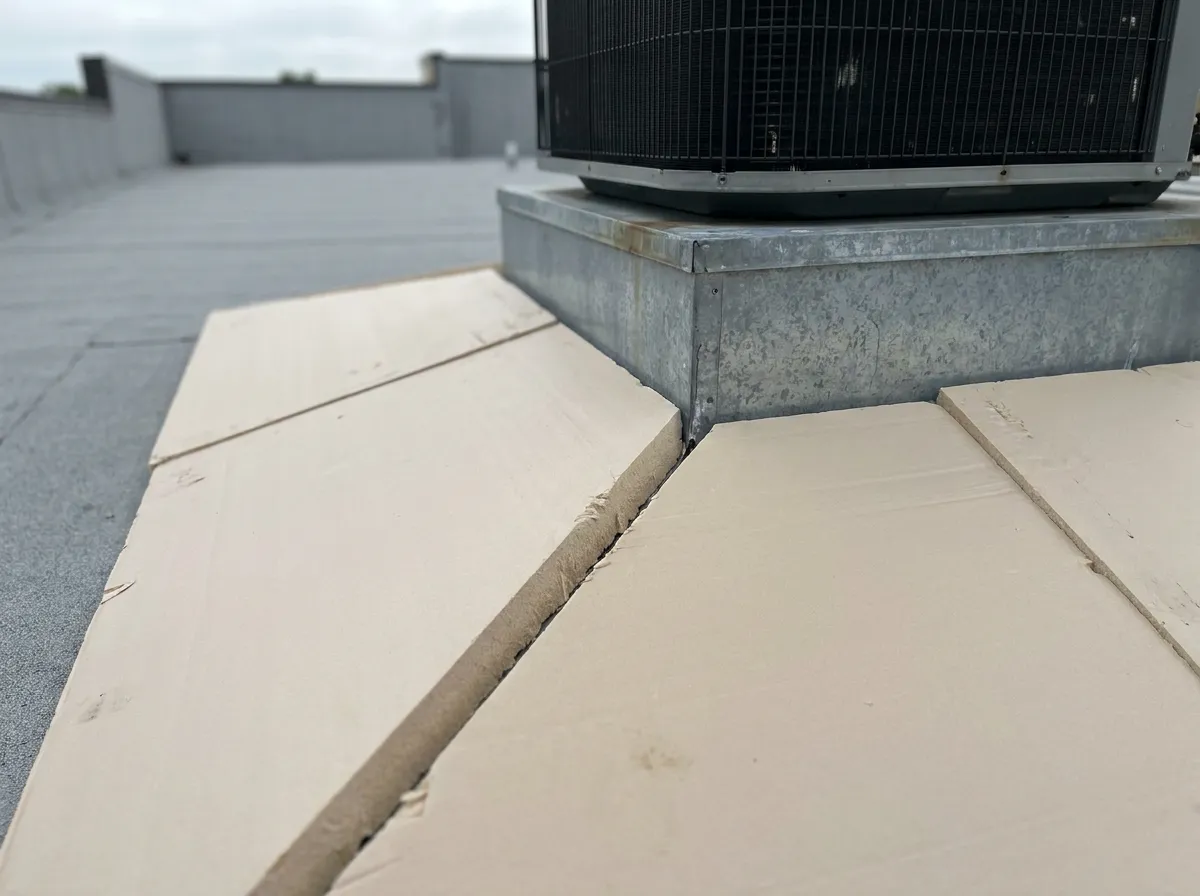
Sagging substrate. The deck has flexed over a load point (HVAC unit, water heater, planter). Fix is structural reinforcement plus tapered insulation to restore slope. $2,500 to $8,000 depending on area.
Settled or wet insulation. Once polyiso gets saturated it compresses and never recovers. Fix is cut-out, dry the deck, replace the insulation, weld in new membrane. $12 to $22 per sq ft of affected area.
the rapid roof response process.
Our flat roof workflow is a 6-step protocol we call Rapid Roof Response, and we walk every owner through it on the first call so there are no surprises. Here’s what happens from the minute you dial (214) 326-3106 to the minute we hand you the warranty certificate.
- First call and dispatch. Sara or one of our coordinators picks up, gets the address, the membrane type if you know it, and the symptom (leak, ponding, visible seam failure). For active leaks we dispatch within 24 hours. For diagnostics we book within 48 to 72 hours.
- On-roof diagnostic. A senior tech runs the infrared scan, capacitance moisture probe, and a full seam and penetration walk. You get photos, the IR map, and the moisture readings emailed before we leave the driveway.
- Path call meeting. We sit down with you (in person, on the phone, or over video) and walk the decision matrix above. Spot repair, recoat, or replace, with dollars and remaining service life on each path. No pressure, no fake urgency.
- Written scope and contract. Fixed line-item quote with membrane type, thickness, fastener pattern, insulation R-value, drain work, warranty terms, and the manufacturer lot numbers we’ll be ordering. Plain English, no fine-print games.
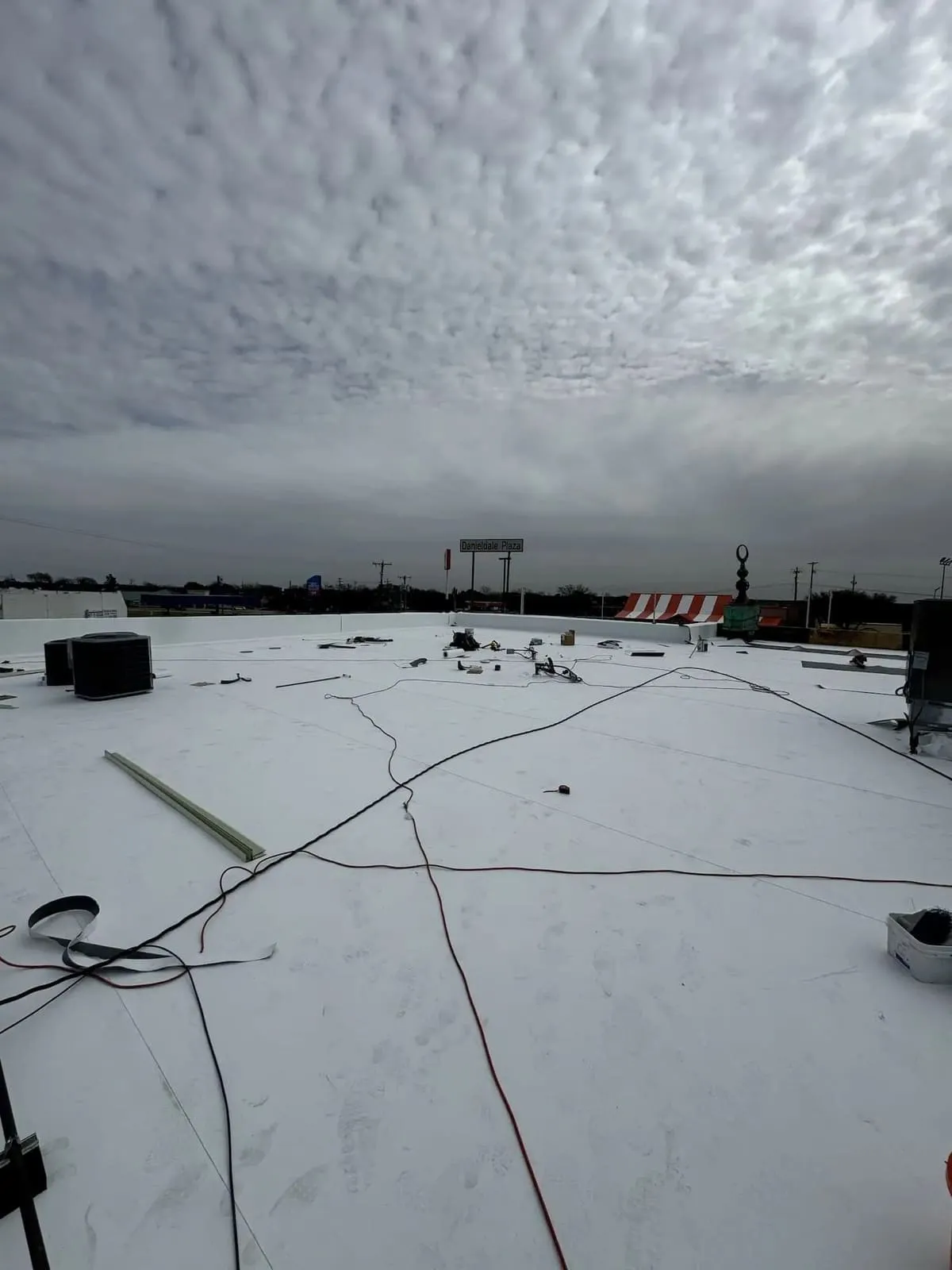
- Repair execution. Crew shows up when we said, materials staged the day before, daily progress photos to you, tarp protocol every night. Heat-welded TPO, primed EPDM, torched mod bit, or sprayed silicone, all to manufacturer spec.
- Flood test and warranty registration. We flood or hose-test the repaired area, walk you through the result, then register the repair with the membrane manufacturer so the warranty holds. You get the certificate and the IR scan archive.
seam repair vs membrane patch vs penetration reseal.
About 80 percent of our targeted flat roof repairs in Dallas fall into one of three buckets. Knowing which bucket you’re in tells you what the repair costs and how long it lasts.
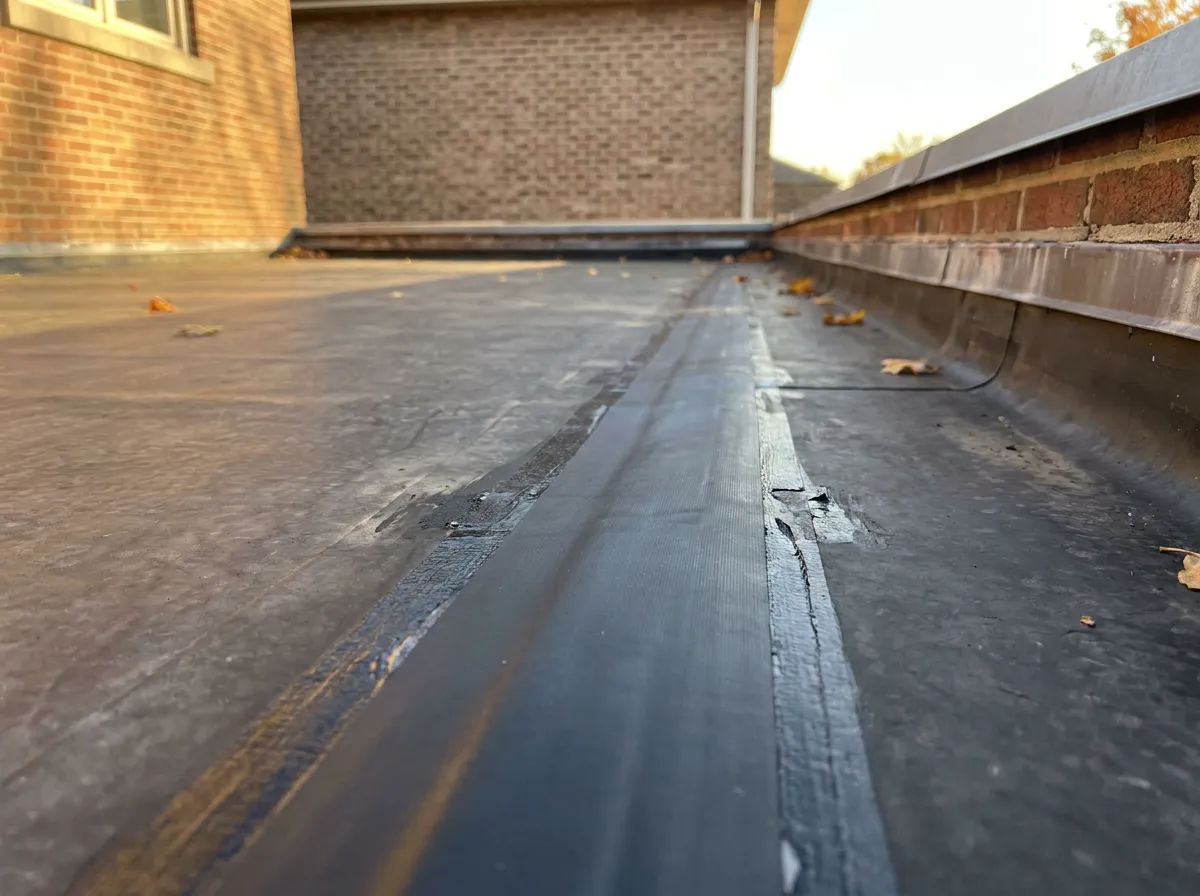
Seam repair. Re-weld or splice a failed seam on TPO or PVC, retape and prime an EPDM seam. The most common failure on TPO roofs over 8 years old is T-joint failure where three sheets meet. Runs $400 to $1,200 per seam depending on length and access.
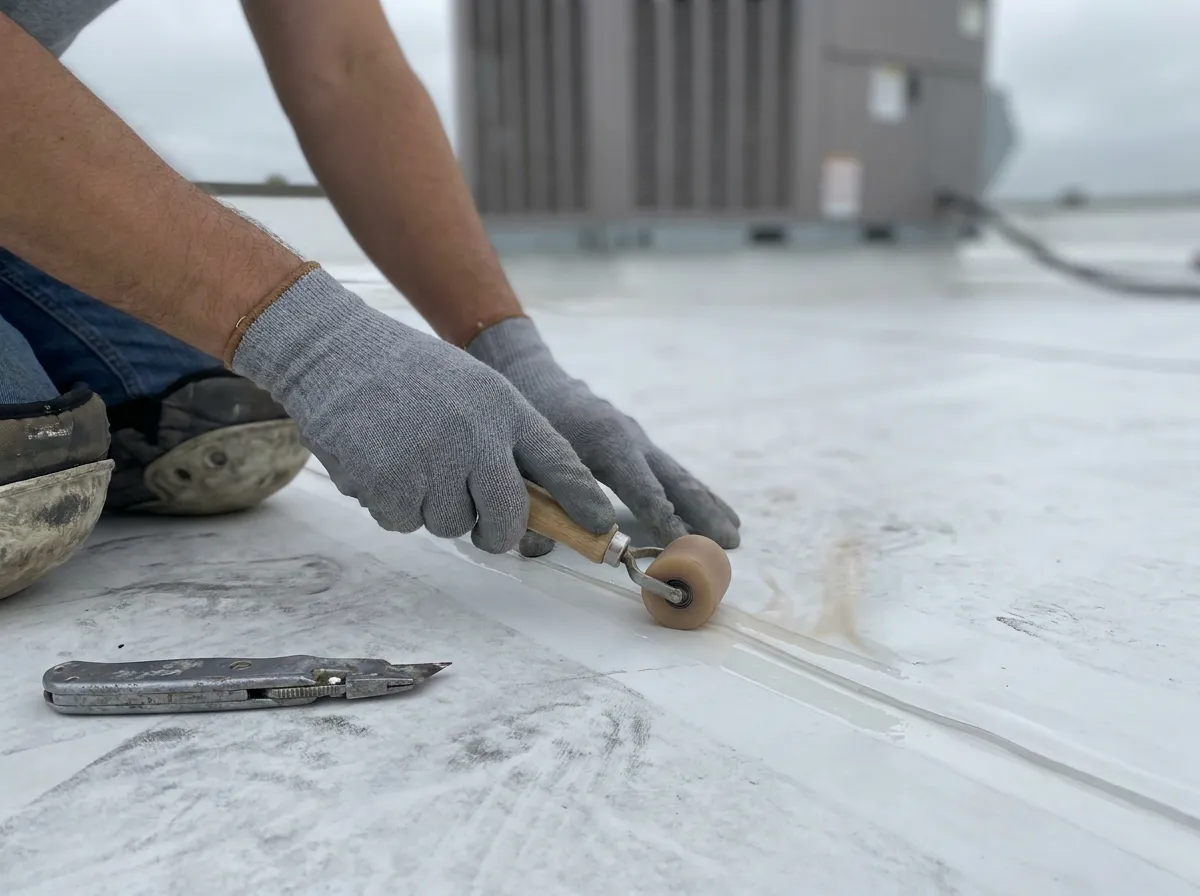
Membrane patch. Cut out a compromised section (storm damage, mechanical puncture, blister) and heat-weld a new piece with a 2-inch perimeter overlap on TPO or PVC, or prime and tape on EPDM. Runs $800 to $2,500 depending on patch size and surrounding membrane condition.
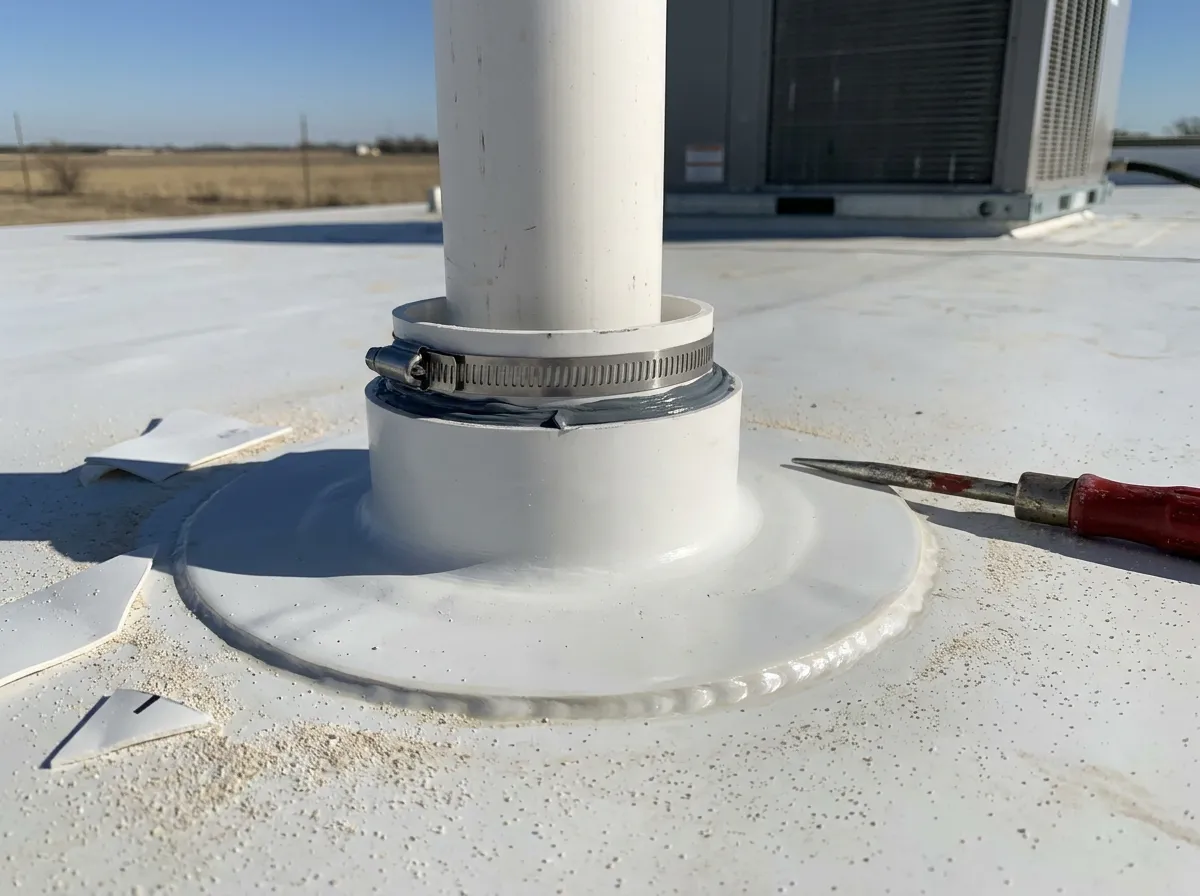
Penetration reseal. Rebuild the flashing around a pipe, HVAC curb, drain, or scupper. This is where 60 percent of flat roof leaks actually start. We strip the old flashing, rebuild with proper target patches and pre-molded boots, then heat-weld or torch the perimeter. Runs $600 to $2,500 per penetration.
Call (214) 326-3106 for a free inspection.
recoating: when it actually buys you 10 years.
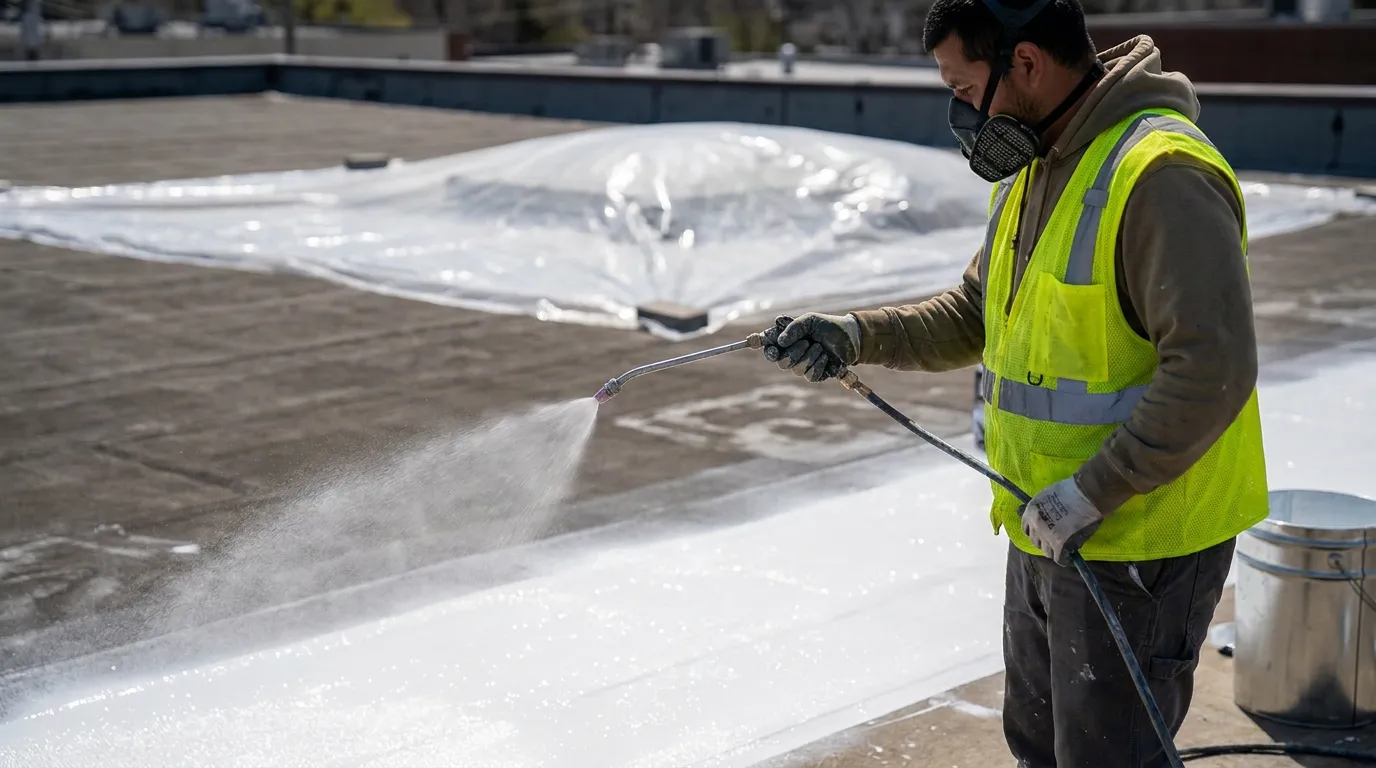
A silicone or acrylic elastomeric coating, applied at 2 to 3 gallons per 100 sq ft over a properly cleaned and primed membrane, will add 7 to 12 years of service life to a qualifying roof at $2 to $5 per sq ft. The qualifying conditions are strict and we won’t bend them.
The membrane has to be structurally sound with under 10 percent wet insulation on the IR scan, no chronic ponding past 48 hours, and seams that are 90 percent intact (we re-weld the rest before coating). Silicone holds up better in Dallas heat and ponding-prone areas. Acrylic is cheaper and works on tighter budgets with clean drainage. If a roof doesn’t qualify and we coat it anyway, the coating traps moisture under the membrane and we’ve just sold you an accelerated replacement.
payment plans, real numbers.
Flat roof work doesn’t always come on a convenient month. A typical 4,500 sq ft silicone recoat at $4 per sq ft runs about $18,000, and a full tear-off and TPO replacement on the same 4,500 sq ft commercial deck with new polyiso runs roughly $55,000. Cash jobs are always welcome, and we offer an in-house payment plan on qualified projects. A larger upfront deposit gets the work started and the balance is split over flexible terms depending on the size of the project. Details are on our payment plans page, and Sara walks you through the plan personally so you’re not feeding paperwork to a stranger.
dfw neighborhoods we serve.
We run flat roof diagnostics and repairs across most of DFW.
On the residential side we see flat sections on modern builds and additions in:
- Lakewood, Preston Hollow, Highland Park, University Park, Uptown, Bishop Arts
- Oak Lawn, Lake Highlands, Casa Linda, M Streets, Knox Henderson
- Bluffview, Old Highland Park, Volk Estates, Beverly Drive, Armstrong Parkway
On the commercial side we cover retail strip centers, medical office buildings, and warehouses in:
- Devonshire, Stonebriar, Phillips Creek Ranch, Frisco Lakes, Starwood, The Trails of West Frisco
- Willow Bend, Preston Meadow, Legacy West, Carpenter Park, Watters Creek, Twin Creeks
- Tucker Hill, Whitley Place, Adriatica, Trinity Falls, Fairview, Twin Creeks Allen
- Star Creek, Mira Lagos, Westchester, Lakeridge, Lakewood Heights
If you’re in Plano, Frisco, McKinney, Allen, Richardson, or Dallas proper, we’re usually on your roof within 48 hours of the first call.
anti-storm-chaser warning.
After every major North Texas storm, out-of-state crews flood Plano and Frisco driveways with door-knock flyers and “free roof” promises. On flat roofs the pattern is worse, because most owners can’t see what’s happening on the deck and the chaser knows it. They sign you to an ACV-only contract, take the first carrier check, slap mastic on a few seams, and disappear before the supplement gets filed or the flood test ever happens. Six months later the leak comes back, the warranty doesn’t exist, and the LLC on the contract is dissolved. If a crew shows up uninvited after a storm, get their Texas contractor address, their CertainTeed credential number, and a sample of past flood-test reports. If they can’t produce all three on the spot, don’t sign.
Call (214) 326-3106 for a free inspection.
what kills a flat roof faster than anything else.
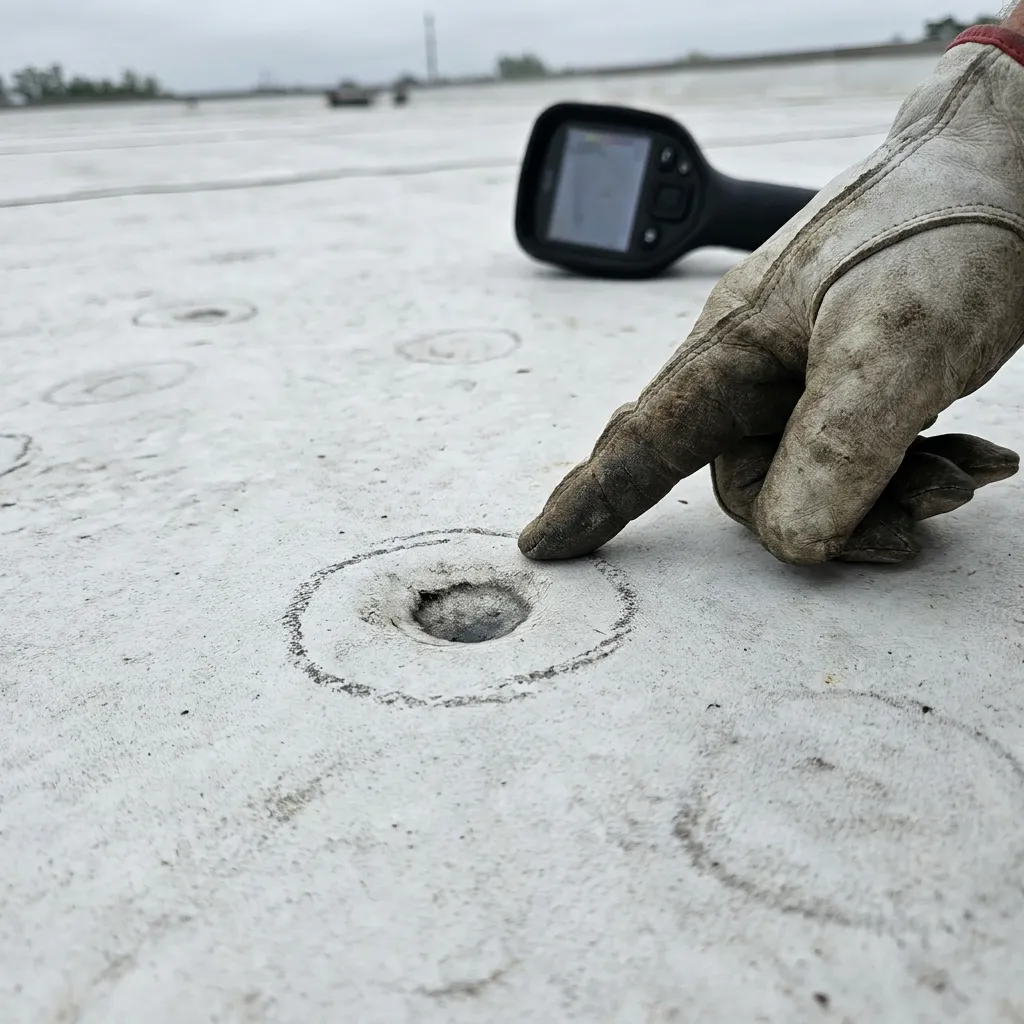
Trapped moisture under the membrane from an undetected seam failure. Water gets in at a T-joint or a pinhole, spreads laterally between the membrane and the insulation, and saturates the polyiso. By the time a tenant calls about a ceiling stain, the deck below already reads 30 to 40 percent moisture content and the insulation R-value is destroyed. That’s why we lead every flat roof visit with an infrared scan. The stain on the ceiling is the last symptom, not the first.
DFW averages 38 inches of rain per year and our spring storm season runs April through June, with the heaviest cells tracking US-75 from McKinney south through Plano and Frisco. May 28 2023, April 9 2024, May 23 2024, and June 17 2024 are the storm dates Texas carriers honor on flat roof hail and wind claims right now. After each of those dates we ran emergency dispatches across Lakewood, Preston Hollow, Plano, and Frisco for tenants with water already through the deck. If your flat roof took a hit on one of those dates and you haven’t had it scanned, the wet insulation is still spreading whether you can see it or not.
If your flat roof is leaking, ponding, or due for a recoat conversation, call (214) 326-3106 anytime. A senior tech will bring the IR camera, map what’s actually happening up there, and tell you which path the data supports. Fixed written quote, no pressure, and a payment plan if you want it.
What's included
- Infrared and capacitance moisture survey to map wet insulation
- TPO and PVC heat-welded seam, T-joint, and patch repair
- EPDM uncured flashing, primer, and seam tape repair
- Modified bitumen torch-down and self-adhered patch work
- Penetration reseal: pipe boots, HVAC curbs, drains, scuppers
- Ponding water diagnosis with tapered insulation or drain relocation
- Acrylic and silicone elastomeric recoat (when the membrane qualifies)
- Tapered insulation design and crickets to redirect drainage
- Drain bowl, strainer, and scupper rebuild with new clamping rings
- Manufacturer warranty preserved when active
How it works
- Moisture map. Infrared scan plus capacitance probe to chart every wet zone before we quote, not after.
- Path call. Spot repair, recoat, or replace. We tell you which path the data supports and why.
- Written scope. Fixed line-item quote with membrane type, thickness, fastener pattern, and warranty terms in plain English.
- Repair to spec. Heat-welded TPO, primed EPDM, torched mod bit, or sprayed silicone, all to manufacturer spec with documented lot numbers.
- Flood test. We flood or hose-test the repair before sign-off so the leak doesn't come back next storm.
- Warranty registration. We register the repair with the membrane manufacturer (GAF, Carlisle, Firestone, Johns Manville) and send you the certificate plus the IR scan archive.