Insurance pays for a new roof in Texas when a covered event, usually hail or wind, damaged the roof badly enough to cross the carrier’s replacement threshold. It pays the full replacement minus your deductible if you have a replacement cost policy, pays a depreciated amount if you have an actual cash value policy, and pays nothing if the roof simply wore out. Those three sentences answer about 80 percent of the calls I take, and the other 20 percent are about what “badly enough” means on a 15 or 20 year old roof.
I have walked roughly 1,400 Dallas-area homeowners through this since Mahmoud and I started Roof Raiders in 2022. Here is how the decision actually gets made, in the carrier’s own terms, so you know where your roof stands before you file.
 Most denial letters come down to one of three things: age, threshold, or documentation. All three are knowable before you file.
age is never the claim. the storm is the claim.
Start with the sentence the Texas Department of Insurance puts on its own page about insurance and your roof: your insurance company “won’t pay for a new roof just because it’s old or worn out.” Curling shingles, granule loss from twenty summers, a leak that finally showed up: none of that is a claim. TDI’s other sentence is the one that opens the door: “You can file a claim if a storm, tree, or something else damaged your roof.”
So the first question is not “is my roof bad?” It is “did a specific covered event damage it, and can I name the date?” In North Texas the answer is often yes. The Insurance Information Institute counted 902 major hail events in Texas in 2025, first in the nation, and State Farm alone paid $1.4 billion in Texas hail claims in 2025, more than any other state. Hail is the reason most roofs in Plano, Frisco, and Keller get replaced on a claim rather than out of pocket.
The trap is filing an age problem as a storm problem. Adjusters are trained to separate the two, and a roof that is 22 years old with uniform granule loss and a handful of bruises reads as wear with a little hail on top. That file gets denied or written as a small repair, and the denial sits in your claims history.
replacement cost vs. actual cash value decides the check.
Two policies can approve the same claim and cut checks $12,000 apart. TDI describes the difference plainly: “Some policies pay up to the full cost to repair your roof at current prices. This is called replacement cost coverage,” and “some policies pay less if the roof is older or showing wear. This is called actual cash value coverage.”
On a replacement cost (RCV) policy, the carrier pays the full scope minus your deductible, usually as two checks: actual cash value up front, and the recoverable depreciation after the work is done and the final invoice is submitted. The ACV vs. RCV guide walks the two-check math, and depreciation recovery covers getting the second one released.
On an actual cash value (ACV) policy, the carrier subtracts depreciation for the roof’s age and that is the final payment. A 17 year old roof on an ACV policy can produce a $4,800 check against an $18,500 job.
The policy type matters more than the storm. Read the declarations page today, not the morning after the hail.
 A scope of loss. The line that matters most is whether the settlement is RCV or ACV, and it is decided by your policy, not the adjuster.
the 15 and 20 year old roof problem.
Here is the part that catches Texas homeowners off guard. TDI warns that “as roofs age, some companies will switch to actual cash value,” and that “if your roof is in poor condition, your company might not cover your roof at all.” In practice that shows up two ways on the declarations page:
- An ACV roof endorsement, which switches the roof (and only the roof) to actual cash value once it passes a certain age, often 15 years.
- A roof surface payment schedule, a table that pays a fixed percentage of replacement cost by roof age and material. A 20 year old architectural roof might sit at 40 to 60 percent on the schedule.
Neither one means the claim is denied. Both mean a 20 year old roof with legitimate hail damage gets approved and paid at a fraction of the replacement cost, with the rest on you. If you have either endorsement, the smart play is to know it now: the Class 4 upgrade at replacement, the windstorm discount that comes with it, and the in-house payment plan on the uncovered portion are all easier decisions when you are not making them the week after a storm.
One more age reality: older roofs get scored harder in the field. The adjuster on a 2005 roof is looking for reasons the damage is wear, so the documentation has to be sharper than it would be on a 2018 roof. Which brings us to the threshold.
the threshold that turns “yes” into “how much”.
Approval and scope are two different decisions. A carrier can agree hail hit your roof and still write the claim as a spot repair on one slope. The rule that separates repair from replacement in Texas is 28 TAC 21.1006: carriers can require roughly 25 percent of a slope to be storm damaged before approving replacement of that slope rather than patching it. Adjusters score a 10 by 10 foot test square on each slope and count strikes, and most carriers here want eight or more functional hits in the worst square.
That is why two neighbors with the same storm get different letters, and why we photograph and chalk every slope, not just the one with the obvious damage. The full rule is in the Texas 25 percent rule guide. Texas law does not let a contractor negotiate your claim for you, so our role is documentation: the NOAA hail swath for your address, chalked test squares on every slope, soft-metal damage on gutters and vents that corroborates the field, and a photo report the adjuster gets before the ladder goes up.
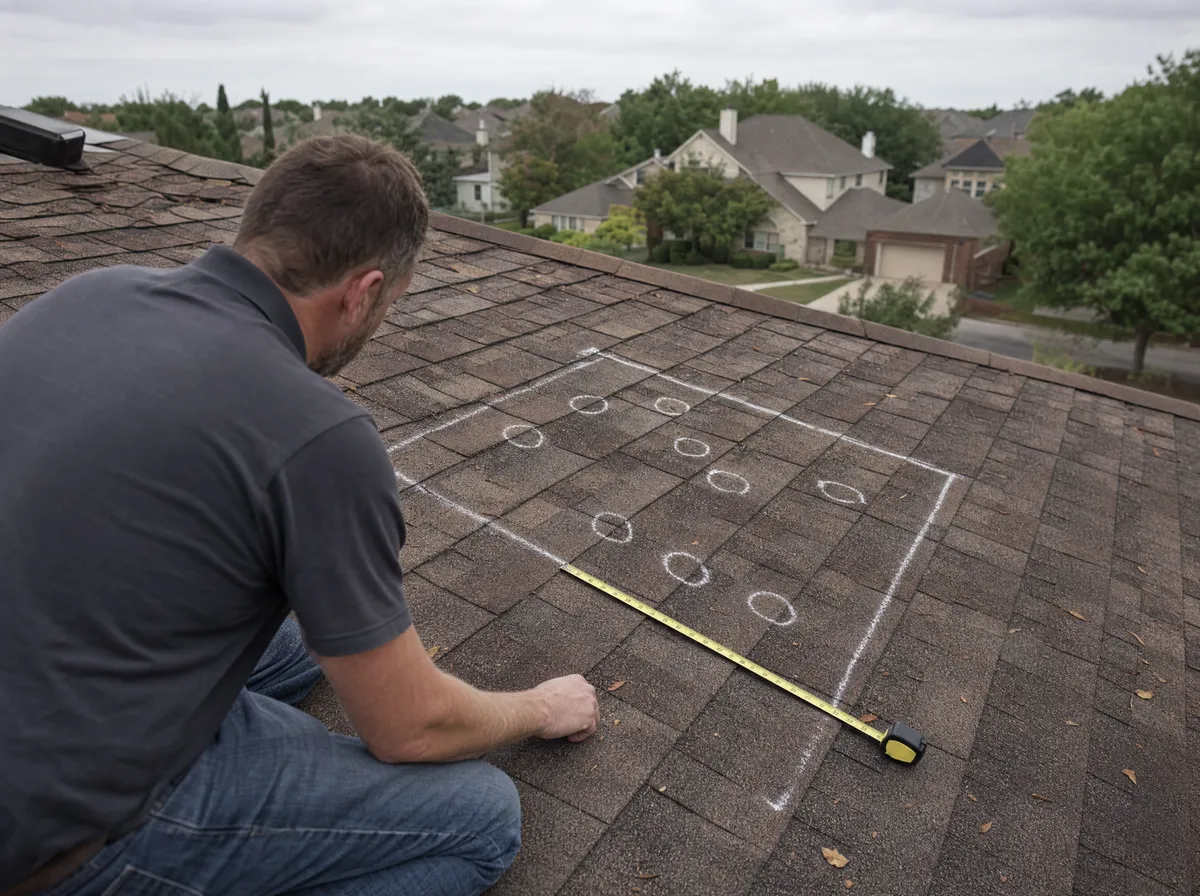 A scored test square. Eight or more functional strikes here is the difference between a repair and a slope replacement.
your deductible is yours. the law is not subtle about it.
Whatever the carrier pays, you pay the deductible, and in Texas that is typically 1 to 2 percent of dwelling coverage, so $3,000 to $7,500 on most DFW homes. TDI’s page on the subject is titled “Is it OK for a contractor to waive my deductible?” and answers itself: “No. A deductible is part of your home insurance policy. It’s illegal for contractors to waive your deductible or help you avoid paying it.” TDI names the two common schemes, inflating the estimate so the insurance payment covers the deductible and offering a rebate that matches it, and notes that contractors who do it “could be fined or go to jail.”
It also matters on your end: “Your insurance company can ask for proof that you paid your deductible before it pays the full amount of your claim,” and TDI lists a canceled check, money order receipt, credit card statement, or “a copy of the payment plan with your contractor” as acceptable proof. A roofer who offers to “handle” your deductible is offering to put your claim at risk. TDI also asks homeowners to check one thing with their agent before a storm: “Ask your agent if the deductible for wind and hail damage is different than the deductible for other types of damages.” In North Texas it often is, and it is often higher.
does a new roof lower your premium? usually. here is how.
The one piece of good news on the insurance side: the roof you put on can cut what you pay every year after. Most Texas carriers discount the windstorm portion of the premium for a UL 2218 Class 4 impact-rated shingle, typically 5 to 28 percent depending on the carrier, and that usually recovers the Class 4 upgrade cost inside four to seven years. The Class 4 discount guide has the paperwork most agents need to apply it.
A newer roof also rates better than an old one in general, and it resets the age clock on those ACV endorsements and roof schedules. If you are replacing on a claim anyway, the incremental cost of Class 4 over standard architectural is the cheapest insurance decision you will make this decade.
when to file, and when not to.
File when a named storm hit your area, you can document the date, the damage is visible in the field and on the soft metals, and the roof is not already on an ACV schedule that makes the payout smaller than the deductible. Do not file for age, for cosmetic-only marks, or for a single small leak on an old roof, because the denial stays in your history and a second claim in a short window can push you into a higher rate tier or non-renewal.
If you are not sure which side you are on, that is exactly what the free inspection is for. We tell homeowners “this is not a claim, this is a repair” more often than the reverse, and the repair vs. replacement math shows how we decide.
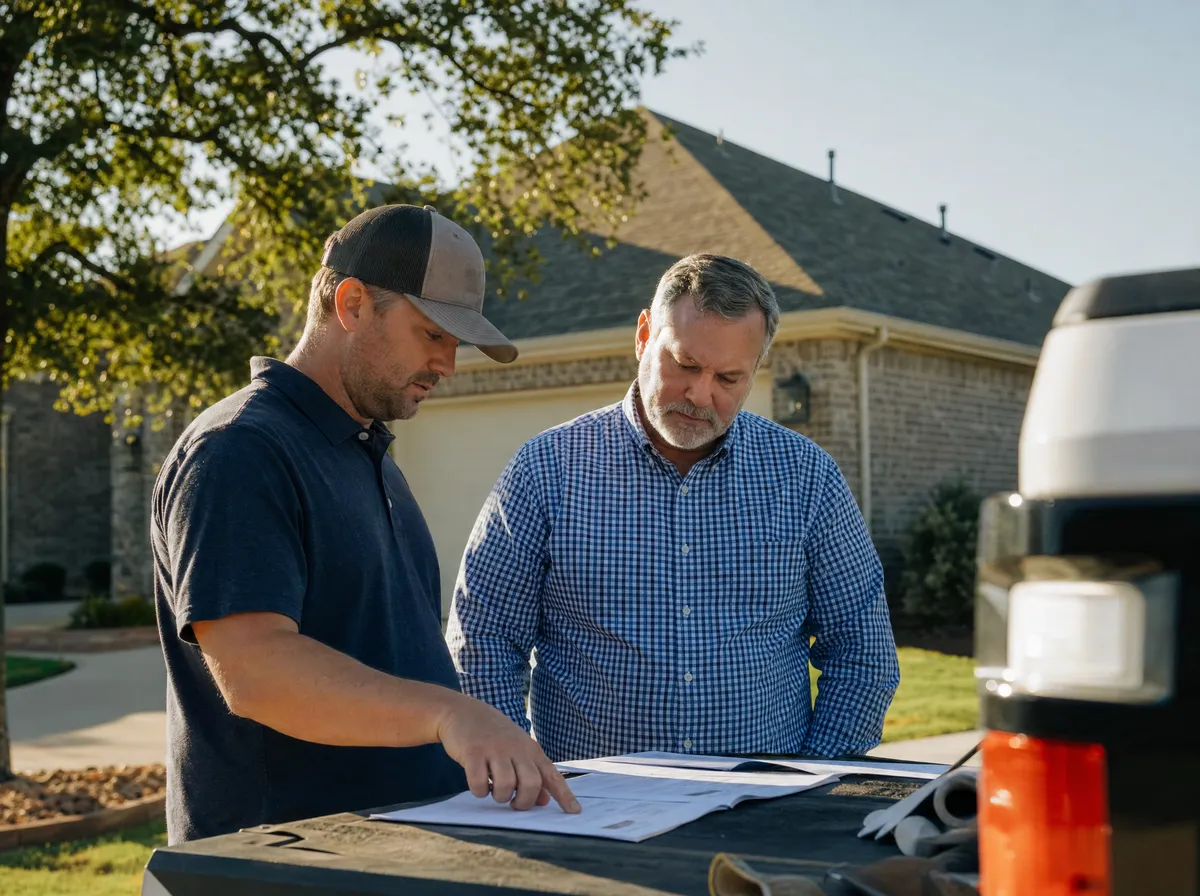 The paperwork review: policy type, deductible, endorsements, and the storm date, before anyone calls the claims line.
how roof raiders handles a claim, and what we do not do.
We meet your adjuster on the roof. We document every slope, pull the storm data for your address, photograph the soft metals, and hand over a written report before the inspection. We complete the work to the approved scope, file supplements when the first scope misses code-required items like ice and water shield or ridge vent, and submit the final invoice so your recoverable depreciation is released. What we do not do is negotiate your claim, because Texas law reserves that for you and your adjuster, and we do not touch your deductible, because the law is equally clear on that.
Start with the step-by-step in how to file a roof insurance claim in Texas, then call (214) 326-3106 for the free inspection. If the roof is a claim, we will say so and be on the roof with your adjuster. If it is not, we will say that too, and the roof replacement page has the honest out-of-pocket numbers.
The question is never whether insurance covers roofs. It is whether a storm did this, what your policy pays on a roof this age, and whether the file proves it.
frequently asked questions.
Does homeowners insurance cover roof replacement in Texas? Yes, when a covered event such as hail or wind damaged the roof enough to meet the carrier’s replacement threshold. Never for age or wear. RCV policies pay the full job minus your deductible; ACV policies also subtract depreciation.
Will insurance cover a 20 year old roof in Texas? For storm damage, often yes, but frequently at actual cash value or on a roof surface schedule that pays a percentage of replacement cost. Check the declarations page for an ACV endorsement before filing.
How often will insurance pay for a new roof? Each separate covered storm with qualifying damage. Two or more claims within a few years can raise your rate tier or trigger non-renewal, so do not file for minor damage.
What do insurance companies look for before approving a roof replacement? A covered cause on a specific date, damage crossing the replacement threshold (roughly 25 percent of a slope in Texas), enough strikes in the test squares, and documentation that separates storm damage from wear.
Do I have to pay my deductible on a roof claim? Yes, in full. It is illegal for a contractor to waive or absorb it, and your carrier can require proof of payment before releasing the full claim.
Does a new roof lower my homeowners insurance? Often. Most Texas carriers discount the windstorm portion for a Class 4 impact-rated roof, typically 5 to 28 percent, and a newer roof rates better than an old one.