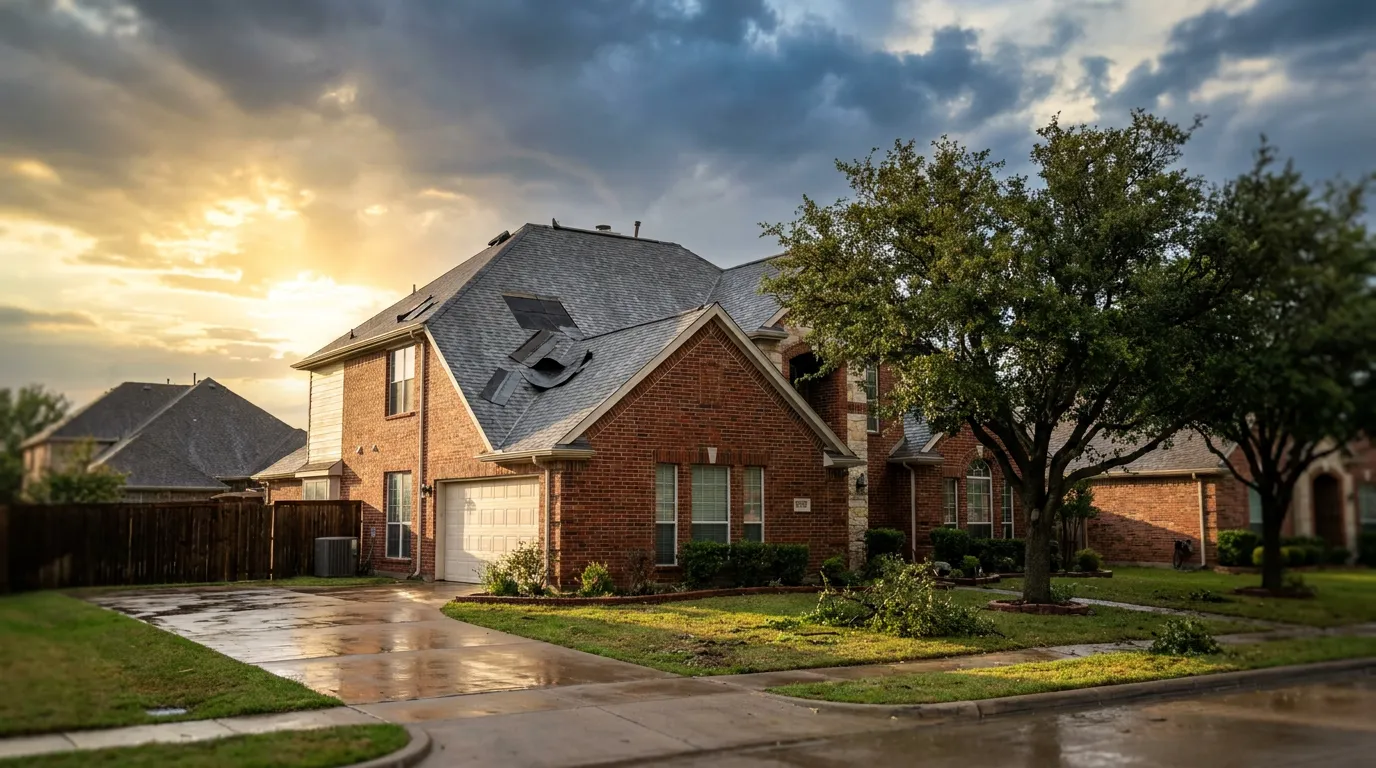
Here is the short version. Wind damage to a roof shows up as creased shingle tabs, courses lifted in a straight line, missing shingles with underlayment showing, displaced ridge cap, and piles of granules at the downspouts. Most of it is invisible from the driveway. It starts happening in gusts well under the numbers that make the news, most Texas homeowner policies cover it when it is documented properly, and the fix ranges from a $450 spot repair to a full replacement. The rest of this post shows you what each type of damage looks like, what wind speed causes it, and how to keep a carrier from calling it “wear and tear.”
I’m Mahmoud. My wife Sara and I started Roof Raiders in 2022, and wind and storm response is the work we built the company around. What follows is what our crews look for after every North Texas windstorm.
the six kinds of wind damage, from mild to bad.
Wind does not tear a roof apart all at once. It works on the weakest shingle first, and each stage looks different from the ground.
1. Broken seal strips. Every asphalt shingle has a strip of adhesive that bonds it to the one below. The Insurance Institute for Business and Home Safety calls the strength of that seal “the most important factor affecting high-wind performance” for self-sealing shingles. When a gust breaks it, the shingle lies back down and looks fine. It is not fine. It lifts again in the next storm, and water tracks under it in the next rain.
2. Creased tabs. A shingle that folded up in the wind and cracked along the fold. From the ground you see nothing. Up close you see a horizontal line across the tab, sometimes with a hairline crack and a strip of lost granules. A creased shingle is a torn shingle that has not finished tearing.
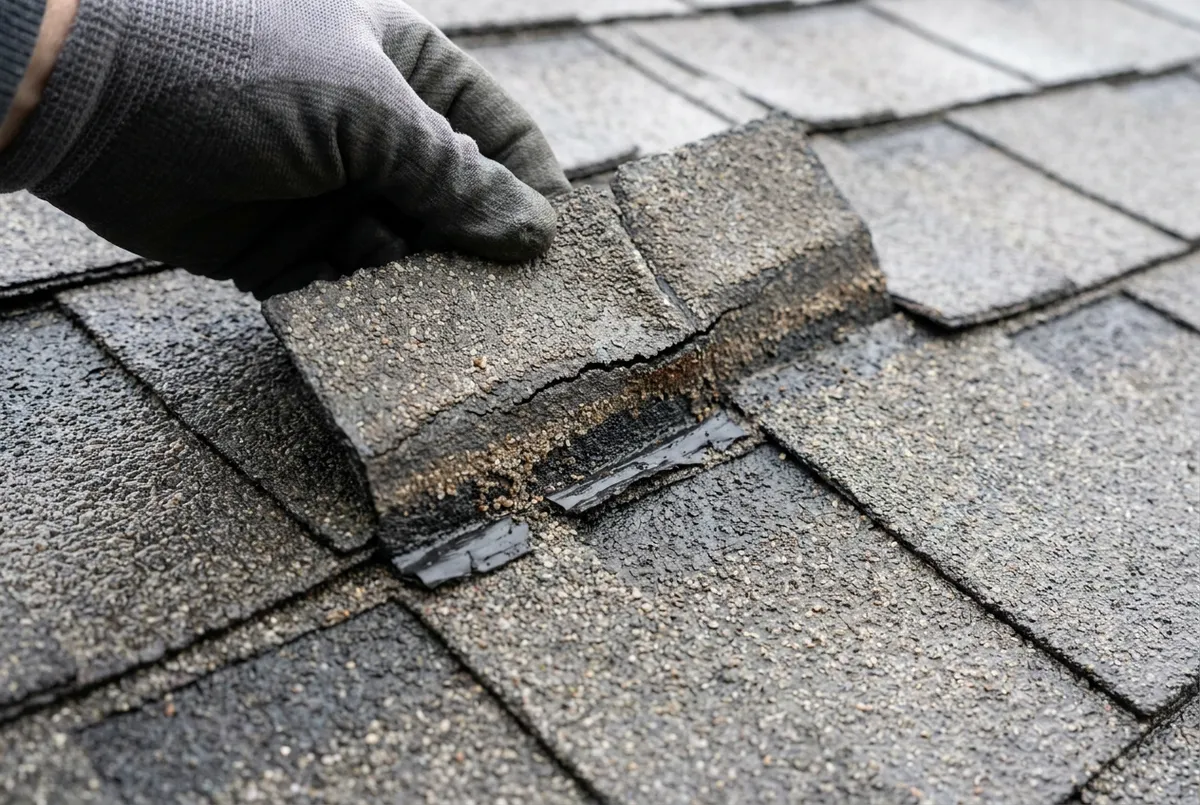
3. Zippering. Wind breaks the seal along an entire course and lifts it in a straight line across the slope, like a zipper. This is the most common wind damage we find on DFW roofs older than five years, and it is almost always on the slope that faced the storm.
4. Lifted or curled tabs. Shingles that stay up. These you can see from the yard with binoculars, usually along the eaves and rakes where the wind gets under the edge first.
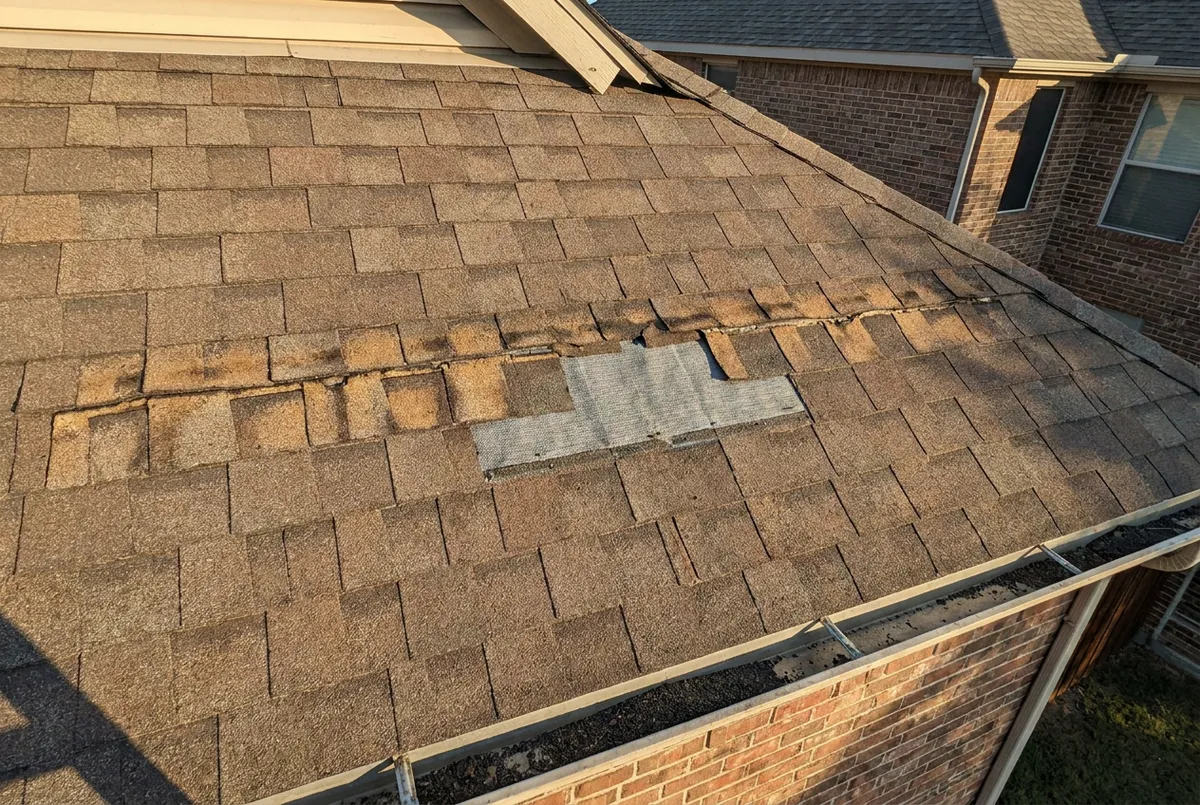
5. Missing shingles. Bare gray or black underlayment showing through, and shingle pieces in the yard or the neighbor’s pool. Once one shingle is gone, the wind has a handle on the next one.
6. Ridge and hip cap loss. The caps along the peak take the highest wind load on the roof. Displaced or cracked cap is the first thing I check from the street because it means the gust was strong enough to work on the rest of the slope too.
Two more signs that are not on the roof at all. Granules piled at the bottom of downspouts after a windstorm mean shingles were flexing hard enough to shed their surface. And a ceiling stain that shows up during the first heavy rain after a storm, not during the storm itself, is the classic sign that a seal strip broke and nobody noticed.
what wind speed actually damages a roof.
Homeowners assume it takes a tornado. It takes a thunderstorm.
The National Weather Service defines a severe thunderstorm as one producing winds of at least 58 mph or hail at least one inch in diameter. DFW averages 46.3 thunderstorm days a year according to NWS Fort Worth climate records, and a share of those clear the severe line every spring.
Here is how the numbers translate on an asphalt roof in my experience:
| Gust speed | What happens on the roof | How often DFW sees it |
|---|---|---|
| 45 to 57 mph | Aged or poorly sealed shingles lift and lose their seal strip | Routine spring gust front |
| 58 to 74 mph | Creasing, zippering, first missing tabs, ridge cap starts to lift | Several times a season |
| 75 to 89 mph | Widespread shingle loss, displaced ridge cap, fascia and soffit damage | Straight-line wind events, most years |
| 90 mph and up | Slopes stripped to the deck, decking exposed, tree strikes | Derechos and supercell outflow, every few years |
Shingle wind ratings explain why the low end of that table matters. Per Professional Roofing magazine, the ASTM D3161 fan test rates shingles at Class A (60 mph), Class D (90 mph), or Class F (110 mph), and the newer ASTM D7158 uplift test runs to Class H. But a rating only holds when the shingle is new, sealed, and nailed to spec. A ten-year-old roof that was installed with four nails and no starter course does not perform like the number on the wrapper.
why the slope facing the storm matters.
Almost every windstorm that hits North Texas comes out of the west, southwest, or northwest. So the damage lands on the west and south slopes first, on the corners where two slopes meet, and along the windward eave.
That tells you where to look. It also tells the adjuster where to look, which is why a good inspection documents every slope separately and names the storm direction in the report. A claim that says “wind damage on the west slope, consistent with the 78 mph gusts recorded during the April 9, 2024 event” survives review. A claim that says “some shingles are messed up” does not.
Our own tarp calls after the big DFW events tell the same story. The April 9, 2024 windstorm through Frisco and McKinney was almost all ridge cap, lifted shingles, and fascia on west-facing slopes. The May 28, 2024 derecho that crossed Arlington and east Tarrant County stripped whole slopes on older three-tab roofs.
the age problem nobody tells you about.
Wind damage is not random. It finds the oldest, hottest roof on the block.
IBHS research on shingle aging found that the seal strip is the failure point, and that unsealing increases with years in service. Add DFW heat. NWS Fort Worth records 20.2 days at or above 100 degrees in a normal year, and a shingle surface runs far hotter than the air. Asphalt loses its flexibility, the sealant dries, and by year eight to twelve a roof that was rated for 110 mph is lifting at 50.
This is also why carriers argue “wear and tear” on wind claims. If the shingles were already brittle, the adjuster’s position is that the storm just finished what age started. The Texas Department of Insurance notes that as roofs age, some companies switch coverage to actual cash value, and a roof in poor condition may not be covered at all. Know which policy you have before the storm, not after.
repair or replace: how we decide.
We repair when the damage is isolated to a few tabs or one course, the decking is dry, and we can still buy a shingle that matches your color and profile. Cash-pay wind repairs on our wind damage roof repair page run $450 to $4,800 depending on slopes, access, and ridge work.
We recommend replacement when any of these are true:
- Wind has broken the seal across a large share of a slope, even if the shingles are still there. An unsealed roof fails in the next storm.
- The shingle line is discontinued, so a repair leaves a mismatched patch that lowers resale value.
- Damage crosses the threshold your carrier uses to approve a full replacement. Our post on the Texas 25 percent rule explains how that math works.
- The roof is past fifteen years old and you are already looking at a second repair. At that point you are paying twice.
A full wind replacement on a 2,400 sq ft Plano home generally lands between $18,500 and $24,200. Every replacement we do gets the high-wind six-nail pattern, a sealed starter course, and a sealed ridge, so the rating on the wrapper is the rating on your roof. Going to Class 4 impact shingles at the same time usually adds $1,400 to $2,200 and can earn a windstorm premium discount with most Texas carriers.
the insurance part: what carriers pay and what they fight.
Most Texas homeowner policies cover sudden wind damage. What they exclude is gradual wear, poor maintenance, and installation defects, which is exactly where a weak claim ends up. Three things keep a wind claim in the covered column:
- A dated storm. Screenshot the NWS storm report or a local news wind map for your zip code the day it happens.
- Dated photos. From the ground and from the roof, with a tape measure for scale, taken inside the first 30 days.
- Slope-by-slope documentation that separates wind line items from hail. Wind and hail are paid as separate perils, and a wind-only scope can miss hail bruising worth thousands on the same roof.
Wind is also worth putting in context. Storm claims are not rare events in this state. State Farm alone paid $1.4 billion in Texas hail claims in 2025, more than any other state, and the same spring supercells that drop the hail bring the wind. Carriers handle a lot of these files. The ones that get approved on the first pass are the ones that arrive with the documentation done.
If you are new to the process, our step-by-step guide on how to file a roof insurance claim in Texas covers the adjuster meeting, ACV vs RCV, and supplements. And if water is already coming in, read what to do during an active roof leak first and call us for a tarp.
what to do in the first 48 hours after a windstorm.
- Walk the yard, not the roof. Look for shingle pieces, granule piles at the downspouts, and fallen ridge cap. Photograph everything where it lies.
- Check the attic with a flashlight. Daylight through the deck, wet insulation, or a damp smell means water is already in.
- Look at the west and south slopes from the street with binoculars or a phone zoom. Lifted tabs and bare underlayment show from there.
- Book a free inspection before you call your carrier. Our roof inspection puts a crew lead on every slope with a camera and a chalk stick and gets you a 30-plus photo PDF within 24 hours, so you open the claim with the evidence already in hand.
- Tarp active leaks immediately. Carriers expect you to mitigate. An open roof that runs for three more days can cost you the interior portion of the claim.
frequently asked questions.
What wind speed causes roof damage? Aged or poorly sealed asphalt shingles can start lifting in gusts of 45 to 57 mph. The National Weather Service classifies 58 mph and up as severe thunderstorm wind, and DFW clears that number several times most springs. At 70 mph and above you get torn tabs, displaced ridge cap, and fascia damage.
Does homeowners insurance cover wind damage to a roof in Texas? Most Texas homeowner policies cover sudden wind damage to the dwelling. What they exclude is wear, age, and poor maintenance, which is where a poorly documented claim gets filed. Dated photos that tie creased or missing shingles to a specific storm are what keep a wind claim in the covered column.
Can wind-damaged shingles be repaired instead of replaced? Yes, when the damage is isolated, the decking is dry, and a matching shingle is still made. Once wind has broken the seal across a large share of a slope, or the shingle line is discontinued, a repair leaves an unsealed roof with a mismatched patch, and replacement is the honest answer.
How do I tell wind damage from hail damage? Wind damage runs in lines and patches: creased tabs, lifted courses, and missing shingles, usually on the slopes facing the storm. Hail damage is scattered round bruises and dents across a whole slope, plus dings on soft metals like gutters and vents. Many DFW storms leave both, and they are filed as separate perils. Our guide to spotting hail damage covers the hail side.
How long do I have to file a wind damage claim in Texas? Read the duties-after-loss section of your policy. Many Texas policies allow up to a year from the date of loss, and some have shortened that window. Either way, document the roof inside the first 30 days. The longer the gap between the storm and the photos, the harder the adjuster will push back.
Should I get on the roof to check for wind damage? No. Wind-damaged shingles are loose underfoot and decking can be soft after a leak. Walk the yard for shingle pieces and granules, check the attic for daylight or wet insulation, and let a roofer with a ladder and a harness do the slope work.
Worth knowing before you settle for a patch: when wind creasing shows up across multiple slopes on a roof that has already been through a few DFW hail seasons, carriers often scope the loss as a full replacement rather than a spot repair. The repair-or-replace math, cost ranges, and tear-off timeline are on our roof replacement page.
If a storm just came through and you are not sure what you are looking at, call us at (214) 326-3106. We will put a crew lead on the roof, photograph every slope, and tell you honestly whether it is a $450 repair, a claim worth filing, or nothing at all. The inspection is free either way, and we would rather tell you “your roof is fine” than talk you into a claim you do not need.