Key takeaways
- North Texas hail season runs March through June and peaks in April and May, when DFW averages 5.8 and 7.6 thunderstorm days a month. A smaller second window returns in October.
- Texas logged 902 major hail events in 2025 (stones 1 inch or larger), more than Kansas and Oklahoma combined, and State Farm alone paid $1.4 billion in Texas hail claims that year.
- The first 72 hours decide the claim: ground photos with a size reference inside the first hour, a professional tarp on any active leak, the claim opened within 48 to 72 hours, and nothing signed at the door.
- A clean DFW hail claim runs 30 to 90 days from the first photo to the depreciation check. We document the damage and meet your adjuster on the roof. The settlement itself stays between you and your carrier.
- Hail is why DFW architectural roofs last 18 to 22 years instead of the 30 on the wrapper, and why Class 4 shingles at $5.50 to $6.50 per square foot are the one pre-season upgrade that pays for itself.
Hail season in Texas runs roughly March through June, and in Dallas-Fort Worth the peak lands in April and May, when the same supercells that produce most of our tornadoes drop the largest stones. A smaller second season shows up around October on strong fall fronts. The rest of the year is not hail-proof, just quieter.
hail season in north texas is a spring problem.
I’m Sara Bannat. My husband Mahmoud runs our crews and I run operations, which means I am the one on the phone with adjusters from State Farm, Allstate, USAA and Farmers from the first week of March until the last fall claim closes. Hail season is the reason Roof Raiders exists, so here is how it actually behaves in North Texas.
The National Weather Service office in Fort Worth puts it plainly in its write-up of the May 5, 1995 Mayfest storm: thunderstorms that produce large hail “can occur throughout the year, but are most common in the spring months.” That storm dropped softball-size hail on Tarrant and Dallas counties, injured more than 400 people and caused about $2 billion in damage, according to NWS Fort Worth.
The monthly numbers back that up. The NWS Fort Worth tornado climatology for North and Central Texas (1950 to 2025) counts 215 tornadoes in March, 555 in April, 525 in May and 154 in June, then a secondary bump of 145 in October. Hail and tornadoes come out of the same supercells, so that curve is a fair map of hail risk too. DFW’s own climate record shows the same shape in thunderstorm days: 4.0 in March, 5.8 in April, 7.6 in May, 6.3 in June, then 3.3 in October, per the NWS DFW annual normals.
April and May account for more North Texas tornadoes than the other ten months combined, and hail rides the same storms. If you own a roof here, those are the two months that matter.
The scale is the other half of the story. The Insurance Information Institute reports Texas led the nation with 902 major hail events in 2025, counting only stones 1 inch or larger, out of 5,432 nationwide. Kansas was second at 375. State Farm paid more than $5.6 billion in hail claims in 2025, and Texas led its list at $1.4 billion. One carrier, one state, one year.
the dfw hail calendar, month by month.
Here is how a typical year goes in Collin, Dallas, Denton and Tarrant counties. The thunderstorm days are DFW’s long-term monthly averages from the NWS record. The last column is what we tell our own customers to do in each window.
| Month | Avg thunderstorm days (DFW) | What usually happens | What to do |
|---|---|---|---|
| January | 1.4 | Cold fronts and ice, not hail. Crews have open calendars. | Book your inspection and any replacement. Cheapest window of the year. |
| February | 2.0 | First warm, humid days. Isolated hail possible late in the month. | Finish pre-season repairs, clean gutters, take baseline photos of the roof and yard. |
| March | 4.0 | Season opens. Dry lines and the first severe days. | Pull your declarations page, confirm your wind and hail deductible, save the claims line in your phone. |
| April | 5.8 | Peak month one. April 11, 2016 (Wylie), April 9, 2024 (Plano, Allen, Wylie), April 27, 2026 (northeast Dallas County, Rockwall). | After any storm: ground photos within the hour, inspection within days. |
| May | 7.6 | Peak month two and the most thunderstorm days of the year. Mayfest 1995, May 28, 2023, May 23, 2024. | Same drill, and expect adjuster queues to stretch after a big event. |
| June | 6.3 | Season tapers, but the biggest stones often land now. June 17, 2024. | Keep documenting. File inside 30 days of the storm. |
| July | 4.7 | Heat. Pop-up storms, rarely large hail. | Build season for approved claims. Single-story replacements finish in a day. |
| August | 4.7 | More of the same. Attic heat is aging your shingles. | Fix small repairs, check pipe boots and seal strips. |
| September | 3.3 | First fall fronts. | Schedule a pre-fall inspection if spring damage was never checked. |
| October | 3.3 | Second season. Strong fronts bring severe weather back. | Repeat the March checklist. Fall claims usually get an adjuster faster. |
| November | 1.9 | Quiet. | Replace or repair before winter. Pricing and scheduling favor you. |
| December | 1.3 | Quiet. | Same. If the roof is past 15 years, this is the month to decide. |
The dates in that table are not decoration. The April 11, 2016 storm damaged roughly 80 percent of the homes in Wylie, caused more than $300 million in damage and set the record for the largest hailstone in the NWS Fort Worth forecast area at 5.25 inches, per NWS Fort Worth’s event summary. The May 28, 2023 storm hit west Plano and the Legacy area hardest. April 9, 2024 ran through Plano, Allen and Wylie. June 17, 2024 produced the largest claims and the longest adjuster waits we have seen. And in the last week of April 2026, NWS Fort Worth’s preliminary summary logged teacup-size hail in northeast Dallas County and Rockwall County on April 27, with softball-size hail elsewhere in North Texas the same week.
The October window is smaller but real. Because it comes after the spring crews have cleared their backlog, a fall claim usually gets a field adjuster and a build date faster than an April one.
the first 72 hours decide the claim.
Everything below assumes the storm has passed and you are safe. Stay off the roof. Our foremen slip on wet, bruised shingles, and they do it for a living. The full hour-by-hour version lives in our Plano hail storm checklist. This is the condensed one.
Hour 0 to 1: photograph the ground before it melts. Hail size matters more than any other variable in your claim, and the evidence is gone in 20 minutes on an April afternoon. Lay a quarter, a golf ball or a tape measure next to the largest stones you can find. A quarter is 1 inch, which is the National Weather Service threshold for severe hail. A golf ball is 1.75 inches. A baseball is 2.75 inches. Note the time the storm started and ended, because carriers match your claim to radar and a wrong date can push you onto a different storm with a different deductible.
Then walk the perimeter and shoot everything: gutters and downspouts, window screens, AC condenser fins, the garage door at a low angle, fence pickets, patio furniture, cars. Zoom in on the soft metals on the roof from the ground: lead pipe boots, vent caps, valley metal. If you are not sure what counts, our guide to telling if hail damaged your roof covers the 10 ground-level signs adjusters look for.
 A dented aluminum gutter is one of the first things an adjuster checks. Aluminum dents at about 1 inch of hail, the same size that bruises a shingle.
Hour 1 to 4: tarp active leaks, professionally. If water is tracking down a rafter in the attic, set a bucket and a towel under it and call for an emergency roof tarp. Do not climb up with a blue tarp from the hardware store. Your policy has a duty to protect the property from further damage, and most carriers reimburse a professional tarp as mitigation. Keep the receipt.
Hour 4 to 24: pull the official storm report. NOAA’s Storm Prediction Center publishes a daily log of every spotter report of hail, with the time, county and stone size, and the NWS Fort Worth office posts event summaries for the big ones. Search your storm date, screenshot the entries closest to your address, and save them with your photos. That page is your storm-date evidence if a desk adjuster ever argues the damage came from a different day. Save doorbell camera footage to a drive the same day, because default retention is short.
Day 1 to 3: open the claim. Call your carrier’s claims line, not your agent. Say that you had hail at the property on the storm date, that you have photos with a size reference, and that you want a field adjuster. Do not say the roof is old, do not guess at the damage, and do not ask them to just send a check. Write down the claim number and the desk adjuster’s direct line. The complete script and the mistakes that get claims denied are in our Texas roof insurance claim guide.
All 72 hours: sign nothing at the door. Within an hour of a hail event, the trucks roll onto Preston Road and Coit. Magnetic door signs, out-of-state plates, “we’re already doing your neighbor’s house.” State Farm’s own advice after the 2025 season was to watch for contractors who go door to door after storms and to contact your insurer before signing any repair contract. Two things to refuse on sight: a contingency contract that locks you to their company if the claim is approved, and any offer to waive or absorb your deductible, which is illegal in Texas and makes you part of the fraud.
Photos with a quarter next to the stone, taken before it melts, do more for a hail claim than any sales pitch on your porch.
how a texas hail claim runs, and how long it takes.
Texas Insurance Code 4102.163 keeps roofing contractors out of the claim settlement itself. That is the law, and it is also how we prefer to work. We document the damage, we meet your adjuster on the roof, and the settlement conversation stays between you and your carrier. Here is the timeline we see across DFW on a claim that goes smoothly.
| Step | Typical timing in DFW |
|---|---|
| Ground photos and a written roofer inspection | Day 0 to 3 |
| Claim opened with the carrier | Within 48 to 72 hours of the storm |
| Field adjuster on site (your roofer on the roof with them) | 5 to 15 business days after filing, 14 to 25 days after a major event |
| Scope of loss arrives | 2 to 10 days after the adjuster visit |
| Supplement for missed items approved | 7 to 30 days, depending on carrier |
| Build day | 2 to 6 weeks after contract. One day for a single-story, two for a two-story. |
| Depreciation check released | 14 to 30 days after the completion invoice |
| Start to finish | 30 to 90 days clean, 90 to 180 if anything is disputed |
The adjuster meeting is the hour that decides the claim. The adjuster is one person on a 12-stop day working from a checklist. Our foreman is up there with a chalk wheel and the photos from the earlier inspection, marking test squares and pointing out the back slope, the soft metals, the ridge cap. Nothing gets missed because nothing is left to memory.
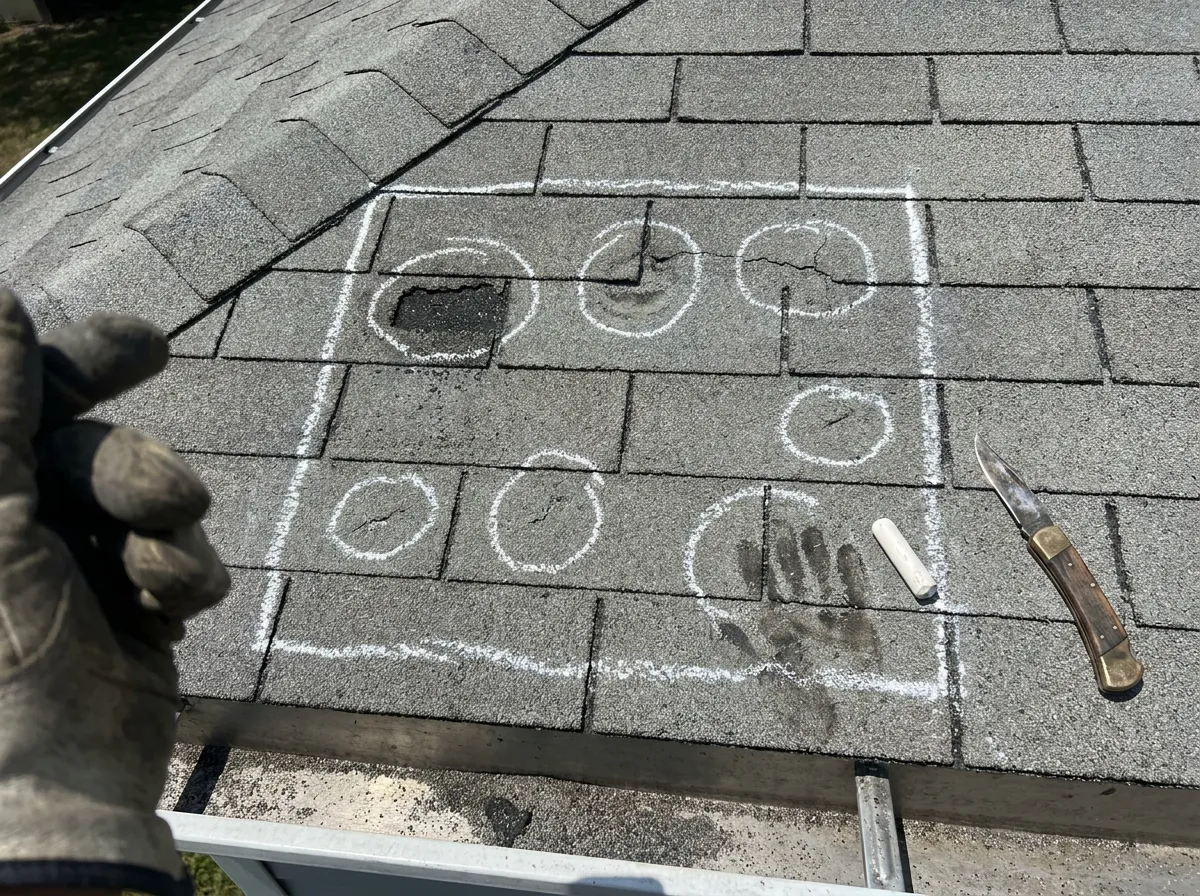 A chalked test square with hail strikes circled. Eight or more functional strikes inside a 10 by 10 foot square is the usual threshold for a full replacement.
Two rules shape what the carrier approves. Carriers generally look for damage across roughly a quarter of a slope before they write replacement over spot repair. And once a repair touches more than 25 percent of the roof area inside a 12-month window, Texas code requires the whole roof to come up to current standards, which is what turns a two-slope hail claim into a full tear-off with a code upgrade supplement. Our plain-language guide to the Texas 25 percent rule walks a real Plano scope through it line by line.
Your first check is actual cash value, the depreciated number minus your deductible. The depreciation check comes after the work is done and the carrier gets the completion invoice. On a 15-year-old roof that gap can be thousands of dollars, so do not cash the first check and walk away. Most full DFW replacements land between $14,500 and $32,000, and on an approved claim at replacement cost, your out-of-pocket is the deductible.
why dfw roofs rarely reach their design life.
The shingle wrapper says 30 years. In North Texas an architectural shingle roof lasts 18 to 22, a three-tab 12 to 15, a Class 4 impact-rated roof 20 to 25, and standing seam metal 40 or more. The gap is heat, a 150-degree attic, and hail. Our Texas roof lifespan guide has the full table and how to find your roof’s age.
Hail does two things. A storm big enough to total the roof replaces it through a claim at year eight or twelve, and the homeowner never learns how long the shingle would have lasted. A storm too small to total it leaves bruises, and every bruise is a coin-size spot with the granules gone and the asphalt exposed to UV. Those spots age at triple speed. A roof that took “cosmetic” hail at year five is not a 20-year roof anymore.
Wind rides with hail, too. The same late-April 2026 storms that dropped softball-size stones produced straight-line wind damage across Parker County, and a creased shingle with a broken seal strip leaks long before it blows off. Our wind damage guide covers what that looks like from the ground.
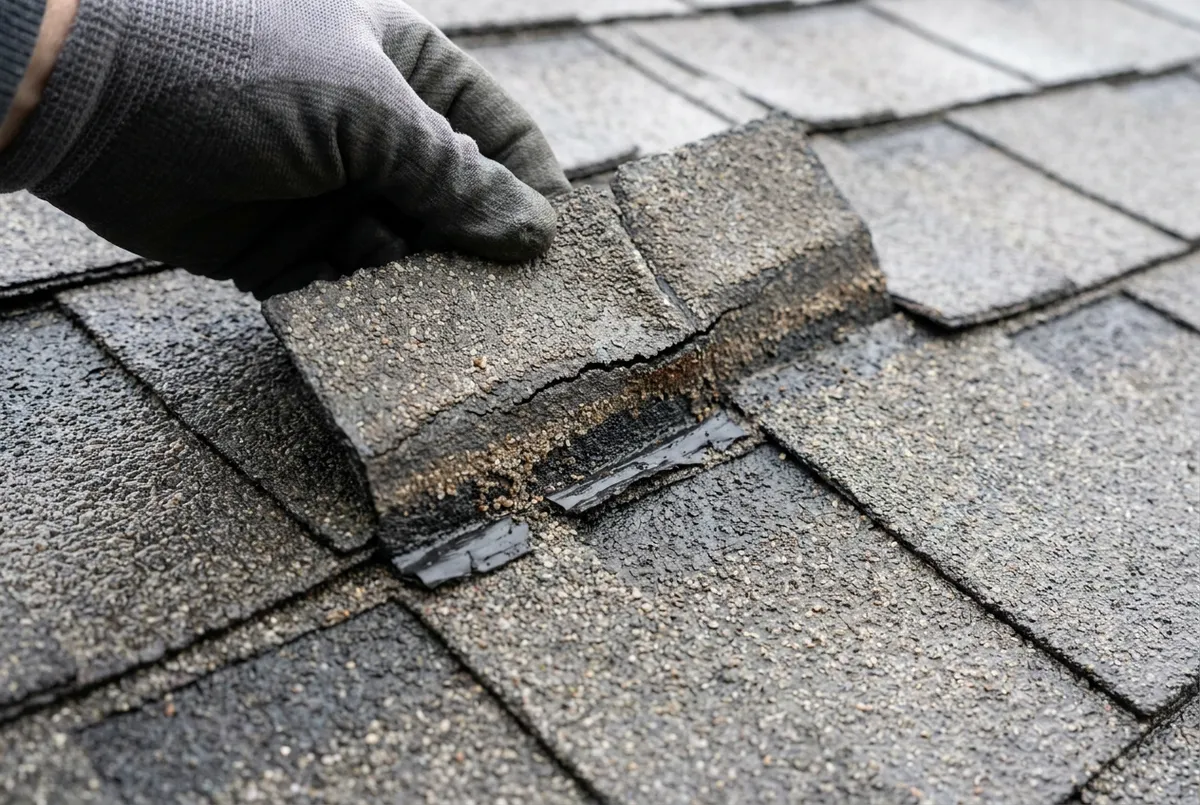 A creased shingle tab with a broken seal strip. Wind damage usually arrives in the same storm as the hail and belongs on the same claim.
In DFW, the question is rarely whether your roof will wear out. It is which April totals it, and whether the claim is documented well enough to pay for a full replacement.
If you are not sure what year your roof went on, our how old is my roof guide walks through permits, appraisal district records and the date stamp on the shingle itself.
the storm chaser checklist, condensed.
Plano, Frisco and McKinney get the most aggressive door knocking in DFW after every event. Higher home values, denser rooflines, faster approvals. The full version with the door scripts is in our storm chaser guide. The short version:
- Out-of-state plates or a rental truck with a magnetic sign.
- A contingency agreement or assignment of benefits handed to you on the porch.
- Pressure to sign today, before your adjuster has seen the roof.
- No office you can drive to. Ours is at 7950 Legacy Dr in Plano.
- Vague credentials. Ask for current general liability and workers’ comp certificates and a manufacturer certification. We are CertainTeed ShingleMaster, a credential fewer than 3 percent of US roofers hold.
- A bid far under or far over the others, with no line items.
- Any mention of covering your deductible. End the conversation.
A real local roofer will tell you to take your time, meet your adjuster with you at no charge, and still be here next April. If your roof took hail or wind, our hail damage roof repair and storm damage roof repair pages cover what the inspection report includes and what we hand the adjuster.
get ready before march, not after the first storm.
Everything above is reaction. The homeowners who come through hail season with the least stress did four things in the winter.
1. Get a free inspection in January or February. A written report with photos of every slope is your baseline. When the adjuster asks whether the damage is new, you have dated proof of what the roof looked like before the storm. We walk the roof, date it, and give you a remaining-life estimate. If it has five good years left, we say so.
2. If you are replacing anyway, go Class 4. Architectural shingles run $3.50 to $5.50 per square foot of roof installed in DFW. Class 4 impact-rated shingles run $5.50 to $6.50, or $65 to $110 more per square over a Landmark roof. On a 2,400 sq ft Plano home, Landmark Pro runs about $22,000 and the Class 4 version about $24,500. Most Texas carriers discount the wind and hail portion of the premium for a Class 4 roof, so ask your agent for the number before you choose. Our Class 4 shingles post runs the payback math, and the shingle roofing page covers the CertainTeed lines we install.
3. Clean and secure the gutters. Gutters are both drainage and evidence. A clogged gutter overflows into the fascia during a May downpour, and a loose one tears off in the straight-line winds that travel with hail. Our Dallas gutter service handles cleanouts, re-hangs and replacement before the season.
4. If the roof is past 15 years, replace it in the November to February window. Insurance pays for storm damage, never for age, and a 20-year-old roof that finally gets totaled may pay at actual cash value only. Winter is the cheapest and fastest time to schedule a full roof replacement. The complete breakdown by home size, pitch, shingle tier and county is in our Texas roof replacement cost guide, and the free roof cost calculator will give you a number for your own address in about a minute.
frequently asked questions.
What month is hail most common in Dallas? April and May. The NWS Fort Worth climatology counts 555 North and Central Texas tornadoes in April and 525 in May out of 1,953 since 1950, and hail rides the same supercells. DFW averages 5.8 thunderstorm days in April and 7.6 in May, the two highest months of the year. March and June bracket the peak, and October brings a smaller second window.
Does insurance cover hail damage in Texas? Yes. Hail is a covered peril on standard Texas homeowner policies, so a hail-damaged roof is paid minus your wind and hail deductible, which is usually 1 to 2 percent of the dwelling coverage. The catch is roof age. Past 15 years, many carriers pay actual cash value only, which subtracts depreciation. Insurance never pays for a roof that simply wore out, and a contractor cannot legally absorb your deductible.
How long after a hail storm can you file a claim in Texas? It depends on your policy, not a single statewide number. The deadline is written into your policy under duties after loss, and carriers have shortened those windows in recent years, so read your declarations page the week of the storm. In practice the clean window is weeks, not months. Fresh damage is easy to prove, adjuster queues fill fast after a DFW event, and carriers question causation on claims filed late.
Is Texas the worst state for hail? By count, yes. The Insurance Information Institute reports Texas led the nation with 902 major hail events in 2025, stones 1 inch or larger, out of 5,432 nationwide. Kansas was second at 375. State Farm alone paid $1.4 billion in Texas hail claims that year. North Texas sits in the busiest part of that map, which is why DFW roofs are replaced by storms long before they wear out.
What size hail damages a roof? One inch, quarter size, is the National Weather Service threshold for severe hail, and it is enough to dent aluminum gutters and bruise a standard asphalt shingle. At 1.25 inches and up you are usually in claim territory, and 1.75 inch golf-ball hail will fracture the mat on most architectural shingles. Class 4 impact-rated shingles are built to take hits that bruise a standard shingle, which is why they earn a carrier discount.
Should I replace an old roof before hail season or wait for a storm? If the roof is past 15 years, replace it in the November to February window and do not wait on a storm. Insurance pays for storm damage, never for age, and a 20-year-old roof that finally gets totaled may pay out at actual cash value only. A winter replacement in architectural shingles runs $3.50 to $5.50 per square foot, crews have open calendars, and you go into April with a roof that can take a hit.
Whether a storm just came through or you want the roof looked at before March, the inspection is free, the report is written, and nobody on our team works on commission. Call (214) 326-3106, run your address through the free roof cost calculator, and ask about in-house payment plans on qualified projects if a replacement is the answer. We serve 42 DFW cities from Plano, and we will still be here next hail season.