Key takeaways
- The most reliable answer is a re-roof permit on file with your city. Plano files them through eTRAKiT, Dallas through the DallasNow portal, Frisco through its Plans and Permits portal, McKinney through the city's online portal, and Fort Worth through Development Services.
- The Texas seller's disclosure (TREC form 55-1) has a line for roof type and approximate age, so your closing packet may already hold the answer.
- The appraisal district build year equals roof age only if the roof has never been replaced. In North Texas hail country, a 20-year-old home is often on its second roof.
- A roofer can bracket a roof's age within a few years from granule loss, seal strips and pipe boots, but cannot pull an exact install year from wear alone.
- Past 15 years, many Texas carriers move the roof to actual cash value, and past 20 some require replacement before renewal. Roof age is a money question.
The most reliable way to find out how old your roof is: pull the re-roof permit record from your city’s building department. No permit on file? Check the seller’s disclosure from your closing packet, then the appraisal district’s year built, and last, have a roofer read the shingles. All four take an afternoon and cost nothing in Dallas-Fort Worth.
I’m Mahmoud, co-owner of Roof Raiders with my wife Sara. The question we hear most on a first call, right after “what will it cost,” is some version of “how old is my roof?” Most homeowners in Plano, Frisco and Dallas honestly do not know, and the number they gave their insurance agent was a guess. Here is how to replace the guess with a date, cheapest method first.
Three reasons the date matters more here than in most of the country. Carriers ask for roof age on new quotes and at renewal, and price the policy on it. Buyers and sellers argue over it during the option period. And in DFW the honest lifespan of an architectural shingle roof is 18 to 22 years, not the 30 on the wrapper, so a roof that “feels fine” at 17 is closer to the end than it looks. Our guide on how long a roof lasts in Texas covers the lifespans; this post is about pinning down the start date.
start with the closing packet, not the ladder.
If you bought the house, look at the seller’s disclosure before anything else. Texas requires the seller of a previously occupied single-family home to give the buyer a Seller’s Disclosure Notice under Section 5.008 of the Texas Property Code, and the current TREC form 55-1 has a line in its first section that reads “Roof Type: ____ Age: ____ (approx.)”. Section 3 asks whether the seller knows of defects in the roof, and Section 4 asks about any previous structural or roof repair.
Three cautions. The seller fills it in from memory, and “approx.” is doing a lot of work on that line. New construction has no disclosure, so a Celina or Prosper build from 2022 skips this step (the roof is the house’s age). And an “unknown” is still useful: it tells you the seller did not pay for a roof during their ownership, which narrows the window.
Dig through the rest of the packet while it is open. The home inspection report from your option period usually states an estimated roof age and condition. If the previous owner replaced the roof as a condition of the sale, the amendment and the contractor’s invoice are in the same file. And if a prior owner replaced the roof through a hail claim, the carrier may have the year; your agent can sometimes pull it, which is worth one phone call.
the city permit is the record that settles it.
Most DFW cities require a permit to re-roof, and the permit record is the one source that is dated, tied to the address, and written by someone other than the seller. It shows the issue date, usually the contractor, and whether a final inspection closed it out. The final inspection date is your roof’s birthday.
A re-roof permit with a final inspection date is the closest thing your roof has to a birth certificate. An open permit with no final is a question mark on your property record.
The lookup works the same way everywhere: open the city’s permit portal, search by street address, filter to building or roofing permits, and read the most recent re-roof entry. If the portal search comes up empty, call the building department and ask for the permit history at your address. Here is where that portal lives in the five cities we get asked about most. Our DFW roof permit guide by city covers fees and turnaround times for the rest.
plano.
Plano’s Building Inspections office is inside the Plano Municipal Center at 1520 K Avenue, Suite 140, and the department answers at 972-941-7140. Residential re-roof permits are filed, and inspections scheduled, through the city’s eTRAKiT portal, so a past permit lives there too. Search the address, open the permit list, and look for the roofing entry with a final inspection date.
dallas.
City of Dallas roofing permits run through the Department of Development Services at the Oak Cliff Municipal Center, 320 East Jefferson Boulevard, Room 118, with online submission through the DallasNow (Develop Dallas) portal the city stood up in 2025. Most re-roofs file as a trade permit under the building division, so search that category rather than “building” when you look. If the DallasNow search comes up empty for a roof you know was replaced, ask Development Services for the permit history on the address. Historic district homes on Swiss Avenue, in Munger Place and State-Thomas also carry a Certificate of Appropriateness from the Landmark Commission, which is a second dated record of the same roof.
frisco.
Re-roof permits in Frisco go through the Building Inspections Division at Frisco City Hall, 6101 Frisco Square Blvd, 3rd Floor. Intake moved to an online Plans and Permits portal, and a like-for-like shingle replacement issues as a residential self-service permit without a separate plan review. The upside for you is a simple record: one permit, one final inspection. Search the address in the portal and read the final inspection date.
mckinney.
McKinney’s Building Inspections division sits at 401 E. Virginia Street, a short walk from the historic courthouse square, open Monday through Friday, 8 a.m. to 5 p.m., and reachable at 469-617-4800. Permits, payments and inspection requests all run through the city’s online portal, which is also where a past re-roof permit shows up. Stonebridge Ranch and Eldorado homes built before the early 2000s have usually been re-roofed at least once, so expect more than one entry and read the newest.
fort worth.
Fort Worth’s Development Services Department handles every residential roofing permit from the Permit Center on the lower level of City Hall, off Throckmorton Street. Search your address through the city’s permit system, or ask the Permit Center for the history. Pay attention to status here: Fort Worth closes a permit with a final inspection, usually within a few business days of completion, and an open permit with no final means a contractor finished and left, or never finished. That open permit stays on your property record and can complicate a sale or refinance.
One more thing about an empty search. No permit on file leaves the question open rather than answering it. A storm-chasing crew may have skipped the permit, which happens after every big hail season, or the work may predate online records. Treat “no permit” as “unknown” and move on to the next two methods.
the appraisal district dates the house, not the roof.
Every DFW county has an appraisal district with a free public search, and every record lists the year the home was built. That is a ceiling on roof age, since the roof cannot be older than the house. It equals the roof’s age only if nobody has ever re-roofed, which in North Texas hail country is a big “if.”
- Dallas County: the Dallas Central Appraisal District appraises property for 61 local governing bodies in Dallas County and lets you find a property by street address (address number, direction, street name, city).
- Collin County (Plano, Frisco, McKinney, Allen, Wylie): the Collin Central Appraisal District, where you search the CCAD appraisal database for property and value information.
- Tarrant County (Fort Worth, Arlington, Keller, Southlake): the Tarrant Appraisal District, which handles 73 taxing units and searches by property address or owner name.
- Denton County (Denton, Lewisville, Flower Mound, Little Elm): the Denton Central Appraisal District public portal.
Frisco and the west edge of Plano straddle the Collin and Denton county line, and the City of Dallas spills into Collin and Denton as well, so if the first district search misses your address, try the neighbor.
Why build year is not roof age: a 1998 Stonebridge Ranch home in McKinney has lived through enough hail seasons that it is probably on its second or third roof, and the appraisal record will still say 1998. Going the other way, some Lake Highlands and North Dallas ranches from the 1960s and 1970s are on three-tab roofs decades past service life, and for those the build year is uncomfortably close to the truth. The appraisal record is not a repair log. Use it for the build year and nothing more.
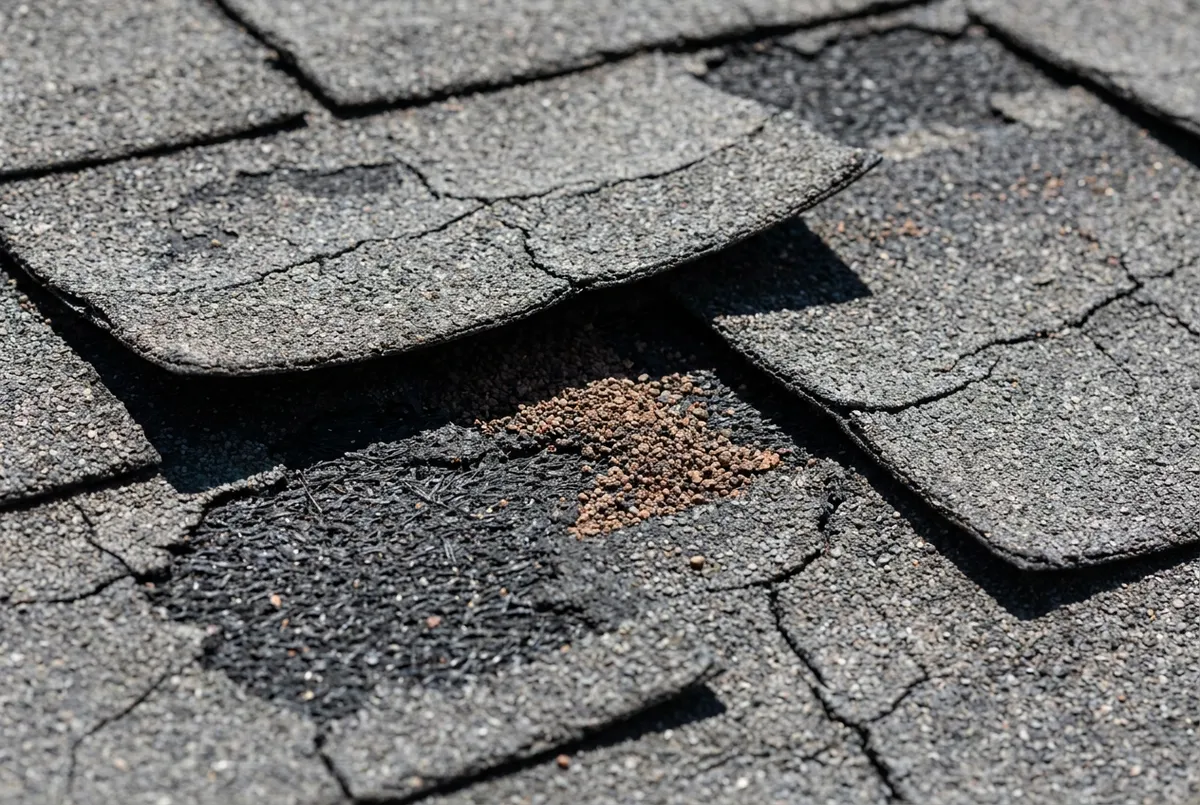 Curling, cupping and bare mat like this put a DFW architectural roof well into its second decade, whatever the paperwork says.
what the shingles themselves will tell you.
When the paperwork fails, the roof still talks. Here is what a roofer looks at, and where the limits are.
Wrapper and underside stamps. Shingle bundles ship in a wrapper printed with the product name, the plant and a date or lot code. Leftover bundles in the garage or attic are a gift, because that code puts the install within a season. Many shingles also carry a code on the underside, and a roofer can lift a tab at the rake and read it. Either way you are reading a manufacture date, not an install date, but shingles usually go on within months of leaving the plant, so treat it as a close bracket.
Granule loss. Asphalt shingles shed granules all their life. Bald patches the size of dinner plates, shiny black mat on the south and west slopes, and granule piles at the downspouts mean an architectural roof in DFW is deep into its second decade. A three-tab roof showing the same wear can be as young as 12.
Seal strips. The adhesive strip under each tab is what holds the roof together in a 58 mph gust. Tabs that lift freely on a warm afternoon mean the seal has aged out, which in our heat starts around year ten.
Pipe boots and accessories. Neoprene pipe boots crack around year ten. A roof with original boots that are still supple is younger than one with caulked, cracked or replaced boots.
Repair patches. A block of mismatched color, one slope newer than the other three, or two shingle profiles on one roof each mark a dated event. The patch is often hail or wind work from a specific storm, and the newer section can sometimes be matched to a permit or a claim.
Attic clues. Plank decking (individual boards with gaps) means the house was built before the mid-1980s. Several generations of nail tips through the deck mean the house has been re-roofed more than once. At the rake edge, two layers of shingles mean someone laid a new roof over the old one instead of tearing off, and the bottom layer is older than the top.
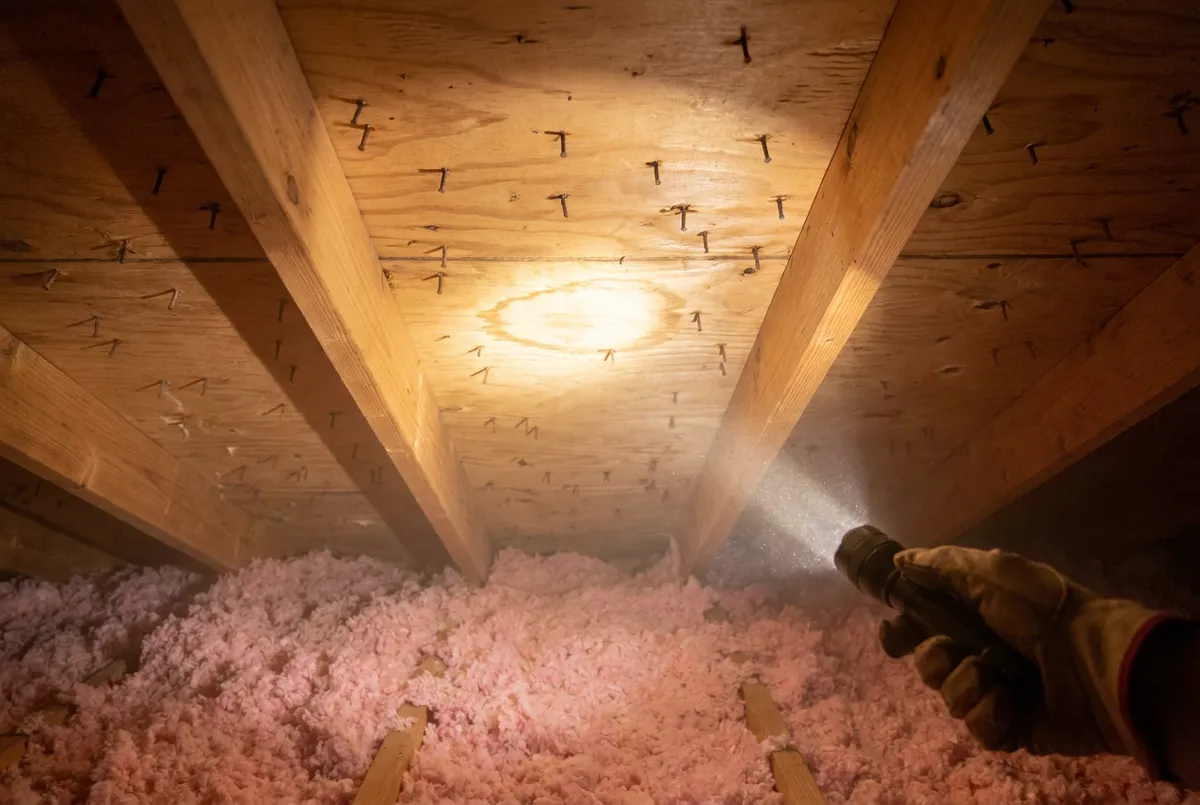 The attic tells you how many roofs a house has worn: nail tips, stain rings and the decking type all date it.
A roofer reads a roof the way a mechanic reads a tire. Wear tells you how much is left far better than it tells you the year it went on.
What a roofer can tell you: the material, whether it is a layover, an age bracket within a few years, how much life is left, and a written condition report your carrier will read. What a roofer cannot tell you: an exact install year from wear alone, whether the install was permitted, or the roof’s claim history. Anyone who hands you a precise year with no wrapper, no stamp and no permit is guessing with confidence. Our free roof inspection puts the age and remaining-life estimate in writing, and we tell you when it is a bracket rather than a date.
why roof age decides what your insurance pays.
This is where the question stops being trivia. Texas carriers ask for roof age on new quotes and at renewal, and the answer changes the policy you get. Across DFW the pattern looks like this:
| Roof age | What carriers usually do in DFW | What a totaled $22,000 roof pays |
|---|---|---|
| Under 10 years | Full replacement cost coverage is the norm | Replacement cost, minus your deductible |
| 10 to 15 years | Inspections requested at renewal; some apply a roof surface schedule that reduces payouts by age | Replacement cost on most policies, reduced on scheduled ones |
| 15 to 20 years | Many carriers move the roof to actual cash value only | Roughly $8,000 to $11,000 after depreciation |
| 20 plus years | Some carriers require replacement before they will write or renew | May be excluded until replaced |
The $22,000 figure is a 2,400 sq ft Plano home in CertainTeed Landmark Pro, and the Class 4 version of the same roof runs about $24,500. Our post on ACV vs RCV for Texas homeowners walks through the depreciation math, and will insurance pay for a new roof in Texas covers what a claim actually funds.
Insurance roof age is a number you will be held to. Get it from a permit, not a guess.
Guess young and the carrier may find out at claim time, when the adjuster lifts a tab and reads the same stamp we would. Guess old and you pay a higher premium, or accept actual cash value coverage you did not need. Keep the permit record, with its final inspection date, in the same folder as your policy. When a storm does hit, we document the damage slope by slope and meet your adjuster on the roof, and that age record is part of the file.
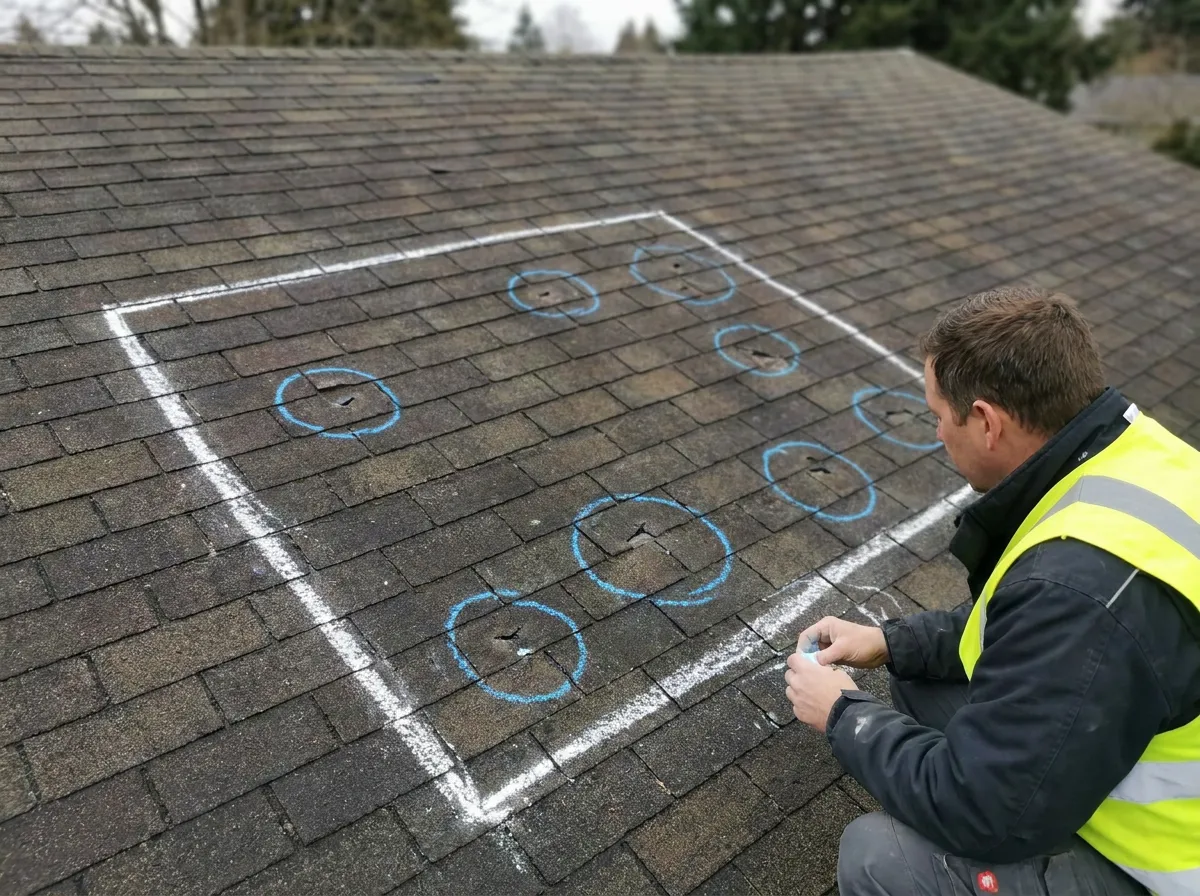 An adjuster scope in McKinney. The roof’s documented age decides whether these bruises pay out at replacement cost or actual cash value.
A new roof resets the clock. On many policies it moves you back from actual cash value to replacement cost coverage, and a Class 4 impact-rated roof usually earns a windstorm discount on top. Send the manufacturer certificate to your agent the week the install finishes.
the four methods side by side.
| Method | Where to look | How reliable | Cost |
|---|---|---|---|
| City re-roof permit | Plano eTRAKiT; Dallas DallasNow; Frisco Plans and Permits portal; McKinney online portal; Fort Worth Development Services Permit Center | Highest. Dated, tied to the address, closed by a city inspector | Free to look up (a new permit itself runs $95 to $300 depending on county) |
| Seller’s disclosure and closing packet | TREC form 55-1, “Roof Type / Age (approx.)” line; inspection report; repair amendments | Good when filled in, but it is the seller’s memory and marked approximate | Free |
| Appraisal district year built | Dallas CAD, Collin CAD, Tarrant Appraisal District, Denton CAD | A ceiling only. Equals roof age just when the roof has never been replaced | Free |
| Reading the roof | Bundle wrapper, underside stamp, granule loss, seal strips, pipe boots, attic decking | A bracket within a few years; exact only with a stamp or wrapper | Free with our inspection |
If two of the four agree, trust the date. If the permit and the shingles disagree, the shingles win, because a permit can be pulled for a roof that was never finished.
when the answer is older than you hoped.
If the permit says 2009 and the shingles are three-tab, the roof is at the end of its DFW life no matter how it looks from the driveway. That does not automatically mean replacing this month. Walk the twelve signs a roof needs replacement and count: three or more and you are replacing; one or two and a repair plus an annual inspection buys time.
For budget, most full DFW replacements land between $14,500 and $32,000 depending on size, pitch, decking and shingle tier. Run your own numbers in the free roof cost calculator and read the Texas roof replacement cost guide for the line items. Every roof replacement we do is a full tear-off with a six-nail high-wind install, and as a CertainTeed ShingleMaster we can file the 5-Star warranty registration that fewer than 3 percent of US roofers are able to offer. Qualified projects can use our in-house payment plan: a larger deposit up front and the balance on a schedule we agree together, with no bank involved.
frequently asked questions.
Does the seller have to disclose roof age in Texas? The Seller’s Disclosure Notice required under Section 5.008 of the Texas Property Code (TREC form 55-1) has a line for roof type and approximate age, plus questions about known roof defects and previous roof repair. Sellers answer from their own knowledge, so a blank or an “unknown” is legal and common. New construction and certain exempt sales skip the form entirely. Treat it as a lead and confirm the date with your city’s permit record.
Can I look up a roof permit by address in Plano or Dallas? Yes. Plano files residential re-roof permits through its eTRAKiT portal, which you can search by address, or you can call Building Inspections at 972-941-7140. Dallas files most re-roofs as trade permits through the DallasNow (Develop Dallas) portal, with records at the Department of Development Services, 320 East Jefferson Boulevard. Look for the final inspection date on the most recent roofing permit. Our DFW roof permit guide by city covers the other cities.
Does the appraisal district show when a roof was replaced? No. Dallas CAD, Collin CAD, Tarrant Appraisal District and Denton CAD list the year the home was built, which equals the roof’s age only if the roof has never been replaced. The appraisal record is not a repair log. Use it for the build year, then check whether a re-roof permit exists at your city. If the permit search is empty and the home is only a few years old, assume the original roof.
Can a roofer tell how old a roof is just by looking? Within a few years, yes. Granule loss, seal strip condition, pipe boot wear and the decking in the attic put a DFW roof in a window: under ten, ten to fifteen, or past fifteen. An exact year needs a manufacturer stamp on the underside of a shingle, a leftover bundle wrapper, or a permit. Our free roof inspection includes an age and remaining-life estimate in the written report.
What roof age will insurance not cover in Texas? There is no single cutoff. In DFW, carriers usually offer full replacement cost coverage under ten years, start asking for inspections between ten and fifteen, and often move the roof to actual cash value past fifteen. Past twenty, some require replacement before they will write or renew. A new roof, especially Class 4 impact shingles, usually moves you back to replacement cost coverage. Details are in our will insurance pay for a new roof guide.
What if there is no re-roof permit on file for my house? It means unknown, not original. The work may predate online records, or a storm-chasing crew may have skipped the permit, which happens after every big hail season. Check the seller’s disclosure and inspection report from closing, pull the build year from your appraisal district, and have a roofer read the shingles and the attic. If those three agree, you have your answer within a few years. If they disagree, the roof itself wins.
If you do not know how old your roof is, or you just found out and the number is past fifteen, call (214) 326-3106 for a free inspection. We will walk every slope, read the shingles and the attic, and put the age and remaining-life estimate in a written report you can hand to your agent. Size the next roof with our free roof cost calculator, and if it is time, ask about the in-house payment plan on qualified projects.