Your Texas roof needs replacement (not repair) when you see three or more of these signs together: widespread granule loss, multiple hail bruises per 100 sq ft, decking rot, or an age past 18 years on a 3-tab shingle. One missing shingle after a storm is a repair. A roof that’s lost half its granules, has cracked field shingles in three slopes, and dates to 2008 is a replacement. The line between the two decisions costs homeowners in Plano, Frisco, and McKinney anywhere from $4,500 to $28,000, so getting it right matters. Here are the 12 signs we look for during every inspection, what they mean for your insurance claim, and when patching is throwing money at a roof that’s already done.
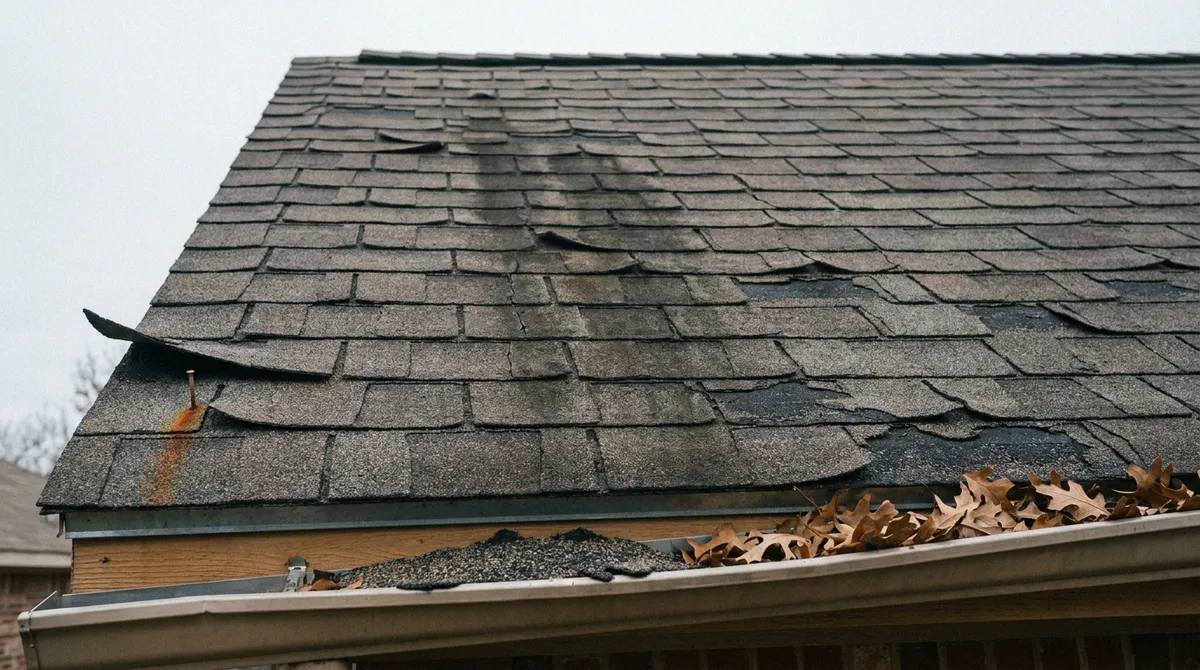 Heavy granule loss on an aged 3-tab roof in the DFW area, a clear sign of replacement rather than repair.
1. your roof is past its texas service life.
North Texas roofs don’t last as long as the manufacturer warranty says. A “30-year” architectural shingle in Dallas County usually gives you 18 to 22 real years because of UV exposure, attic temperatures over 140°F, and our hail frequency. A 3-tab shingle averages 12 to 16 years here.
Here’s the rough rule we use on inspections:
| Shingle type | DFW real-world service life |
|---|---|
| 3-tab (e.g., CertainTeed XT 25) | 12 to 16 years |
| Architectural (e.g., Landmark, Duration) | 18 to 22 years |
| Designer/luxury (e.g., Presidential, Grand Manor) | 22 to 28 years |
| Impact-rated Class 4 (e.g., NorthGate, Armorshield II) | 20 to 25 years (insurance discount stays) |
If your roof is within three years of the upper bound and showing other signs on this list, you’re looking at replacement. Patching a 17-year-old roof to “buy two more years” almost never works out cheaper than just replacing it now.
2. granule loss is widespread, not localized.
Asphalt shingles shed granules over their life. That’s normal. What’s not normal is finding a quarter-inch of granules in your gutter downspouts, bald spots the size of dinner plates on south-facing slopes, or shiny black asphalt showing through across an entire field.
Granules are the UV shield. Once they’re gone, the asphalt mat underneath cooks. We see this most on south and west exposures in neighborhoods like Stonebriar in Frisco and Twin Creeks in Allen where afternoon sun hammers the roof from 1 PM to sundown.
A single bald patch from a tree branch rubbing? Repair. Granule loss across multiple slopes with gutters full of black grit? Replacement.
3. hail bruises in multiple test squares.
Texas insurance carriers use the 8-out-of-100 rule. An adjuster chalks a 10-foot by 10-foot test square on each slope and counts hail hits. If there are 8 or more functional impacts (bruises that cracked the mat, not just dings in the granules) in a single square, that slope is totaled. If three or more slopes test out, the whole roof gets approved for replacement.
After the May 28, 2023 hail event in Rowlett and Garland, we wrote scopes on roofs with 12 to 18 hits per square. After the April 9, 2024 storm that ran from Sanger down through Plano, we saw squares with 22+ hits. Those are clean replacement claims.
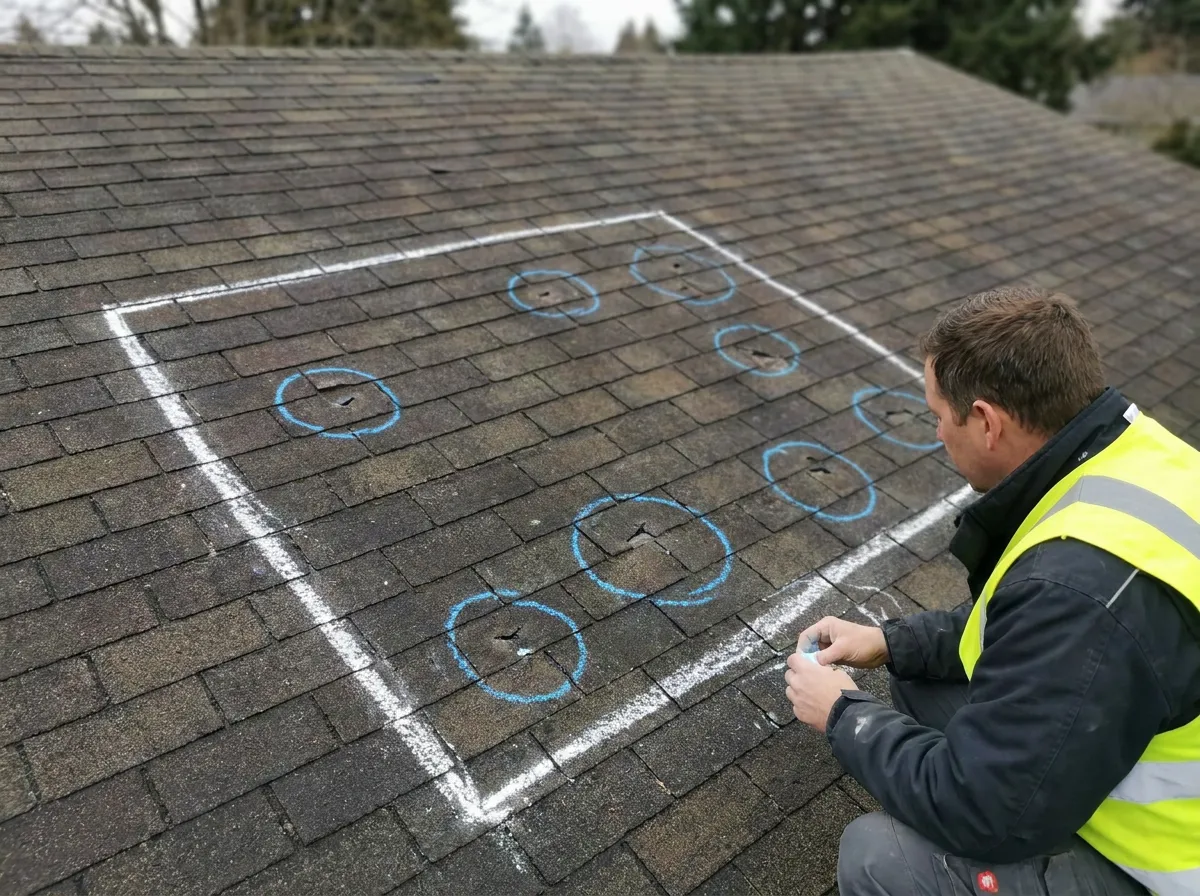 An adjuster test square marked with chalk circles showing functional hail impacts across 100 square feet.
If you think you have hail damage and your last storm date was within 365 days, get a free roof inspection before your carrier’s claim window closes.
4. shingles are cracking, curling, or cupping across whole slopes.
Three distinct failure modes, all pointing the same direction:
- Cracking: vertical splits in the shingle face, usually from thermal cycling. Common on 3-tabs older than 14 years.
- Curling: corners lift up off the slope. Caused by moisture cycling and asphalt drying out.
- Cupping: shingle centers rise while edges stay down, making a U shape. End-stage failure.
One or two cracked shingles near a vent pipe is a repair. Field-wide cracking, curling, or cupping across an entire slope is a replacement. By the time shingles cup, the sealant strips have failed and the next 60 mph straight-line wind will start peeling them off in rows.
5. you can see daylight through the roof deck from the attic.
Go up in your attic on a sunny afternoon. Turn off the lights. If you see pinpricks or thin lines of daylight anywhere except where vents are supposed to be, you have a deck problem.
Common causes:
- Nail pops where shingles backed out and exposed the deck
- Rotted decking from a long-running slow leak
- Storm-lifted shingles that left exposed underlayment, which then UV-degraded
Daylight in the attic almost always means roof replacement, not patching, because by the time light gets through, water’s been getting through too, often for months.
6. the decking feels spongy when walked.
A healthy roof deck (typically 7/16” OSB or 1/2” plywood) feels solid under boot. A failing deck flexes, bounces, or feels soft. That’s water-saturated wood that’s lost structural integrity.
Spongy spots near valleys, chimneys, and skylights are the most common. Once a 4’x8’ sheet of decking is rotted, you can’t just shingle over it. The new nails won’t hold and the roof will fail prematurely. Decking replacement runs about $75 to $110 per sheet installed in the DFW market, and most replacements we do need somewhere between 2 and 10 sheets swapped out.
If you’re walking your own roof and it feels wrong underfoot, stop walking it and call us at (214) 326-3106.
7. multiple leaks in different locations.
One leak around one chimney flashing? Repair it. Leaks in the master bedroom ceiling, the kitchen ceiling, and the garage soffit, all from different roof penetrations? You’ve got a system failure, not a flashing failure.
Multiple simultaneous leaks usually mean the underlayment is shot. The 30-pound felt or synthetic underlayment underneath your shingles is the secondary water barrier. When it cracks from age and heat, every shingle gap, nail penetration, and seam becomes a potential leak path. You can’t replace underlayment without tearing off the shingles, so at that point you’re already 80% of the way to a replacement anyway.
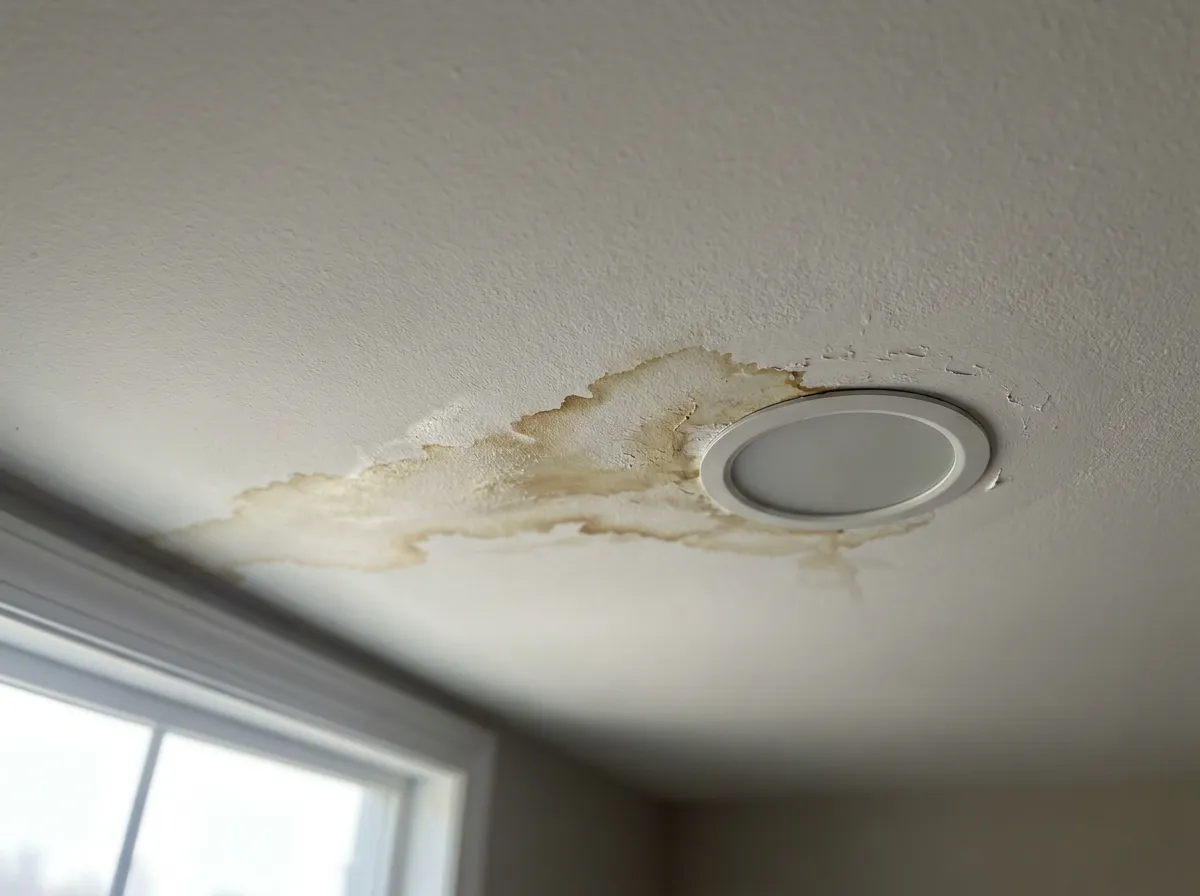 Ceiling stains from multiple leak paths on an aging roof, a case where replacement beat chasing patches.
8. flashing is rusted, lifted, or sealed with caulk patches.
Flashing is the metal that seals roof penetrations: chimneys, walls, valleys, plumbing vents, skylights. When flashing fails, water gets in around the penetration even if the shingles are fine.
Signs flashing is past its life:
- Rust streaks on shingles below chimneys or wall step flashing
- Lifted edges you can see from the ground
- Visible caulk smears (sometimes called “tar patches”) covering the flashing seams
Caulk is a bandage. Properly installed flashing doesn’t need caulk to hold water out. If your last roofer (or the previous homeowner) tubed a bunch of NP1 or roof cement onto the chimney flashing, that’s a sign the underlying system failed and someone tried to extend its life cheaply.
On a 6-year-old roof, we replace the flashing. On a 17-year-old roof with caulked flashing and granule loss, we replace the roof.
9. ridge cap shingles are missing, broken, or have blown off.
The ridge is the highest, most wind-exposed part of your roof. Ridge cap shingles wear out before field shingles, and when they go, water runs straight down into the attic.
Missing ridge caps after a single wind event (like the June 17, 2024 derecho that ran from Denton through Mesquite) are usually a repair. Ridge caps that are split, brittle, missing granules, and blowing off in normal 35 mph wind are a sign the whole roof is at the end of its life. Brittleness at the ridge is a leading indicator for field shingle failure in the next 12 to 24 months.
10. your neighbors are getting new roofs after the same storm.
If you live in a neighborhood like Lewisville’s Castle Hills, Wylie’s Inspiration, or Prosper’s Windsong Ranch and you see five or six roofs going up on your street in the six months after a hail event, your roof probably qualifies too.
Hail patterns are localized but not random. Storm cells drop hail across a 1 to 5 mile swath, and homes within that swath generally show similar damage. If your immediate neighbors filed successful claims and replaced their roofs, you owe yourself an inspection before your carrier’s claim deadline (usually 12 months from date of loss in Texas, but check your specific policy).
We get called weeks after our crews finish a neighbor’s job. The homeowner waited too long, the claim window closed, and now they’re looking at out-of-pocket replacement. Don’t be that homeowner.
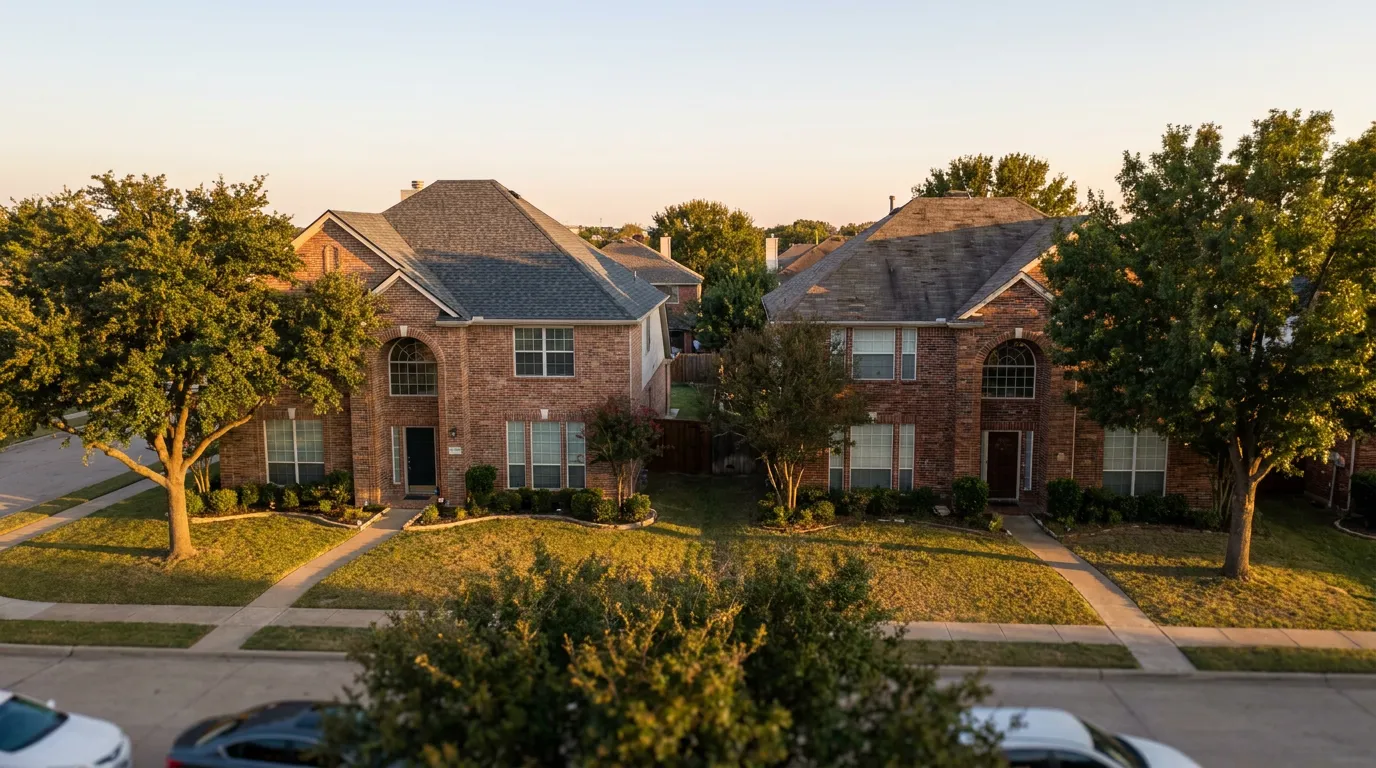 Two homes on the same street, one re-roofed after a hail event and one that waited and missed its claim window.
11. sagging anywhere along the rooflines.
Stand across the street and look at your roof against the sky. The lines should be straight. Ridges should be level. Hips should run in clean diagonal lines. Eaves should be horizontal.
Any sag, dip, or wave means structural trouble underneath:
- Rotted decking sheets
- Failed rafters or trusses (rare but serious)
- Water-saturated insulation pulling the deck down
Sagging is never a repair. It’s a tear-off, deck replacement, and full re-roof, sometimes with truss reinforcement on top of that. If your roofline doesn’t look straight, call us immediately. A sagging roof can become a collapsed roof in a strong storm, and that’s a life-safety problem.
12. you’re on your third repair in two years.
The repair-vs-replace math is simple. If you’ve spent $1,800 on three patch jobs in 24 months and your roof is over 15 years old, you’ve already paid for 10% to 15% of a full replacement and you still have an old roof.
The cutoff we use with homeowners: if repair quotes total 25% or more of replacement cost, replace it. A new architectural shingle roof replacement on a 2,400 sq ft Plano home runs roughly $11,500 to $16,000 in 2026. Spending $4,000 on patches over two years on that same house is breakeven math you’re going to lose.
DFW roof replacement cost ranges, 2026.
Real numbers from jobs we wrote in the last 90 days across Collin, Dallas, Denton, and Tarrant counties:
| Home size (heated sq ft) | Roof area (sq ft) | Architectural shingle replacement |
|---|---|---|
| 1,400 to 1,800 | 1,800 to 2,400 | $8,500 to $12,500 |
| 1,900 to 2,500 | 2,400 to 3,200 | $11,500 to $16,500 |
| 2,600 to 3,400 | 3,200 to 4,400 | $15,500 to $22,000 |
| 3,500 to 4,500 | 4,400 to 5,800 | $20,000 to $28,000 |
Class 4 impact-rated shingles add about $1,800 to $3,500 on top, and most Texas carriers give you a 10% to 25% wind/hail premium discount that pays back the upgrade in 4 to 7 years. If cost is the holdup, we offer an in-house payment plan on qualified projects. A larger upfront deposit gets the work started and the balance is split over flexible terms depending on the size of the project. Details on our payment plans page. For the full breakdown of roof replacement cost in Dallas by home size, pitch, decking, and shingle tier, start with our 2026 cost guide, which is where the numbers in this table come from.
when a repair is actually the right call.
We’re not trying to sell replacements that aren’t needed. Here’s when roof repair is the honest answer:
- Roof is under 10 years old and damage is isolated to one slope or one penetration
- Storm hit one slope but the other three test clean under the 8-in-100 rule
- A single tree branch tore off a 4 sq ft patch
- One pipe boot cracked and is leaking around the bathroom vent
- Flashing failed at one chimney but the field shingles are healthy
In these cases we’ll write a repair scope, get you back to weathertight, and check the roof again at the next inspection cycle.
frequently asked questions.
How long does a roof last in Texas? Architectural shingles average 18 to 22 years in DFW. 3-tab shingles average 12 to 16. Impact-rated Class 4 shingles can hit 25 years and keep your wind/hail insurance discount the whole time.
Will insurance pay for a full replacement or just repairs? If three or more slopes fail the 8-in-100 hail test, or if wind damage exceeds a partial-slope threshold, most Texas carriers approve full replacement. The adjuster’s scope, not your roofer, makes the call. We’ll meet the adjuster on site and document everything so nothing gets missed.
How long do I have to file a hail damage claim in Texas? Most Texas homeowner policies give you 12 months from the date of loss, but some HO-3 policies require notification within 30 to 90 days. Read your declarations page or call your carrier. After the May 28, 2023 and April 9, 2024 storms, we saw homeowners miss the deadline because they waited to see if the leaks would start.
Can I just install a new roof over my old one? Texas code allows two layers of asphalt shingles, but we almost never recommend it. A second layer hides decking problems, voids most shingle warranties, and adds 350 to 600 lbs of dead load to your trusses. Tear-off costs an extra $1,500 to $2,500 and is worth every dollar.
What’s the difference between ACV and RCV on my claim? RCV (replacement cost value) pays what it costs to replace the roof today. ACV (actual cash value) pays RCV minus depreciation based on the roof’s age. If you have an RCV policy you’ll get the depreciation back as a supplement after the work is complete. ACV-only policies are common on roofs over 15 years old.
How long does a roof replacement take? Most DFW residential replacements are a single-day job: tear-off in the morning, decking inspection and replacement, underlayment, shingles, ridge, cleanup. We typically have crews on site from 7 AM to about 5 PM. Larger or cut-up roofs run two days.
If you’ve spotted three or more of these signs on your roof, don’t wait for the next storm to make the decision for you. Call us at (214) 326-3106 for a free, no-pressure inspection. We’ll climb your roof, document what we find with photos, and give you an honest answer on repair vs. replace. If a patch fixes it, that’s what we’ll quote. If it’s past saving, you’ll get a real number you can take to your insurance carrier.