
Key takeaways
- Compare scopes first and totals second. The cheapest of three bids is usually the one with the most line items missing, and the missing lines come back as change orders.
- A complete DFW roofing estimate shows 14 line items, from tear-off and a per-sheet decking rate ($70 to $100) to the permit ($95 to $300 by county) and dump fees.
- On a 2,400 sq ft Plano home going to Landmark Pro, bids of $16,200, $19,800 and $24,500 describe three different jobs. Once the scopes match, the low bid lands at $18,600 to $20,600 with ice and water shield and disposal still unpriced.
- Five lines go missing most often: decking allowance, ice and water shield, ridge vent ($8 to $18 per linear foot), permit, and disposal.
- Installed architectural shingles run $3.50 to $5.50 per square foot of roof in DFW. A bid under that floor took something out of the installed rate.
- Texas law makes it illegal for a roofer to waive or absorb your insurance deductible. A bid built around that offer belongs in the trash.
To compare roofing estimates, line up the scopes before you look at the totals. Put all three bids side by side against the 14 line items below and mark what each one leaves out. The cheapest bid is usually the one with the most lines missing, and those lines come back later as change orders.
line up the scopes before you look at the totals.
Three bids on the same house in Plano are almost never three prices for the same roof. They are three scopes, and the gaps between them are where the money hides. The pricing behind every number in this post lives in our Texas roof replacement cost guide. This is the comparison method that goes with it.
The method takes ten minutes. Print the bids, draw 14 rows down a sheet of paper, and write what each bid says for each row. Blank cells are the story. A bid that is $3,600 cheaper with four blank rows is incomplete rather than cheap, and the blanks arrive mid-tear-off as change orders, when the old roof is in the trailer and you have no bargaining position.
Keep two numbers on the sheet. Roof area in DFW runs about 1.2 to 1.3 times the home’s square footage, so a 2,400 sq ft house carries roughly 3,000 sq ft of roof, or 30 squares. And installed architectural shingles run $3.50 to $5.50 per square foot of roof. Divide every total by the roof area. A number under $3.50 in architectural means something that belongs in the installed rate was taken out.
For scale, NerdWallet puts the national average replacement at $9,500 with a range of about $5,800 to $46,000, or $4 to $11 per square foot. That spread is the whole point. Two bids can both sit inside a “normal” range and still describe different roofs.
Every blank row on a bid is a change order you have not received yet.
the 14 line items every dfw roofing estimate should show.
Every bid should arrive on company letterhead with a street address and a phone number, and it should show all 14 of these. Here is what each line covers, what it costs across Dallas-Fort Worth, and what it looks like when it is missing.
-
Tear-off. Removing every existing layer to bare deck, priced per square and higher for two-layer roofs. It is part of the installed rate. Missing: the bid says “install over existing” or “roof-over.” A layover voids most manufacturer warranties and hides the decking you need to see.
-
Decking replacement, per sheet, on the contract. OSB or plywood the tear-off exposes as rotten, split or delaminated, at $70 to $100 per sheet. A 1990s Plano or Frisco home usually needs three to seven sheets. A 1960s plank-decked Lakewood house can need $1,800 to $3,400. Missing: no rate at all, which means $1,500 to $3,000 arriving mid-tear-off as a change order.
-
Underlayment, by type and brand. Synthetic underlayment across the whole deck, named by brand, instead of 15 lb felt. Included in the installed rate. Missing: “felt or synthetic,” “underlayment as needed,” or no line.
-
Ice and water shield. Self-adhered membrane in every valley, around every penetration, and up from the eaves. Included in a complete installed rate. The Insurance Information Institute counts 902 major hail events in Texas in 2025, more than any other state, and this is the layer that keeps wind-driven rain out of the attic after a storm lifts a shingle. Missing: no mention of valleys anywhere on the page.
-
Drip edge, new. Metal on every eave and rake, replaced rather than reused. Included in the installed rate. Missing: “reuse existing drip edge” or “drip edge as needed.”
-
Shingle brand, line, color, and the warranty tier that will be registered. “CertainTeed Landmark Pro, Weathered Wood, 5-Star SureStart Plus registration” is a line. “30-year architectural or equivalent” is a guess. Installed rates per square foot of roof: architectural $3.50 to $5.50, Class 4 impact $5.50 to $6.50, designer (Landmark Pro, Presidential) $7 to $11, standing seam metal $12 to $22. InterNACHI’s life expectancy chart gives architectural asphalt 30 years nationally; in DFW heat and hail we see 18 to 22, which is why the line and tier matter more than the “30-year” label. Missing: “or equivalent,” no color, no warranty tier.
-
Ridge vent, in linear feet. Continuous ridge ventilation at $8 to $18 per linear foot, which runs $600 to $2,000 on a typical DFW roof, or a written alternative ventilation plan. Missing: “reuse existing vents,” which on a 1990s house means rusted box vents and an attic that cooks the shingles from underneath every August. Our ridge vent vs. box vent post has the math.
-
Pipe boots, vents and flashing, counted. Every plumbing boot, exhaust vent and turbine replaced, with the count and material on the bid. Missing: “flashing as needed.” Cracked pipe boots are the most common leak we repair on roofs under ten years old.
-
Step and counter flashing at walls and chimneys. New step flashing at every wall, and a chimney reflash at $250 to $600, or $800 to $2,500 if the cricket has to be rebuilt. Missing: “reuse where possible,” which leaves the 1998 flashing under the 2026 shingles.
-
Gutter detach and reset. Needed when the gutters sit over the drip edge line or the fascia needs attention. Missing: silence, then a charge the day the gutters come down.
-
Detached and secondary structures. A detached garage, shed or patio cover as its own line with its own square count, or “none” written in. Missing: a patio cover that gets shingled “while we’re up there” and billed afterward.
-
Permit, with who pulls it. Every DFW city permits a reroof: $95 to $250 in Collin County, $125 to $300 in Dallas, $110 to $275 in Tarrant, $95 to $260 in Denton. Even Homewyse excludes permit and inspection fees from its $5.09 to $6.66 per square foot national estimate, which is exactly how a bid leaves them out too. Missing: no permit line, or “homeowner to obtain.” Our DFW permit guide by city has the fee for your city hall.
-
Cleanup, magnetic sweep and dump fees. Hauling the old roof off, a magnetic nail sweep of the yard and driveway, and the landfill ticket. Missing: no disposal line, then a dumpster charge on the final invoice.
-
Dates, payment terms and warranty registration, in writing. A start date, a finish date (single-story replacements usually finish in one day, two-story in two), the deposit and payment schedule, and who files the manufacturer registration. Missing: “weather permitting” with no date at all, full payment up front, or a warranty that nobody is responsible for registering.
Two or more missing and the bid is either inexperienced or incomplete on purpose. Either way, the low number is a draft.
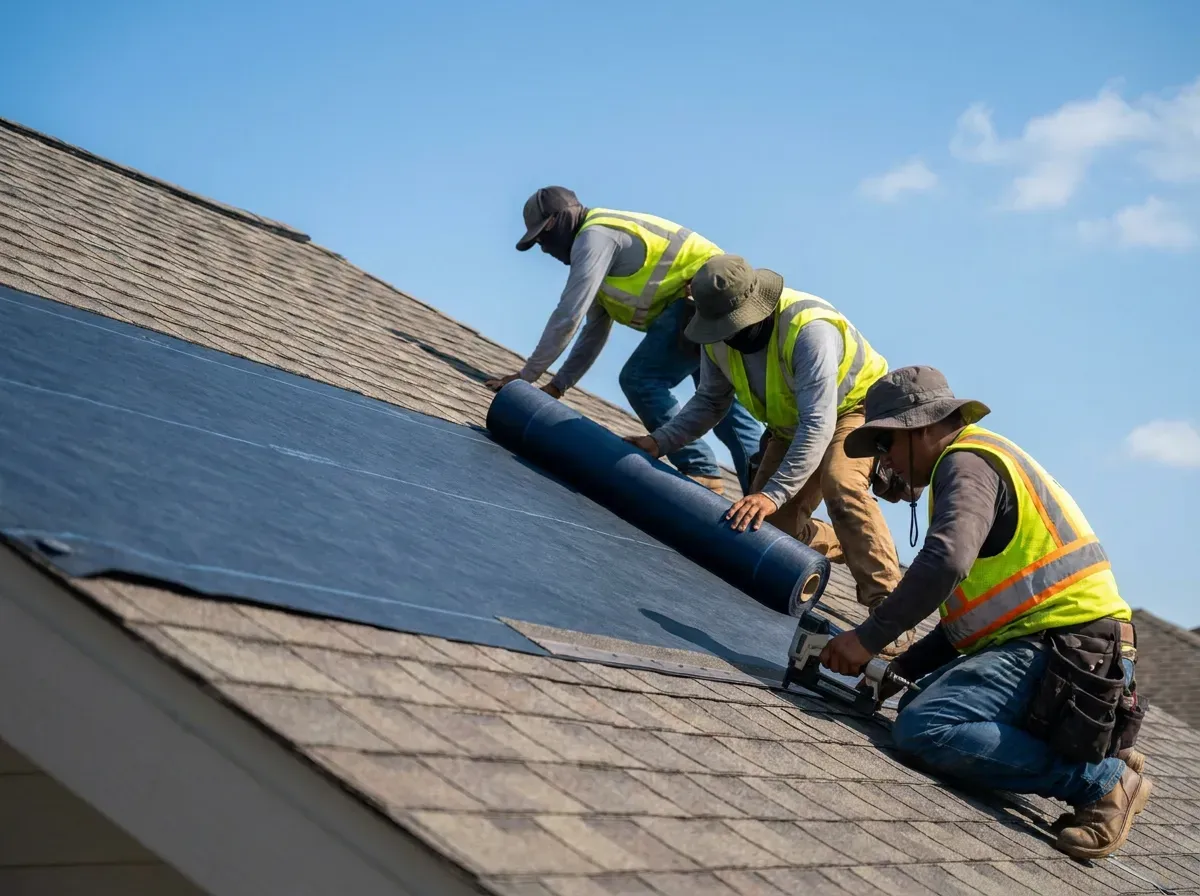 Lines 3 and 4 going down before a single shingle. These are the two layers a 2000s roof never got and a low bid quietly skips.
three bids on one plano house, line by line.
This is a representative example built from the pricing in our cost guide, not a named customer. The house: a 1998 two-story off Hedgcoxe Road in west Plano, 2,400 sq ft of living space, about 3,000 sq ft of roof (30 squares), a 7/12 pitch, one brick chimney, 80 linear feet of ridge, gutters all around, no detached structures. The old roof is a builder-grade architectural shingle and the owner asked all three roofers for Landmark Pro. The bids came back at $16,200, $19,800 and $24,500.
| Line item | Bid A, $16,200 | Bid B, $19,800 | Bid C, $24,500 |
|---|---|---|---|
| 1. Tear-off | Yes | Yes | Yes |
| 2. Decking rate | Not shown | 5 sheets at $85 included, rate on contract | 5 sheets at $90 included, rate on contract |
| 3. Underlayment | ”Felt or synthetic” | Synthetic, brand named | Synthetic, brand named |
| 4. Ice and water shield | Not shown | Valleys, eaves, penetrations | Valleys, eaves, penetrations |
| 5. Drip edge | ”As needed” | New, eaves and rakes | New, eaves and rakes |
| 6. Shingle | ”Landmark Pro or equivalent,” no color, no tier | Landmark Pro, color and tier named | Landmark IR (Class 4), color named, 5-Star registration |
| 7. Ridge vent | ”Reuse existing vents” | Not shown | 80 linear feet |
| 8. Pipe boots and flashing | ”As needed” | Counted | Counted |
| 9. Chimney flashing | ”Reuse where possible” | Not shown | Reflash, new step and counter flashing |
| 10. Gutter reset | Yes | Yes | Yes |
| 11. Detached structures | Blank | Blank | ”None” |
| 12. Permit | Not shown | Not shown | Plano permit, pulled by contractor |
| 13. Cleanup and disposal | Not shown | Yes | Yes |
| 14. Dates, payment, registration | Payment in full on completion, no dates | Dates, deposit, schedule | Dates, deposit, schedule, registration named |
| Complete / vague / missing | 2 / 6 / 6 | 10 / 0 / 4 | 14 / 0 / 0 |
Now the gaps, and why each one exists.
Bid A priced a base architectural shingle and wrote “Landmark Pro or equivalent” on top of it. At $16,200 on 30 squares, it is $5.40 per square foot of roof, which is the architectural rate, well under the $7 floor for a designer tier. Everything vague on Bid A is a place the roofer kept the option to do less. The decking rate, the ridge vent, the permit and the disposal are simply absent.
Bid B is an honest Landmark Pro bid that left three things off: ridge vent (it reuses the box vents), the chimney reflash, and the permit. On a 1998 house with a brick chimney, all three will come up.
Bid C quoted Landmark IR, the Class 4 impact version, because the roofer walked the street after the April 2024 hail round and recommended it. It is a different shingle at a different rate, and every one of the 14 lines is on the page.
Here is what each bid costs once the scope matches a complete Landmark Pro job.
| Bid | As written | What has to be added to match a complete scope | Realistic total |
|---|---|---|---|
| A | $16,200 | Actual Landmark Pro instead of “equivalent” (+$35 to $55 per square, $1,050 to $1,650), five sheets of decking ($350 to $500), 80 ft of ridge vent ($640 to $1,440), permit ($95 to $250), chimney reflash ($250 to $600) | $18,600 to $20,600, with ice and water shield, new drip edge and dump fees still unpriced |
| B | $19,800 | 80 ft of ridge vent ($640 to $1,440), chimney reflash ($250 to $600), permit ($95 to $250) | $20,800 to $22,100, which is where a 2,400 sq ft Plano home in Landmark Pro should land (about $22,000) |
| C | $24,500 | Nothing. This is the Class 4 version of the same scope, about $2,500 over Landmark Pro from the $65 to $110 per square upgrade | $24,500 as written |
The spread on the table was $8,300. About $2,500 of it is a better shingle. The rest is scope. Bid A becomes the most expensive Landmark Pro roof once its blanks are filled, Bid B is the fair Landmark Pro price once three lines are added in writing, and Bid C is the only number that was finished the day it was handed over. The right move with Bid B is to ask for the three lines on paper before signing, which a real local roofer will do in an afternoon.
Bid C had the highest number on the table and the only number that was finished.
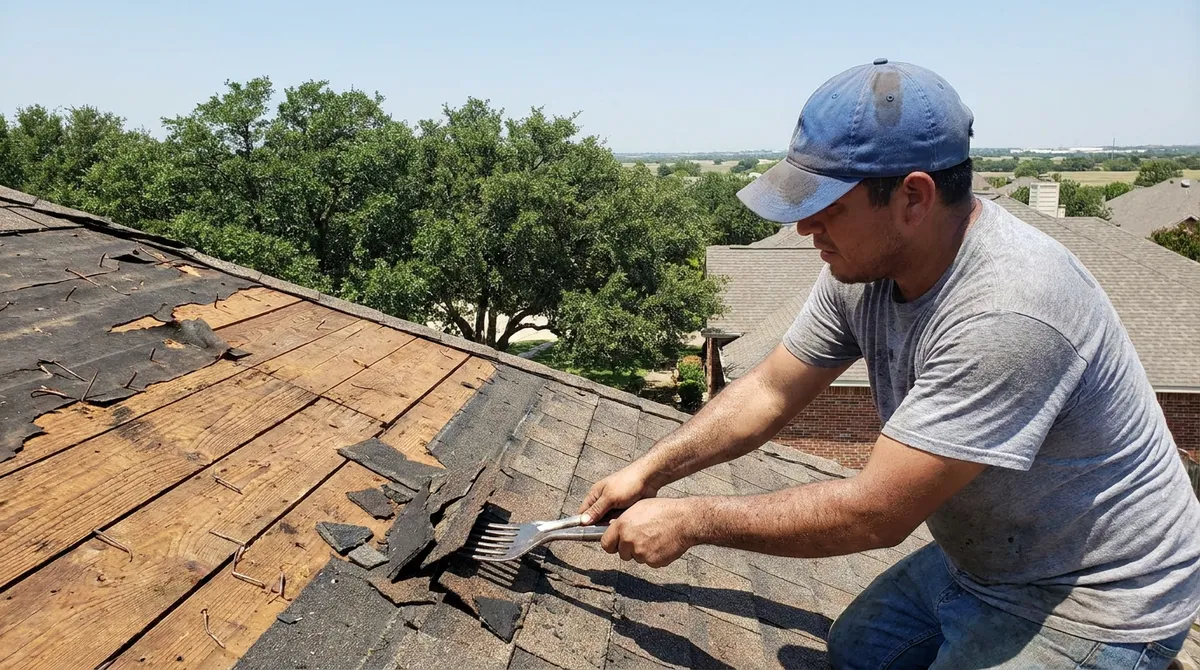 Tear-off is when the decking count becomes real. A per-sheet rate on the contract means the number is known even when the count is not.
the five lines a low bid almost always leaves out.
Across the bids homeowners bring us to review from Frisco, McKinney and Richardson, the same five lines go missing.
Decking allowance. The budget breaker. Ask every bidder: “What is your per-sheet decking rate, and is it on the contract?” At $70 to $100 per sheet, a published rate turns an unknown into arithmetic.
Ice and water shield. A bid that never mentions valleys is a bid that is sealing them with underlayment and hope. Texas gets more major hail than any other state, and valleys are where the water concentrates after the storm.
Ridge vent. $8 to $18 per linear foot is easy to drop from a bid, and “reuse existing vents” sounds thrifty. An unbalanced attic shortens the life of the shingles you just paid for, and manufacturer warranties lean on ventilation to code.
Permit. $95 to $300 depending on the county, pulled by the contractor, inspected after the install. “Homeowner to obtain” is a tell that the roofer would rather not be on file with the city.
Disposal. A 30-square tear-off fills a trailer. If the bid does not say who pays the landfill, you do, on the final invoice.
ask these before you sign anything.
The scope sheet tells you what each bid includes. These five questions tell you who you are hiring.
“Will you waive or absorb my deductible?” The only right answer is no. Texas Insurance Code Chapter 707, in force since September 1, 2019, makes it illegal for a contractor to waive, absorb, rebate or otherwise pay a homeowner’s deductible, and the Texas Department of Insurance warns that your carrier can ask for proof you paid it. A roofer who offers is offering insurance fraud with your name on the paperwork. Our guide on spotting a storm chaser covers the rest of that script.
“Who pulls the permit?” The contractor, in the contractor’s name, with the inspection scheduled. Plano Building Inspections turns residential reroof permits in one to three business days. A roofer who wants you to pull it is avoiding the record.
“Who registers the manufacturer warranty, and at what tier?” The shingle line, the tier and the registering party belong on the bid. CertainTeed’s 5-Star SureStart Plus coverage can only be registered by a ShingleMaster contractor, and fewer than 3 percent of US roofers hold that credential. Ask for the registration confirmation after the job, in your name.
“What are the start and finish dates?” Single-story replacements usually finish in one day, two-story in two. “Weather permitting” is reasonable. No date at all is a bid you cannot hold anyone to. What to expect during a roof replacement walks through the day itself.
“Who is on site?” The name of the crew lead, and whether the crew works for the company or a subcontractor nobody at the office has met. The person on the roof decides the details that matter in wind. The Insurance Institute for Business and Home Safety calls the seal between shingles “the most important factor affecting high-wind performance,” notes that manufacturers require hand-sealing on steep slopes and in extended cold weather, and reports that hand-sealing in those conditions “is not common practice.” On a 12/12 Keller custom in January, the crew lead is the warranty.
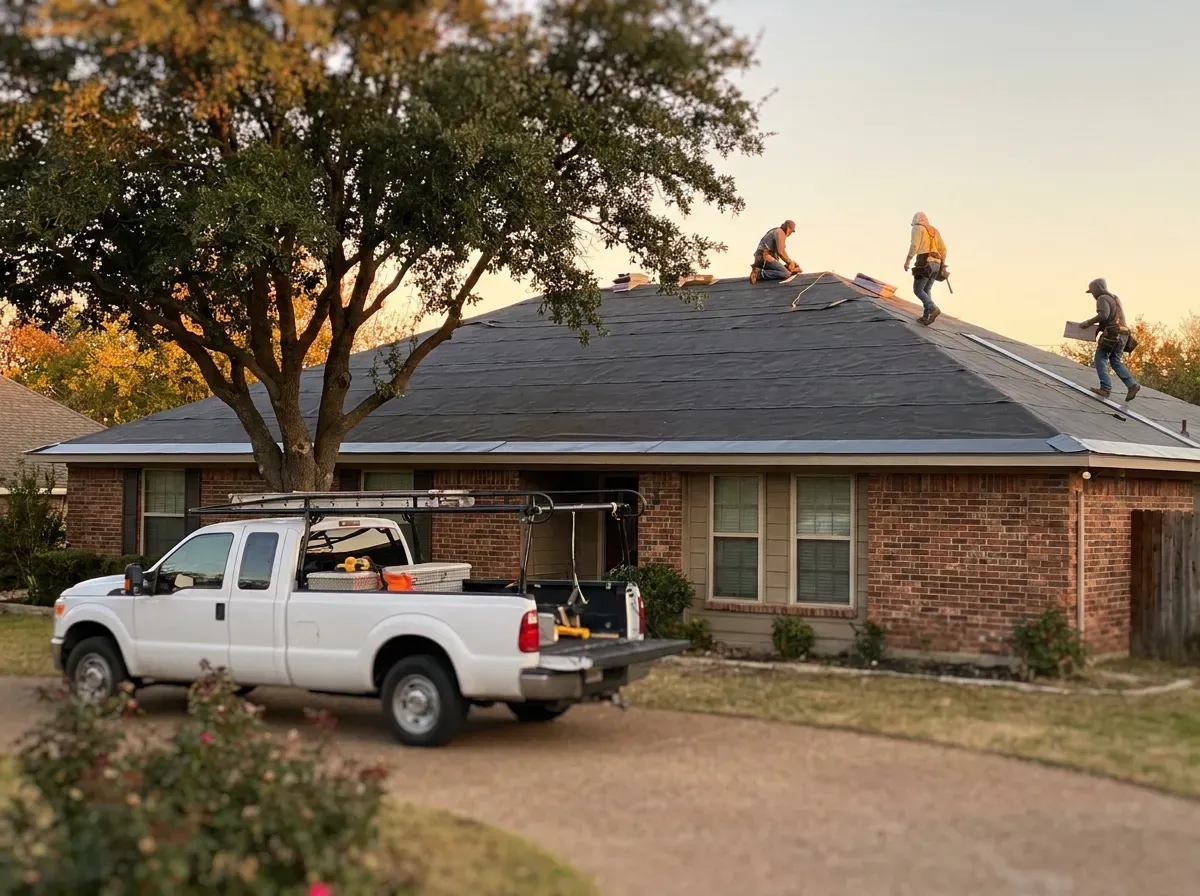 A dry-in walkthrough with the owner before the shingles go on. Ask every bidder who will be standing here on your job.
what a roof raiders estimate includes.
Plainly: a free inspection first, then a fixed written estimate with all 14 lines on it.
The inspection means every slope photographed, the attic checked, the decking probed, and if a storm is involved, the NOAA hail swath pulled for your address. We document the damage and we meet your adjuster on the roof. Your claim is between you and your carrier.
The estimate names the shingle line, color and the warranty tier we will register, carries a per-sheet decking rate on the contract, lists the ridge vent in linear feet, shows the permit as a line item we pull, includes disposal and the magnetic sweep, and prints a start date and a finish date. Our scope on every full roof replacement is the same: full tear-off to bare deck, synthetic underlayment across the deck, ice and water shield in every valley and 36 inches up from the eaves, new drip edge, new flashings and pipe boots, ridge ventilation to code, and a triple magnetic sweep before the trailer leaves. The warranties behind it are CertainTeed’s, including the 5-Star registration we can file as a ShingleMaster contractor.
On payment, a covered claim means your out-of-pocket is your deductible. On a retail replacement we take cash or offer an in-house payment plan on qualified projects: a larger upfront deposit, the balance on a schedule we agree on together, no bank and no third party. Roof replacement financing in Texas explains how that compares to the alternatives.
If you are still building your list of three, our look at the best roofing companies in Plano is the vetting method we would want used on us.
Same 14 lines on every bid we write. If a competitor’s number is lower, ask which lines came out.
frequently asked questions.
What should a roofing estimate include? Fourteen lines: tear-off, a per-sheet decking rate ($70 to $100 in DFW), underlayment by brand, ice and water shield, new drip edge, the shingle brand, line, color and warranty tier, ridge vent in linear feet, pipe boot and flashing counts, step and counter flashing, gutter reset, detached structures, the permit ($95 to $300 by county) and who pulls it, cleanup and dump fees, and dates, payment terms and warranty registration in writing. Two or more missing and the total is not real.
How do I compare roofing estimates? Compare scopes first, totals second. Put the bids side by side against the 14 line items and mark each one complete, vague or missing. Divide each total by the roof area (about 1.2 to 1.3 times your home’s square footage) to get a per-square-foot rate, and treat anything under $3.50 for architectural shingles as a sign something was removed. Then ask each bidder, in writing, to price the lines they left out before you choose.
What is a fair price for a roof repair? A fair repair quote reads like a small replacement bid: it names the failure (a cracked pipe boot, lifted step flashing, a hail-bruised slope), the material going in, and whether decking is involved. The small-item scale on a DFW replacement bid is the yardstick, such as $250 to $600 to reflash a chimney or $150 to $350 to reflash a skylight. On an architectural roof past 18 years, run repair vs. replacement before paying for a repair that only buys a season.
Why is one roofing estimate so much cheaper than the others? Because it describes a smaller job. The usual missing lines are a decking allowance, ice and water shield, ridge vent, the permit and disposal, plus a shingle written as “or equivalent” that turns out to be a base-grade tier. On a 2,400 sq ft Plano home those gaps are worth roughly $2,400 to $4,400 before dump fees, which is about the distance between a $16,200 bid and a $19,800 one.
Should I always pick the cheapest roofing bid? No, and the most expensive one is no safer. Pick the bid whose scope you can read in full, then compare prices among the bids that show all 14 lines. A low bid with blanks becomes the expensive bid through change orders. If a bid you like is missing lines, ask the contractor to add them in writing. A good roofer will. A storm chaser will push you to sign today instead.
How many roofing estimates should I get in Texas? Three, on company letterhead with a street address and a phone number, which is also the Texas Department of Insurance’s standard advice. Three is enough to see the spread and expose the outlier without drowning in paperwork. Make sure every bidder measures the same roof and quotes the same shingle tier, or write the tier you want on each request so the scopes line up.
Can a roofer waive or pay my deductible in Texas? No. Since 2019, Texas Insurance Code Chapter 707 makes it illegal for a contractor to waive, absorb or rebate an insurance deductible, and your carrier can ask for proof that you paid it. A bid that reads “free after insurance” or “we cover the deductible” is a fraud with your name on it. On a covered claim your real cost is the deductible, typically 1 to 2 percent of dwelling coverage.
Ready to put a complete bid on the table next to the other two? Run your address through the free roof cost calculator for a satellite-measured range in about a minute, then call (214) 326-3106 to schedule the free inspection. Every estimate we write shows all 14 lines, and the in-house payment plan on qualified projects is there if you need it.