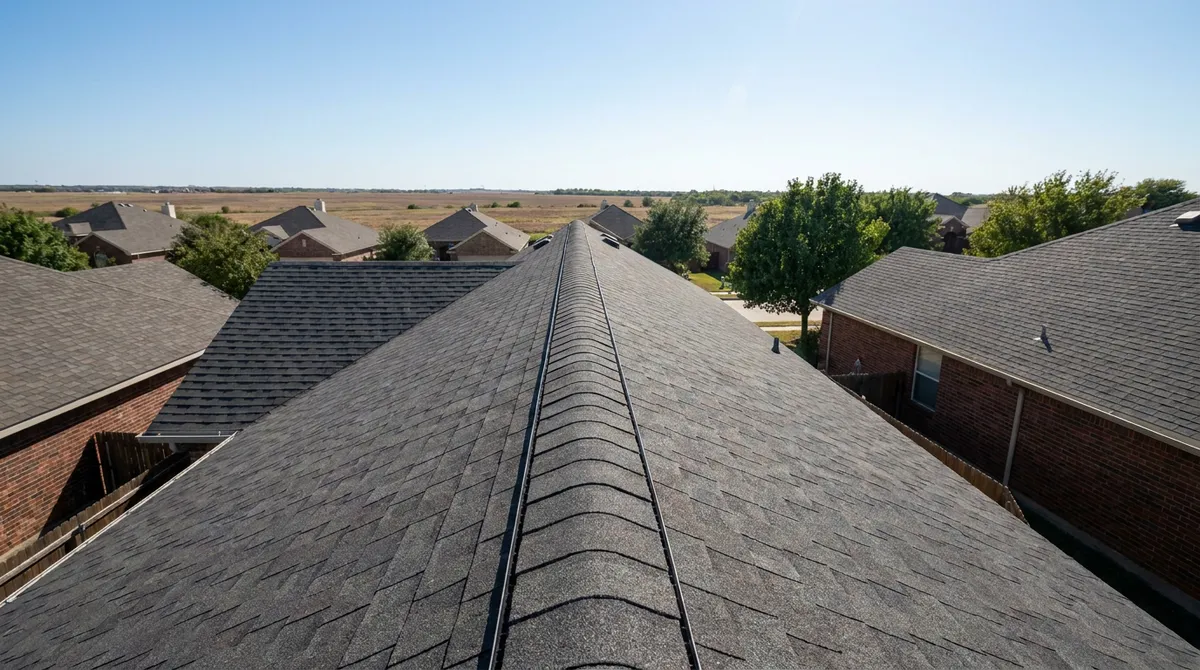
For most Dallas homes with a continuous ridge line, a ridge vent paired with soffit intake beats box vents on attic temperature, code compliance, and long-term shingle life. Box vents (also called turtle vents or louvers) still have a place on complex roofs with short ridges, dormers, or hip-heavy designs where ridge length runs short. After installing both systems on roughly 600 DFW homes since 2022, I’ll tell you exactly when we pick one over the other, what the 2024 IRC requires in Plano and Dallas, and why the wrong vent choice can cook your shingles five years early in our 100-degree summers.
I’m Mahmoud Abu Saad. My wife Sara and I started Roof Raiders out of Plano in 2022 right after she was laid off at 40 weeks pregnant. We’re CertainTeed ShingleMaster certified (top 3% of contractors nationally), and attic ventilation is one of those details we won’t cut corners on.
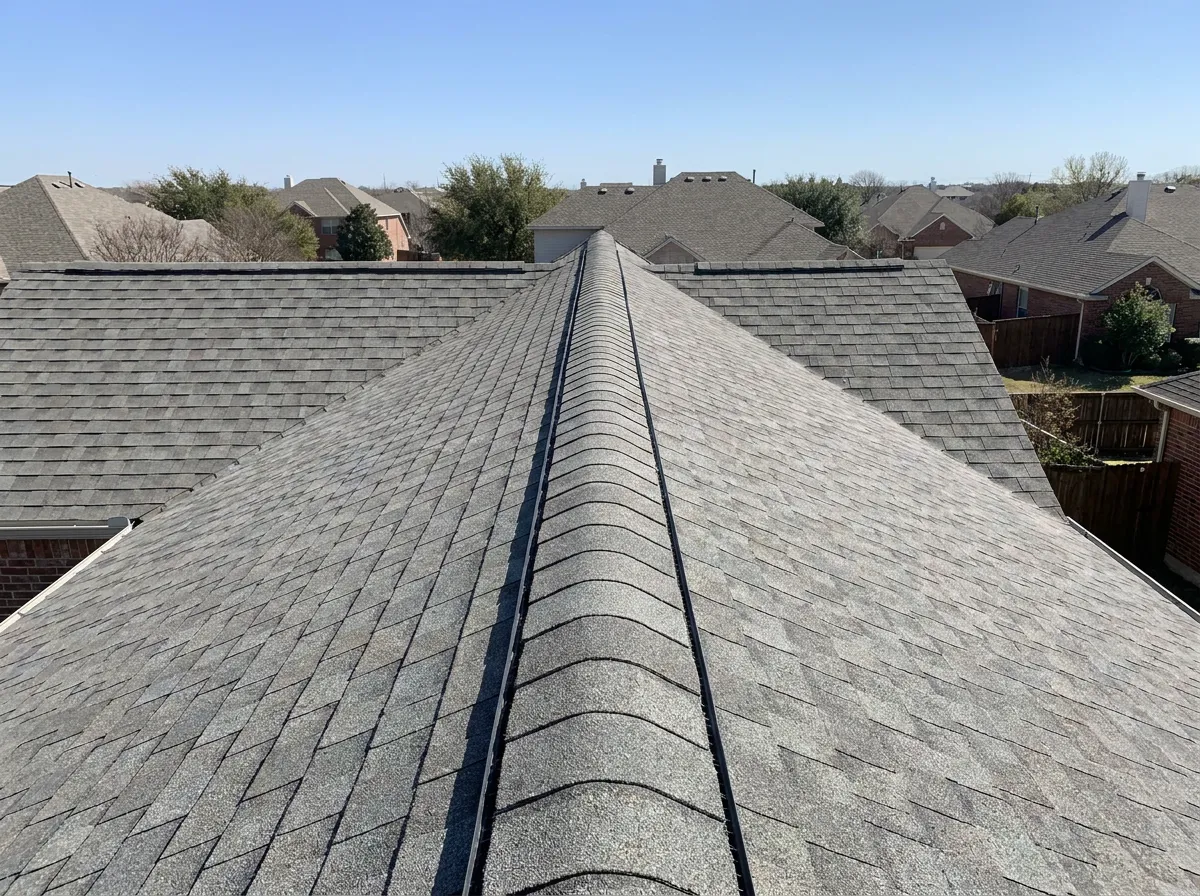 Illustration of a continuous ridge vent capped with matching CertainTeed Landmark shingles on a two-story home.
what each vent actually does.
Both vents do the same job: they exhaust hot air out of your attic so cooler air can pull in through your soffits. The difference is geometry.
A ridge vent is a continuous strip that runs along the peak of your roof. We cut a 1.5 to 2 inch slot in the decking on each side of the ridge, install the vent over it, then cap it with matching shingles. From the street, you barely see it.
A box vent is a square or rectangular hood (usually 12 by 12 inches) that sits a few feet below the ridge. Each one covers roughly 50 to 60 square inches of net free area. On a typical Plano two-story, you’d need 6 to 10 of them spaced across the back slope.
The mechanics matter because heat rises. Ridge vents exhaust at the highest point on the roof, which is where the hottest air collects. Box vents exhaust a few feet lower, which means a pocket of trapped heat sits above them and bakes the underside of your decking.
attic temperatures, measured.
We run infrared temp checks on every inspection because the difference is real. Here’s what I logged on three Frisco homes during the August 2025 heat dome (113 degree ambient):
| home | vent system | peak attic temp | shingle surface temp |
|---|---|---|---|
| 2,400 sq ft ranch, ridge vent + soffit | properly balanced | 128°F | 154°F |
| 2,600 sq ft two-story, 4 box vents | undersized intake | 151°F | 168°F |
| 3,100 sq ft, mixed (2 ridge + 3 box) | competing exhaust | 144°F | 161°F |
That 23 degree gap on attic temperature is the difference between a 25-year shingle lasting 22 years and lasting 14. CertainTeed and GAF both void the warranty if attic ventilation falls below the 1:300 ratio (1 sq ft of net free vent area per 300 sq ft of attic floor), and box-vent-only setups often miss that ratio when homeowners just count what’s already on the roof without checking the math.
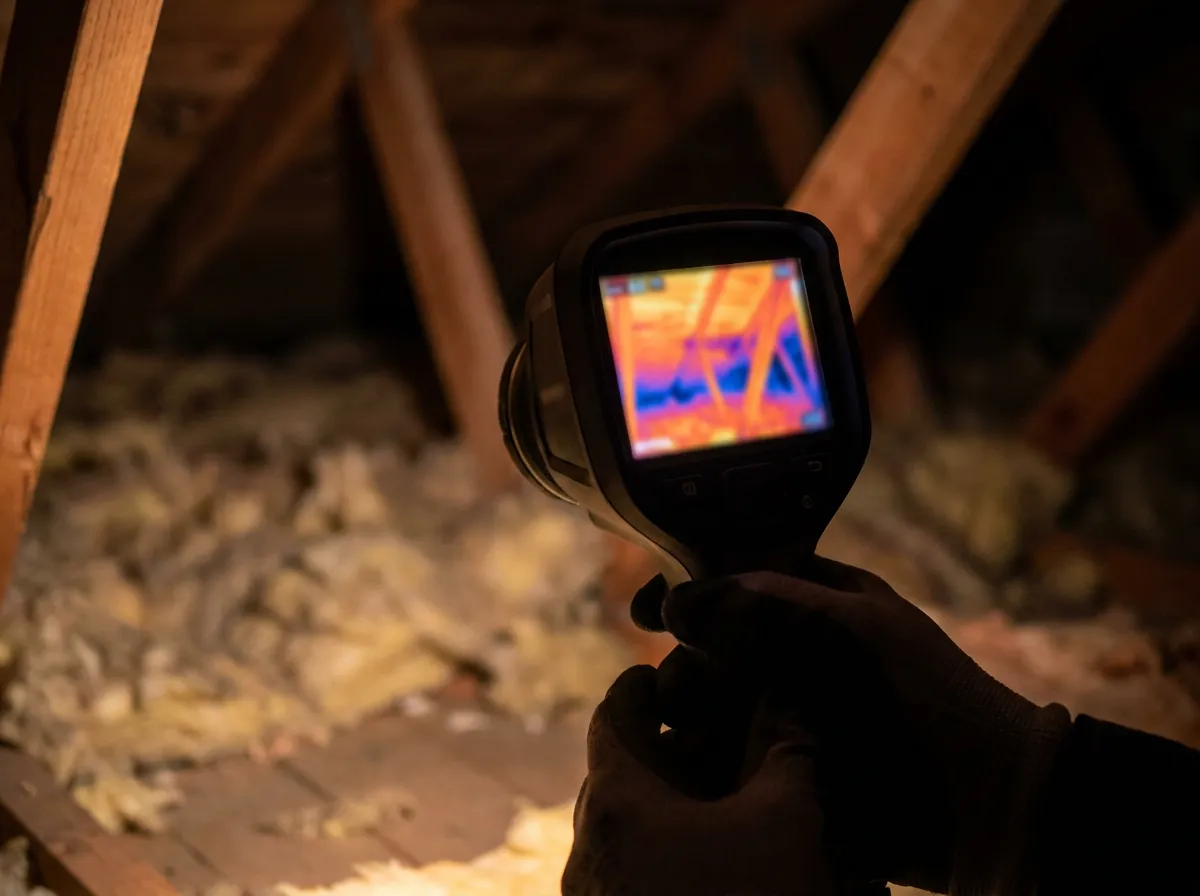 Illustrative thermal scan showing how heat collects above box vents in an attic.
what dallas and plano code actually requires.
The 2024 International Residential Code (adopted by Dallas, Plano, Frisco, McKinney, Allen, and most DFW cities) requires 1 square foot of net free ventilation area per 150 square feet of attic floor, OR 1:300 if you split intake and exhaust at least 40/60 with a vapor retarder on the warm side.
In real numbers on a 2,500 sq ft home:
- 1:300 ratio: 8.33 sq ft of total NFA (4.17 intake, 4.17 exhaust)
- 1:150 ratio (no vapor retarder): 16.67 sq ft total NFA
A continuous ridge vent on a 40-foot ridge gives you roughly 5.8 sq ft of NFA (18 sq in per linear foot is typical). One box vent gives you about 0.42 sq ft. To match the ridge vent with box vents alone, you’d need 14 of them, which is a lot of penetrations through your decking and a lot of potential leak points.
The other thing inspectors check: you cannot mix ridge vents and box vents on the same plane. They short-circuit each other. The ridge pulls air from the closest box vent instead of the soffits, and the section of attic farthest from both gets no airflow. We’ve torn off plenty of roofs in Richardson and Garland where the previous installer left both in place and the deck rotted out within seven years.
when we install ridge vent.
We default to ridge vent on roughly 75% of our roof replacements in Dallas. The math works when:
- Continuous ridge length is 30 feet or more. Below that, NFA drops below the 1:300 requirement and you’ll need supplemental intake somewhere else.
- Soffit intake is adequate or can be added. No exhaust system works without intake. If the soffits are blocked by insulation or undersized, we either add baffles or cut additional soffit vents.
- The roof pitch is 3:12 or steeper. Below 3:12, ridge vents can let wind-driven rain past the baffle.
- No power attic fans are present. Power fans depressurize the attic and pull conditioned air out of the house through ceiling penetrations. We remove them and cap the hole.
Cost-wise, a continuous ridge vent adds roughly $450 to $850 to a full replacement depending on ridge length. On a typical 2,500 sq ft Plano home, expect around $600.
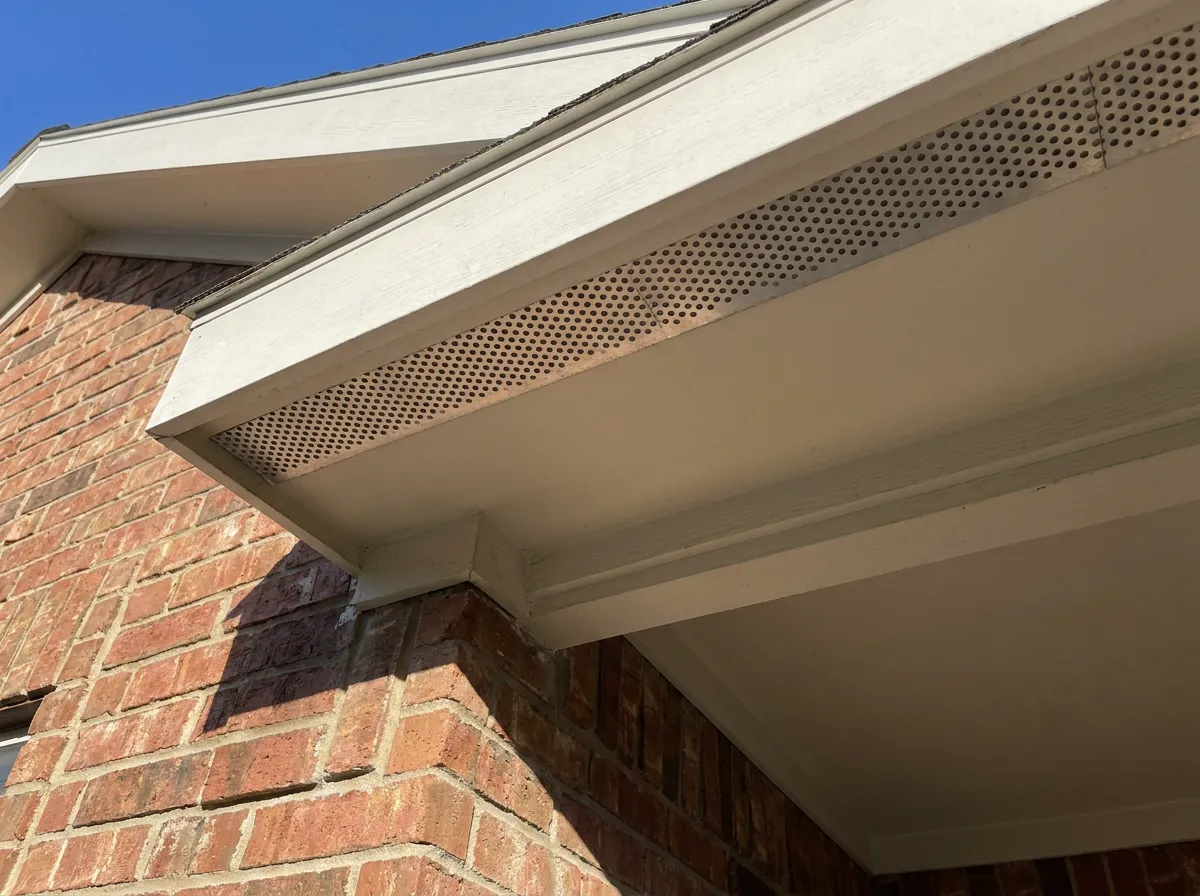 Adding continuous soffit intake on an older home that originally had vents blocked behind the insulation.
when we install box vents.
Box vents still earn their place on certain DFW roof shapes. We pick them when:
- Ridge length is under 25 feet (common on hip roofs and complex cut-ups in Highland Park and University Park).
- Multiple short ridges make continuous ridge venting impractical.
- Dormers and valleys break up the ridge into 6-foot segments that aren’t worth slotting.
- Historic district restrictions prohibit visible ridge modifications (rare, but it happens in parts of Dallas).
When we install box vents, we use CertainTeed or Air Vent units with at least 61 sq in of NFA each. We space them every 8 to 10 feet across the upper third of the back slope, and we calculate the exact count from the attic square footage. Not the “looks about right” approach.
Box vent cost runs $65 to $95 per vent installed during a replacement, so a typical 6-vent layout adds $400 to $600 total.
the soffit intake problem nobody talks about.
We’ve inspected hundreds of Dallas homes where the homeowner paid for premium exhaust ventilation and the attic still ran hot. The reason is almost always intake.
Soffit vents in DFW homes built before 2005 are commonly:
- Blocked by blown-in insulation that drifted into the soffit cavity
- Painted over during exterior repaints (looks fine, zero airflow)
- Undersized for the original attic square footage
- Missing entirely on additions
You can install the most expensive ridge vent on the market and it won’t move air if there’s no intake. We check soffit airflow with a smoke pencil on every inspection. If we don’t see smoke pulling toward the soffit when we light it inside the attic, intake is failing and we fix it during the roof replacement or as a standalone repair.
 Smoke pencil test in an attic confirming intake flow from the soffit toward the ridge vent.
what we install and why.
For ridge vents we use CertainTeed Filtrasol or GAF Cobra Snow Country Advanced. Both have external baffles that deflect wind-driven rain (we proved that one out during the May 28, 2023 hailstorm with 80 mph straight-line winds) and integrated weather filters that block insects and embers. NFA runs 18 sq in per linear foot.
For box vents we use CertainTeed Universal Static Vent or Air Vent Stand-Up in weathered wood, brown, or black. We match shingle color so they disappear from the street. Each provides 61 sq in of NFA.
Both are stainless or galvanized fastener compatible, both carry 25-year warranties when installed with matching system components, and both qualify under CertainTeed’s SureStart Plus warranty extension that we offer as a ShingleMaster contractor.
frequently asked questions.
Can I just add ridge vent to my existing roof without a full replacement? Yes, but it’s rarely cost-effective. Cutting the ridge slot, removing the old ridge cap, installing the vent, and capping with new matching shingles runs $1,200 to $2,200 on most Dallas homes. If your roof is more than 10 years old, that money is usually better applied toward a full replacement where ventilation is included.
Do ridge vents leak in heavy rain? Properly installed ridge vents with external baffles don’t leak in normal rain or even in DFW thunderstorms. We’ve inspected ours after the April 9, 2024 and June 17, 2024 storms with no infiltration. Cheap mesh-style ridge vents without baffles can let wind-driven rain past in winds over 50 mph, which is why we don’t install them.
Will a ridge vent replacement lower my electric bill? Yes, but not dramatically. Most Dallas homeowners see a 5 to 15% drop in cooling costs during July and August after fixing attic ventilation. The bigger savings come from extended shingle life and reduced HVAC strain, which add up over 10 to 15 years.
Are power attic fans better than ridge or box vents? No. Power fans depressurize the attic and pull conditioned air from your house up through ceiling penetrations, which costs more in cooling than they save. We remove them on most replacements and cap the opening.
Does my homeowner’s insurance care which vent type I have? Carriers don’t dictate vent type, but they will deny shingle warranty claims if the manufacturer’s ventilation requirements weren’t met. That’s an ACV vs RCV issue if you ever file a hail claim. Documented proper ventilation supports your RCV claim.
How long does ridge vent installation take during a replacement? About 2 to 4 extra hours on a typical replacement, which is why we include it in our base scope rather than as an upsell. Box vent installation runs 1 to 2 hours total for a 6-vent layout.
If you’re planning a replacement in Plano or Dallas and want a straight answer on which vent system fits your roof shape and attic size, call us at (214) 326-3106 or run the numbers on our free roof cost calculator. We’ll walk your attic, measure your ridge length, check your soffit intake, and tell you exactly what your home needs. No upsells on systems that don’t fit.