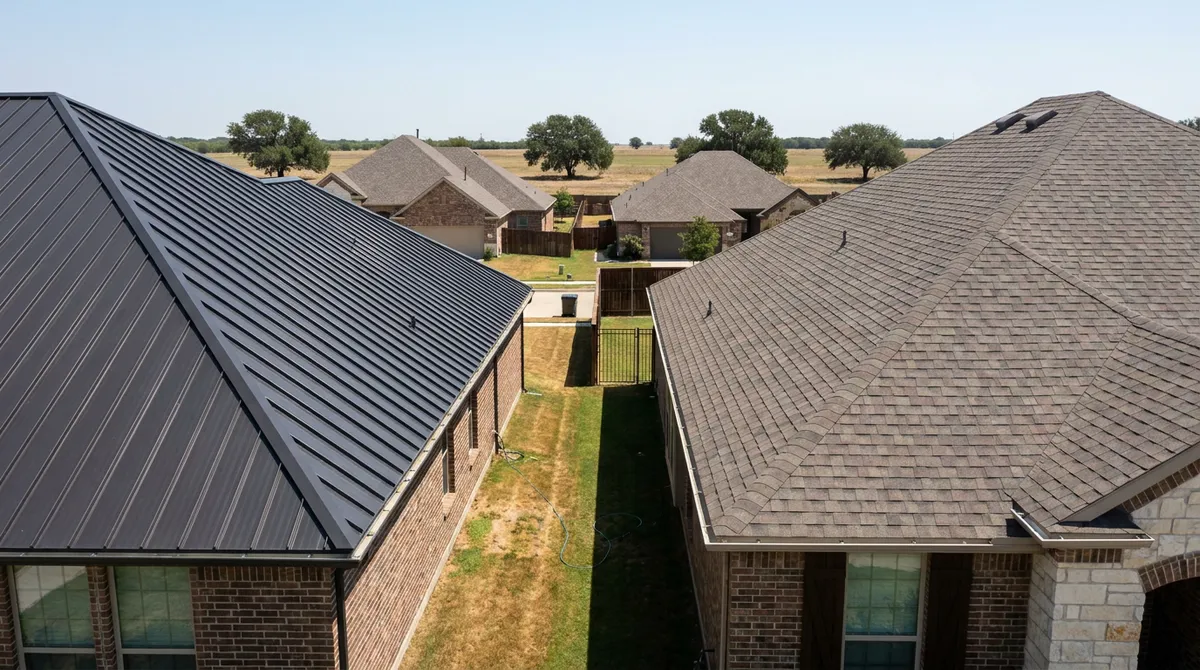
If you’re staring at a 110-degree forecast and wondering whether to spend $45,000 on a standing seam metal roof or $18,000 on architectural shingles, here’s the short answer: in Dallas heat, a properly installed standing seam metal roof keeps your attic 50 to 80 degrees cooler than a comparable asphalt shingle roof, lasts 2 to 3 times longer, and survives hail better than almost any shingle on the market. That said, shingles win on upfront cost, insurance claim simplicity, and resale predictability for homes under $500k. I’ve installed both across Plano, Frisco, and Dallas since 2022, and the right call depends on how long you’re staying, what your attic looks like, and whether you’ve already burned through a hail claim this decade. Let’s walk through the real numbers.
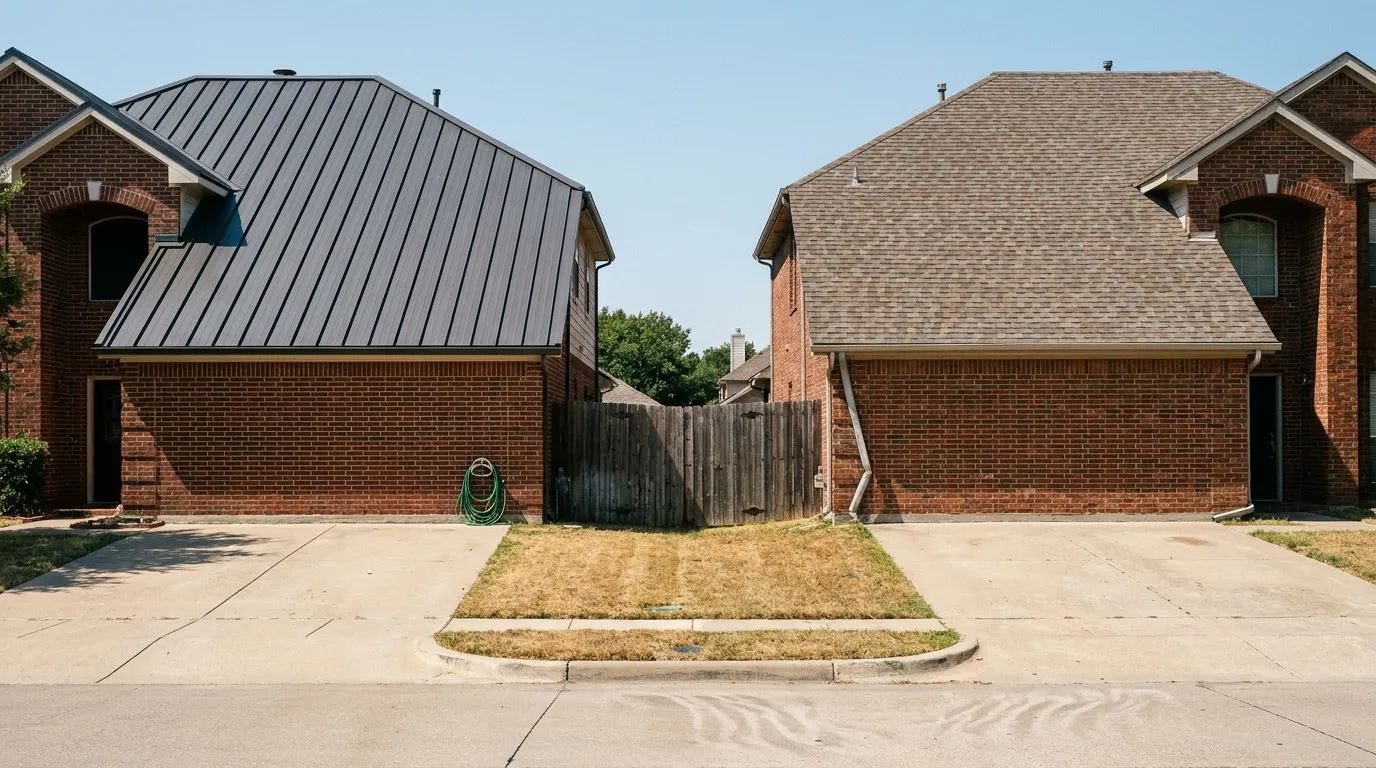 Two suburban homes side by side, standing seam Galvalume metal on one and architectural asphalt shingles on the other, shown on a hot summer afternoon.
the real cost gap in 2026 dfw pricing.
The price spread between shingle and metal is wider in DFW than the national averages suggest, mostly because our labor pool runs hot during storm seasons and metal crews are scarcer than shingle crews. Here’s what we’re quoting on a standard 2,800 sq ft Plano two-story with a 7/12 pitch as of January 2026:
| roof system | installed cost | cost per sq ft | typical lifespan in dfw |
|---|---|---|---|
| CertainTeed Landmark (3-tab upgrade) | $14,500 to $17,000 | $5.20 to $6.10 | 15 to 18 years |
| CertainTeed Landmark Pro architectural | $17,500 to $21,000 | $6.25 to $7.50 | 20 to 25 years |
| Owens Corning Duration Storm Class 4 | $19,000 to $23,500 | $6.80 to $8.40 | 22 to 28 years |
| Standing seam 24-gauge Galvalume metal | $38,000 to $48,000 | $13.50 to $17.10 | 45 to 60 years |
| Stone-coated steel (DECRA, Boral) | $42,000 to $52,000 | $15.00 to $18.50 | 40 to 50 years |
A few things drive that gap. Metal panels themselves run $4.50 to $6.50 per sq ft at material cost, versus $1.10 to $1.80 for architectural shingles. The bigger jump comes from labor. Standing seam requires a crew that can run panels straight on 36-foot rakes, terminate ridges and valleys without face-fastening, and bend custom flashings on site. We’ve got two crews that do it well, and they bill at roughly 2.2x the rate of our shingle crews.
If paying cash for the whole job upfront isn’t in the cards, we offer an in-house payment plan on qualified projects. A larger upfront deposit gets the work started and the balance is split over flexible terms depending on the size of the project. Details on our payment plans page.
attic temperatures: what we actually measured.
This is where metal earns its premium in DFW. Last July, Sara and I ran temperature loggers in eight Plano and Frisco attics over a 10-day stretch where outdoor highs hit 102 to 108°F. Four were architectural shingle, four were metal (two standing seam, two stone-coated steel). All had R-38 batt insulation in the attic floor, and all had ridge-and-soffit ventilation.
The shingle attics hit 138 to 152°F at the peak of the day. The metal attics topped out at 88 to 104°F. That’s a 50 to 80-degree gap, measured at the underside of the roof deck around 3pm.
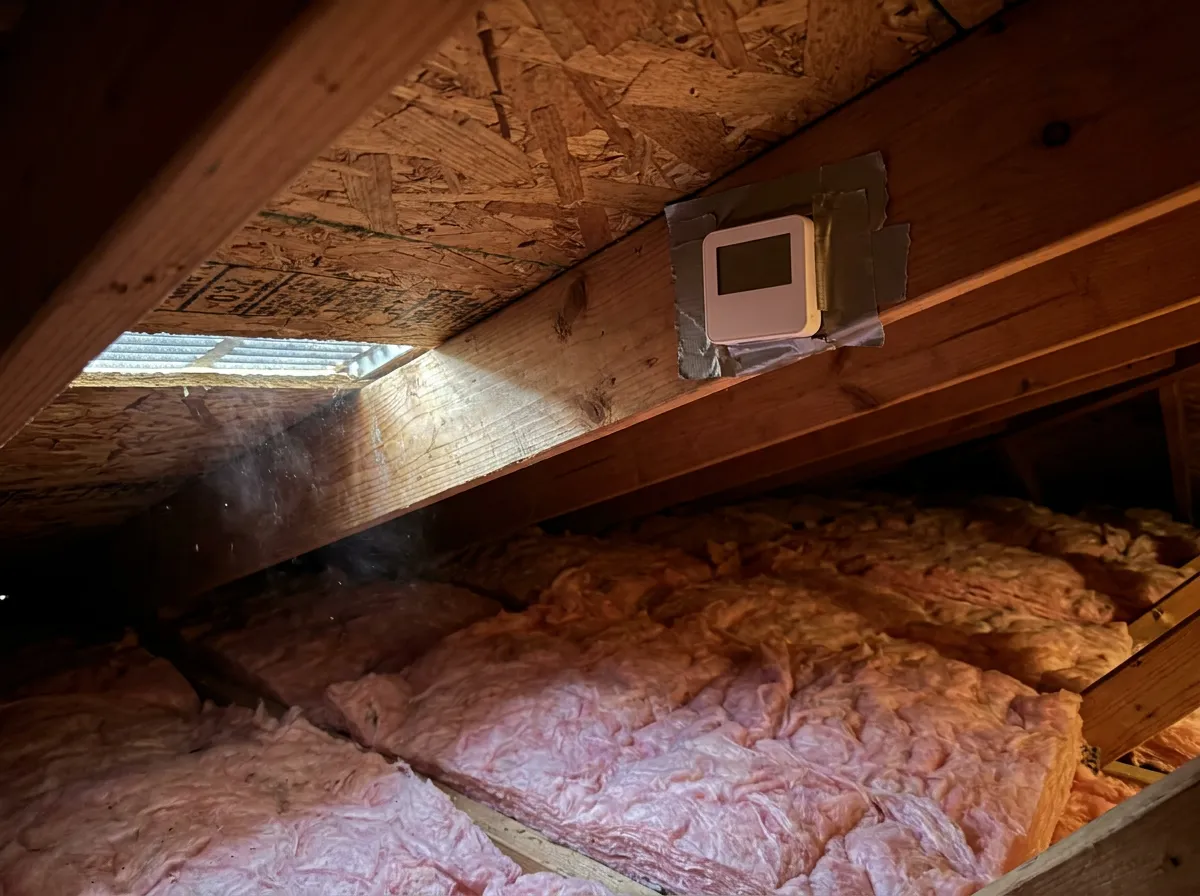 A small temperature logger taped to the underside of the roof deck in an attic with R-38 batt insulation on the floor below, illustrating how attic heat is measured.
Two things explain the gap. First, painted Galvalume and stone-coated steel reflect 60 to 70% of solar radiation, versus 15 to 25% for standard asphalt shingles. Second, the air gap created by the metal panel system (most metal installs sit on a batten or counter-batten with a vent channel) gives heat somewhere to escape before it conducts into the deck.
The HVAC implication matters more than people realize. A 60°F cooler attic means your ductwork (assuming it runs through the attic, which 90% of DFW homes do) isn’t fighting a 145°F sauna. Customers who switched to metal report 18 to 28% summer electric savings, and that lines up with what the energy modeling predicts. On a $380 July bill, that’s $70 to $105/month.
hail performance and the insurance reality.
DFW averages 2 to 3 hail events per year that exceed 1 inch. We’ve worked claims on every major storm since 2022, including the May 28 2023 Plano supercell, the April 9 2024 Allen/McKinney event, the May 23 2024 Wylie/Garland line, and the June 17 2024 Dallas/Highland Park cluster. Here’s what I’ve seen on actual roofs.
Asphalt shingle performance:
- 1.0 to 1.25 inch hail: cosmetic granule loss, often functional damage on 10 to 20% of slopes
- 1.5 to 1.75 inch hail: mat fractures on most south and west slopes, full replacement typical
- 2.0 inch+ hail: full tear-off across all slopes, sometimes deck damage
Standing seam metal performance:
- 1.0 to 1.75 inch hail: dimples on the panel faces, no functional damage, no leaks
- 2.0 to 2.5 inch hail: visible denting, possible paint chipping, almost never functional damage
- 2.75 inch+ hail (like June 17, 2024): denting visible from the ground, but I’ve yet to see a standing seam panel actually fail in DFW
Now here’s the insurance wrinkle that surprises people. Cosmetic damage to metal roofs is often excluded from coverage. Most DFW carriers added cosmetic exclusion endorsements to metal roof policies between 2020 and 2023. So if your standing seam roof gets dented but doesn’t leak, the carrier writes a $0 scope. Your shingle neighbor with the same storm exposure gets a full replacement at $22,000 RCV.
If you’re buying metal, read your policy. Ask the agent explicitly: “Is cosmetic damage to my metal roof covered, and what’s the deductible?” Get the answer in writing. We’ve walked customers through this on hail damage claims in Dallas more times than I can count.
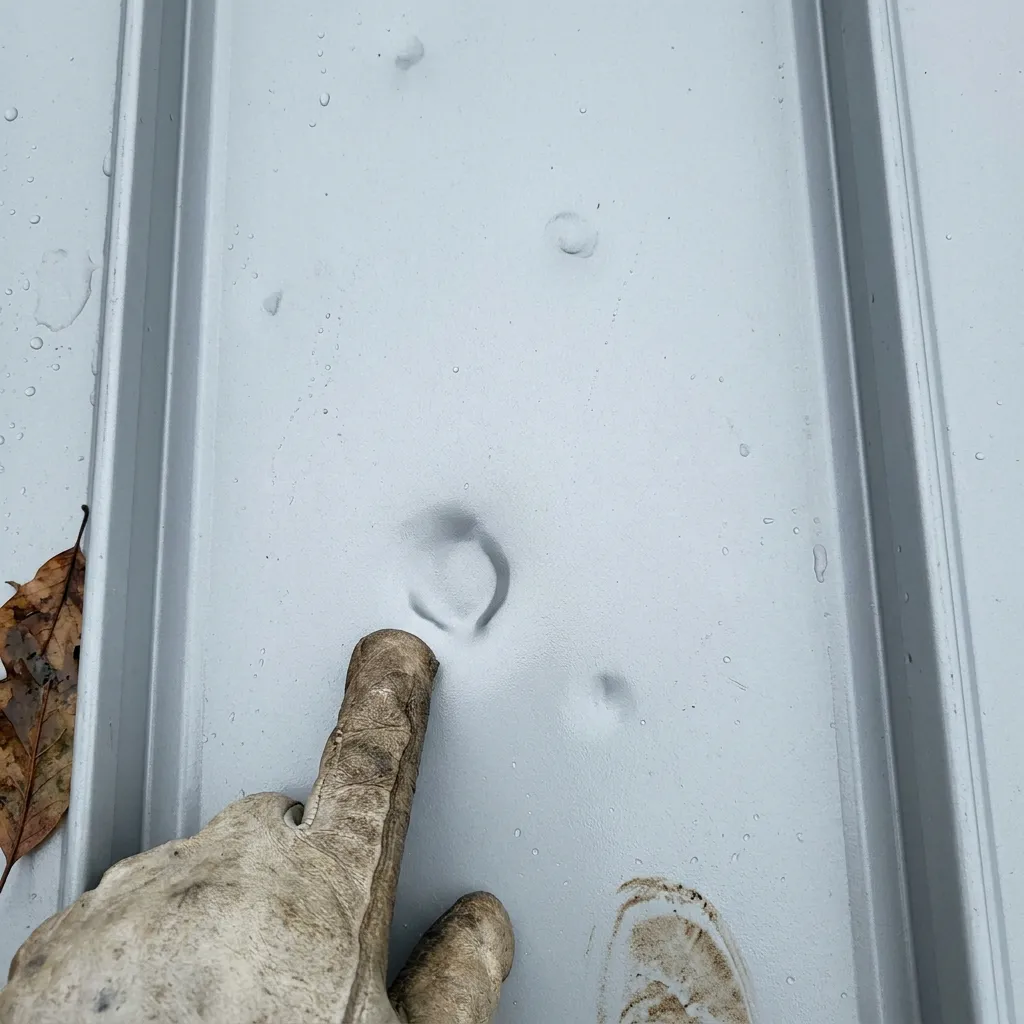 Visible hail denting across a standing seam Galvalume panel after a major storm, the kind of cosmetic damage often excluded from metal roof policies.
lifespan math: when metal pays back.
Run the 50-year numbers and metal almost always wins, but the breakeven point matters more than the total.
On a 2,800 sq ft home in Plano, here’s how the math typically plays out over 50 years (assuming you stay put or your kids inherit):
| scenario | year 0 | year 18 | year 36 | 50-year total |
|---|---|---|---|---|
| Architectural shingles ($19k each) | $19,000 | $24,000 (inflation adjusted) | $30,000 | $73,000 (3 roofs) |
| Standing seam metal ($44k) | $44,000 | $0 | $0 | $44,000 (1 roof) |
| Stone-coated steel ($47k) | $47,000 | $0 | $0 | $47,000 (1 roof) |
That’s a $26,000 to $29,000 lifetime savings on metal, plus the cooling cost savings (roughly $80/month average across the year, or $48,000 over 50 years undiscounted). On paper, metal smokes shingles for long-term owners.
The breakeven typically lands around year 12 to 14 for owner-occupants. If you’re planning to move within 8 years, shingles are almost always the smarter financial call. Buyers in the $300k to $500k DFW range don’t pay much premium for metal roofs at resale. Above $750k, especially in Highland Park and the older Plano neighborhoods, a properly installed standing seam roof can add $15,000 to $25,000 to appraised value.
For more on the full replacement decision, see our deep dive on roof replacement in Dallas and run real numbers through the free roof cost calculator.
noise, expansion, and the things nobody mentions.
A few things about metal roofs that the sales-driven content online tends to skip.
Noise. A standing seam roof installed over a solid deck with synthetic underlayment and R-38 attic insulation is roughly as quiet as a shingle roof in a rainstorm. I’ve measured 4 to 7 dB difference inside the living space, which is barely perceptible. Metal-over-purlins (which you see on barns) is genuinely loud. That’s not how we install residential metal.
Thermal expansion. A 40-foot standing seam panel expands and contracts roughly 1/2 inch across a 100°F temperature swing. In DFW, where attic temps can swing from 30°F in January to 150°F in July, that movement is real. Cheap installs use exposed fasteners that hole-elongate over 15 years and start to leak. Properly clipped standing seam (the kind we install) accommodates movement by design.
Walkability. Standing seam panels dent if you walk on them wrong. HVAC technicians, satellite installers, and Christmas-light hangers need to know which panels they can step on (over the seams, between purlins) and which they can’t (mid-panel between supports). We hand customers a one-page guide at handover.
Color fade. Kynar 500 / PVDF paint systems hold color for 30-plus years with under 5 Delta-E shift. Cheaper SMP (silicone-modified polyester) paint, which some installers use to hit a lower price point, fades visibly by year 12 to 15. If a metal quote is suspiciously cheap, ask about the paint system.
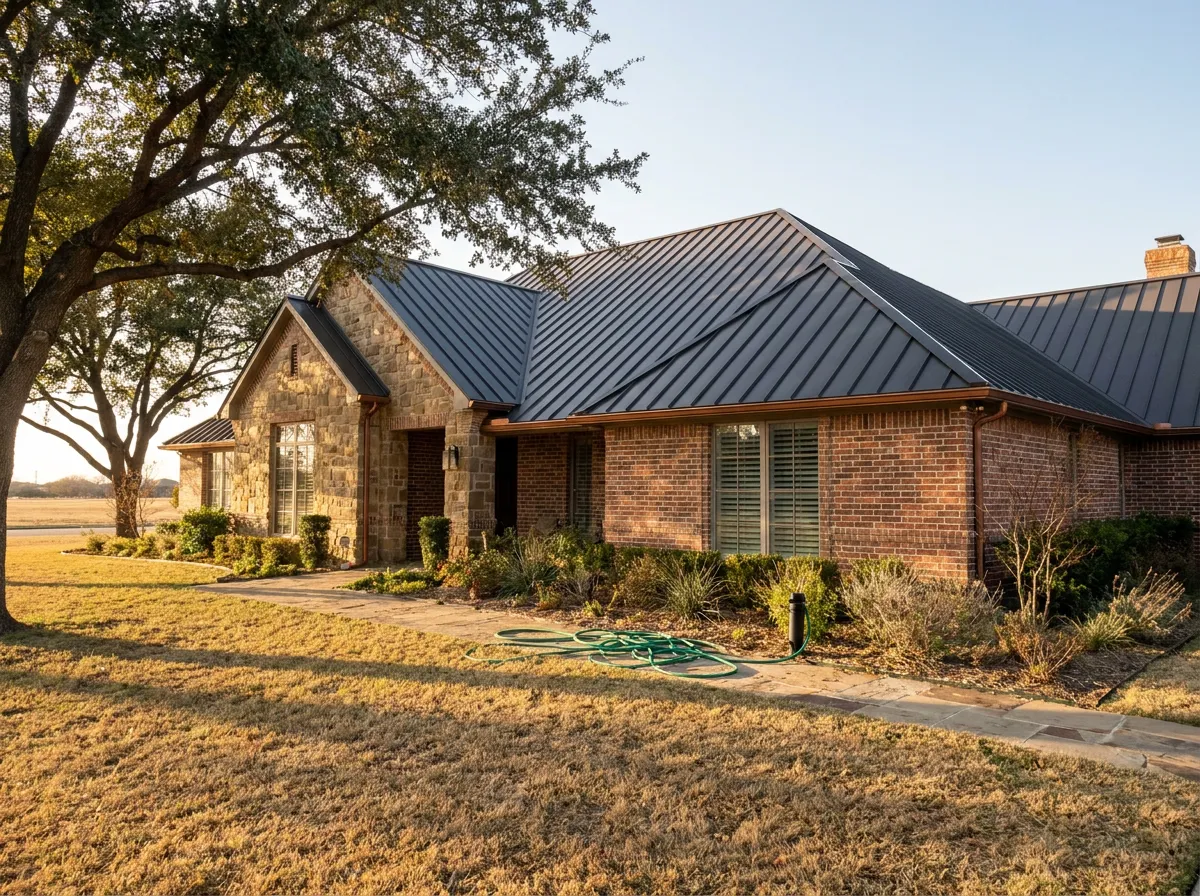 A matte black 24-gauge Galvalume standing seam roof with a Kynar 500 finish on an upscale North Texas home, holding its color years after install.
what we recommend by situation.
Here’s how we actually counsel customers when they call us. No abstractions, just the patterns we see.
Choose architectural shingles (Landmark Pro or Duration Storm) if:
- You’re staying less than 10 years
- Your home value is under $500k
- You’ve had a hail claim in the last 24 months and want carrier-friendly replacement
- You have a tight budget and want to add insulation, gutters, or solar separately
- Your HOA restricts metal (common in some Frisco and Prosper developments)
Choose standing seam metal if:
- You’re staying 12-plus years
- Your attic temps are killing your summer electric bill
- You’re in a high-end neighborhood where metal adds resale value
- You’ve already maxed out hail claims and want a roof that doesn’t need replacement
- You have a low-slope section (under 3/12) where metal outperforms shingles
Choose stone-coated steel if:
- You want metal performance but need an HOA-friendly look that mimics tile or shake
- You’re in a fire-prone area (less relevant in DFW, but real in West Plano and rural Collin County)
- You want the longest warranty on the market (most stone-coated systems carry 50-year, transferable)
For commercial buildings, the math shifts. We run mostly TPO and standing seam on commercial buildings across Dallas, and on most flat-to-low-slope commercial roofs, metal is the wrong call. See our breakdown on commercial roofing in Dallas for that conversation.
frequently asked questions.
How much does a metal roof cost in Dallas for a 2,500 sq ft house? Expect $34,000 to $42,000 for standing seam Galvalume, or $38,000 to $46,000 for stone-coated steel, fully installed. Pricing varies with pitch, complexity, and whether tear-off is needed. We’ve quoted as low as $31,000 and as high as $58,000 on the same square footage depending on cut-ups.
Will a metal roof lower my homeowners insurance in Texas? Sometimes. Carriers like USAA, State Farm, and Allstate offer 5 to 15% premium discounts for impact-rated roofs, which includes most standing seam systems. The discount often gets clawed back by cosmetic damage exclusions and higher deductibles on metal roofs. Net impact varies. Always ask your agent to run both quotes side by side.
Does a metal roof make the house hotter in Dallas summer? No, the opposite. Painted Galvalume and stone-coated steel reflect 60 to 70% of solar radiation, versus 15 to 25% for asphalt shingles. We measured 50 to 80°F cooler attic temps in metal roof homes across Plano and Frisco in July 2025. Cooling savings typically run 18 to 28% in summer months.
Can hail dent a standing seam metal roof? Yes, hail over 1.75 inches will leave visible dents on most standing seam panels. Functional damage (leaks) is rare even at 2.5 inches. The bigger issue is that most DFW carriers now exclude cosmetic damage from metal roof policies, so dents may not be covered. Read your endorsement before signing.
What’s the cheapest way to cool my attic without replacing the roof? Before spending $45,000 on metal, run through the cheap wins first. Add ridge and soffit vents if you don’t have them ($800 to $1,800), upgrade attic insulation from R-19 to R-38 ($2,200 to $3,500 in a Plano-sized home), and add a radiant barrier to the underside of the deck ($1,500 to $2,800). Those three together typically drop attic temps 25 to 40°F.
How long does a metal roof installation take in DFW? A standard 2,800 sq ft Plano home takes our metal crew 6 to 9 working days, versus 2 to 3 days for architectural shingles. Standing seam panels are cut, formed, and clipped on site, and ridge, valley, and chimney flashings are custom bent. We schedule metal jobs out 4 to 7 weeks in calm weather and longer after storm events.
If you’re weighing metal versus shingle on a Plano, Frisco, or Dallas home and want a real conversation about which one fits your timeline and budget, call us at (214) 326-3106 or check our recent installations for both systems side by side. We’ll measure your roof, pull your insurance policy, look at your attic, and tell you straight up which one we’d put on our own house. No pressure quotes, no upsell scripts. Mahmoud or Sara will pick up the phone.