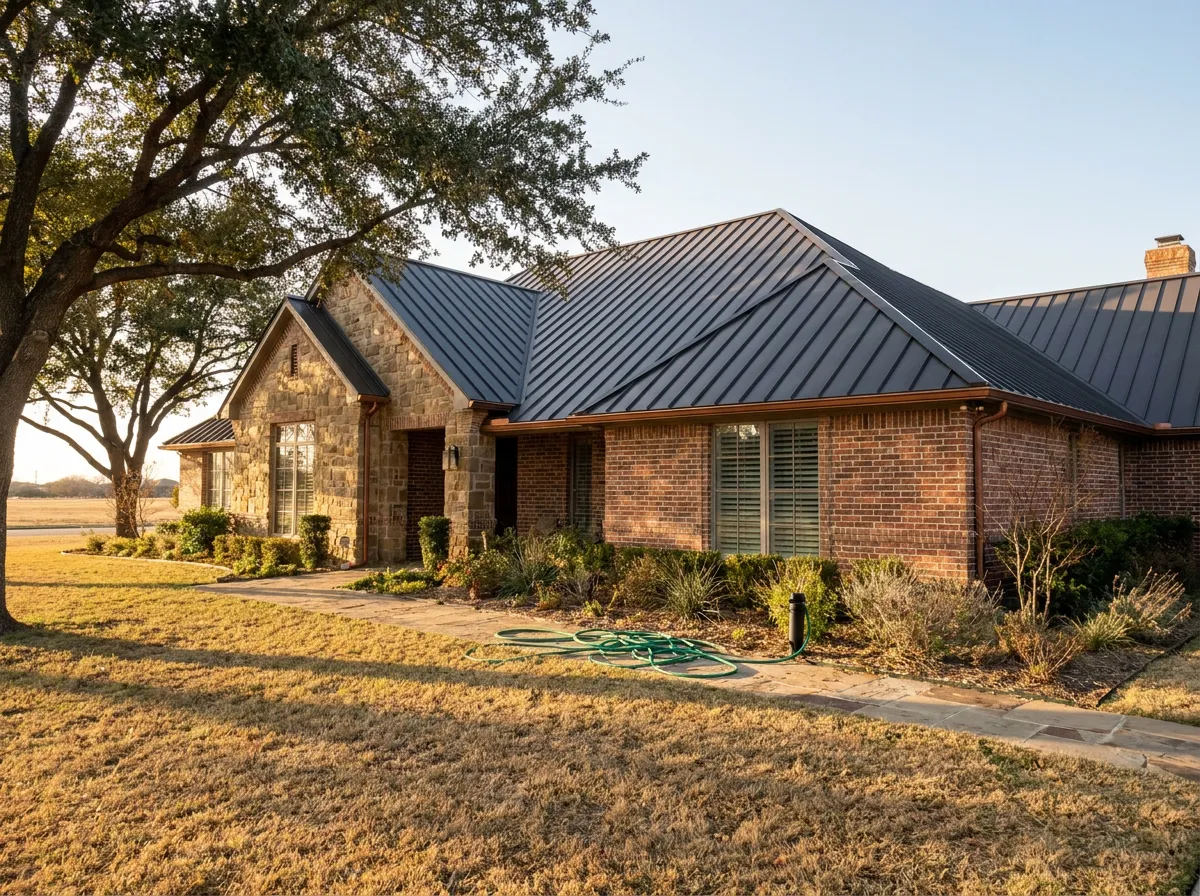
Key takeaways
- Standing seam metal runs $12 to $22 per square foot of roof installed across Dallas-Fort Worth, tear-off included. A 2,400 sq ft roof lands between $28,800 and $52,800.
- That is roughly two to four times architectural shingles ($3.50 to $5.50 per square foot) on the same roof, for a roof that lasts 40-plus years instead of 18 to 22.
- Five decisions set where you land in the range: gauge (24 vs 26), seam profile (snap-lock vs mechanically seamed), paint finish (PVDF vs SMP), pitch (5, 10 or 15 percent) and the number of penetrations.
- Roof area is about 1.2 to 1.3 times your home's square footage, and every roofer prices by roof area, not house area.
- Texas led the country with 902 major hail events in 2025. A 24-gauge, UL 2218 Class 4 panel is the spec for any home north of I-20.
- Some carriers discount Class 4 rated metal, and many now exclude cosmetic hail dents on metal. Ask your agent for both in writing.
A standing seam metal roof costs $12 to $22 per square foot of roof installed across Dallas-Fort Worth in 2026, so a typical 2,400 sq ft roof runs $28,800 to $52,800 with tear-off, underlayment, flashing and haul-off included. That is two to four times architectural shingles on the same house, for a roof that lasts 40-plus years.
standing seam cost by home size in dfw.
Roofers price by roof area, not house area. Pitch, overhangs and cutting waste push the roof past the floor plan, and across the DFW homes we measure a roof runs about 1.2 to 1.3 times the home’s square footage. A 2,000 sq ft home carries roughly 2,400 sq ft of roof, or 24 squares (a square is 100 sq ft of roof).
Here is 2026 standing seam pricing for a full tear-off and replace in DFW, beside the architectural shingle column from our Texas roof cost guide.
| Home size | Roof area (approx.) | Architectural shingle | Standing seam metal |
|---|---|---|---|
| 1,500 sq ft | ~1,800 sq ft (18 sq) | $6,300 to $9,900 | $21,600 to $39,600 |
| 2,000 sq ft | ~2,400 sq ft (24 sq) | $8,400 to $13,200 | $28,800 to $52,800 |
| 2,500 sq ft | ~3,000 sq ft (30 sq) | $10,500 to $16,500 | $36,000 to $66,000 |
| 3,000 sq ft | ~3,600 sq ft (36 sq) | $12,600 to $19,800 | $43,200 to $79,200 |
The roof area column uses the 1.2 multiplier; a steep, cut-up two-story in Frisco or Keller runs closer to 1.3. The low end of the metal column is 26-gauge snap-lock in an SMP finish on a simple 6/12 single-story. The high end is 24-gauge, mechanically seamed, PVDF, steep and heavily flashed.
A 2,000 sq ft home carries about 2,400 sq ft of roof. That is the number every standing seam bid should start from, and the first thing to check when three bids disagree.
Most full shingle replacements we do land between $14,500 and $32,000. Standing seam sits above that band almost every time, which is why most of our metal goes on in Plano’s Willow Bend and Stonebriar, Phillips Creek Ranch in Frisco, and Timarron in Southlake.
six things that move a standing seam quote.
Two 2,400 sq ft roofs can land $20,000 apart and both be priced honestly. These are the lines doing it.
Gauge: 24 vs 26. Lower number, thicker steel: 24-gauge is roughly 0.024 inches, 26-gauge roughly 0.018. On our quotes 24-gauge adds about $1.50 per square foot, around $3,600 on a 2,400 sq ft roof. For that you get far better dent resistance under the 2 to 3 inch hail that hit Frisco and Prosper on May 28, 2023, less oil-canning, and the UL 2218 Class 4 rating carriers look for. North of I-20 we spec 24. On a porch or accent roof, 26 is fine.
 24-gauge next to 26-gauge. Six thousandths of an inch decides whether the roof carries a Class 4 rating.
Panel width and seam profile. Panels come 12, 16 or 18 inches wide; narrower means more seams and clips per square foot but less oil-canning. Most DFW homes get 16-inch. The seam moves the price more: snap-lock panels press together by hand and sit at the low end of the range, while mechanically seamed panels are folded 180 degrees by a powered seamer and sit in the upper half. You need the mechanical seam on 2/12 to 3/12 slopes, runs over 30 feet, and anywhere wind uplift is the priority. Our standing seam page has the full matrix.
Paint finish: PVDF (Kynar 500) vs SMP. This is the line contractors quietly trim. PVDF is about 70 percent polyvinylidene fluoride resin and 30 percent acrylic, and Kynar 500 has been on buildings since 1965 per Arkema. SMP (silicone-modified polyester) is the cheaper system. Sheffield Metals publishes both coil warranties side by side: 30 years of fade and chalk coverage on each, but PVDF is held to a tighter fade limit (5 Hunter delta-E units versus 7 for SMP on roofs) and a higher chalk rating (8 versus 6), and PVDF coil cost about 60 to 80 percent more than SMP as of early 2022. Installed, that works out to roughly $1,800 to $2,400 on a 2,400 sq ft roof. With 61 percent of possible sunshine a year in DFW, PVDF is where we put the money.
Pitch. Walkable 4/12 to 6/12 is base. We add 5 percent for moderate pitch, 10 for steep, and 15 for the 10/12 and 12/12 roofs on custom builds along the Dallas North Tollway. Harnesses, staging and slower panel handling are why.
Tear-off and decking. Tear-off, haul-off, dump fees and a magnetic nail sweep are inside the $12 to $22 range. Decking cannot be priced until the old roof is off: rotted sheets are replaced at $70 to $100 each, photographed, and billed only as used. A 20-year-old roof in Richardson or Garland typically gives up two to eight sheets.
Penetrations, flashing and the rest. Every pipe, vent, skylight and chimney gets a custom-bent pan flashing or cricket, so nine penetrations cost more than three. Ridge vent runs $8 to $18 per linear foot. Permits run $95 to $300 by county: Collin $95 to $250, Dallas $125 to $300, Tarrant $110 to $275, Denton $95 to $260. All of it belongs on the bid as a line, not a week-two change order. Our guide to comparing DFW roofing estimates shows how to read three bids against each other.
standing seam vs exposed fastener vs stone-coated.
“Metal roof” covers three different products, and the cheap quote at your door is usually the middle column priced like the left one.
| Standing seam | Exposed fastener (R-panel, 5V crimp) | Stone-coated steel | |
|---|---|---|---|
| Installed cost in DFW | $12 to $22 per sq ft | $5 to $9 per sq ft | $9 to $14 per sq ft |
| Fasteners | Concealed clips, panel floats | Screws through the face with rubber washers | At the panel nose, hidden by the next course |
| Hail | 24-gauge dents at 1.75 inches and up, rarely leaks; Class 4 on most 24-gauge systems | Thinner 26 to 29 gauge dents more; every washer is a future leak | Granules hide dents; Class 4 on DECRA and Boral |
| Warranty (manufacturer only) | PVDF fade and chalk, typically 30 years, plus substrate | SMP finish, looser fade limits | Limited lifetime, often transferable |
| DFW lifespan | 40-plus years | Panels 25 to 35; washers need attention by year 12 to 15 | 40 to 50 years |
 Standing seam, stone-coated steel, R-panel and corrugated. Same word on the quote, four different roofs.
The rubber washer under an exposed screw is the clock on that roof. Standing seam has no washer to dry out, which is most of what you are paying for.
Stone-coated steel is the HOA workaround: it reads as shingle or tile from the curb and clears committees in older Carrollton and Richardson neighborhoods that still ban metal by name. Our metal roofing overview covers all four systems.
two representative dfw standing seam jobs, itemized.
These are representative examples built from the pricing in this post, not named customers. They show how a per-square-foot number becomes an invoice.
Example A: single-story in Plano, 24-gauge snap-lock, Kynar 500. 2,000 sq ft home, about 2,400 sq ft of roof (24 squares), 6/12 pitch, four penetrations, Collin County permit.
- Tear-off, haul-off, dump fees and nail sweep: $2,400
- Decking, three sheets at $70 to $100: about $270
- High-temp synthetic underlayment plus ice and water shield: $1,900
- 24-gauge Kynar 500 panels, clips and fasteners, standard color: $14,400
- Custom-bent ridge and hip caps, valleys, pan flashings, pipe boots: $3,200
- Ridge vent, 50 linear feet at $8 to $18: about $650
- Labor for panel set, snap-lock seaming and flashing: $12,500
- Permit, Collin County: about $180
- Total: about $35,500, or $14.80 per square foot of roof
Example B: two-story in Southlake, 24-gauge mechanically seamed, custom Kynar color. 2,800 sq ft home, about 3,500 sq ft of roof (35 squares) at the 1.25 multiplier, 10/12 pitch, nine penetrations including a chimney, Tarrant County permit.
- Tear-off, haul-off and dump fees on a two-story: $3,850
- Decking, eight sheets at $70 to $100: about $700
- High-temp synthetic underlayment plus ice and water shield: $2,900
- 24-gauge mechanically seamed Kynar panels and clips, custom color (about 10 percent material upcharge): $24,500
- Chimney cricket, nine penetrations, ridge and hip caps, valleys: $6,200
- Ridge vent, 70 linear feet: about $900
- Labor including powered seaming: $21,000
- Steep-pitch adder, 15 percent on labor and tear-off: about $3,700
- Permit, Tarrant County: about $240
- Total: about $64,000, or $18.30 per square foot of roof
Same product, $28,500 apart, and nothing on either list is padding. Example B has 46 percent more roof, a seam that takes a machine, a chimney, and a pitch nobody walks without a harness. Run yours through the free roof cost calculator, then hold any bid against these line items.
why we tear off before metal goes on.
Someone will quote standing seam over your existing shingles to skip the tear-off. Some codes allow a recover over one layer. We tear off on every standing seam job anyway.
You cannot inspect what you cannot see. Rotted decking under a 20-year-old roof does not announce itself, and clips driven into soft plywood lose pull-out strength, which is the first thing a 70 mph June straight-line wind tests.
The manufacturer wants a clean substrate. Panel and finish warranties assume a solid deck and a high-temp underlayment. Shingle granules telegraph through a 24-gauge panel as waviness you will see from the street.
The insurance file. If the replacement started as a hail claim, the Texas 25 percent rule brings the slope to current code and the adjuster’s file wants decking and underlayment documented. We photograph every sheet and meet your adjuster on the roof. We document the damage; we do not adjust the claim, and Texas Insurance Code 4102.163 is why.
It is already in the price. Tear-off and haul-off are inside the $12 to $22 range. A recover saves a day, not a category. Our roof replacement page walks through the process.
 Panels going on over a clean, dried-in deck. The tear-off and inspection are what make the 40-year number believable.
what metal does to a dallas attic in august.
DFW averages 20.2 days a year at or above 100 degrees, with normal highs of 95.6 in July and 95.8 in August and a record 113 in June 1980, per the National Weather Service Fort Worth office, which also counts 2,824 cooling degree days a year. Your attic lives through all of them, and in most DFW homes so does your ductwork.
A light or mid-tone PVDF panel reflects much of that load before it reaches the deck. The EPA reports that high solar reflectance can cut peak cooling demand by 11 to 27 percent in air-conditioned homes. In the July logger test in our metal vs shingle post, metal attics in Plano and Frisco ran 50 to 80 degrees cooler at the deck than shingle attics the same week.
The roof you buy is also the attic you live under. In Collin County that is a July decision as much as a hail decision.
Color is the lever. Surrey Beige, Sandstone and Slate Gray do the reflecting; Matte Black looks sharp on a Highland Park Tudor and gives some of that back.
when the metal premium pays back.
Be honest about the comparison. Against the cheapest architectural shingle, two roofs at $8,400 to $13,200 each still cost less over 40 years than one metal roof at $28,800 to $52,800. Metal does not win on dollars alone against a builder-grade shingle.
Compare like with like and it changes. The shingle most of our Plano customers actually buy is Landmark Pro or a Class 4 impact shingle, about $22,000 to $24,500 on a 2,400 sq ft roof. Two of those over 40 years, the second at 2046 prices, is comfortably past $45,000. A 24-gauge snap-lock Kynar roof on the same house is one purchase in the mid-$30,000s to about $40,000.
Three things tilt it the rest of the way. Lifespan: DFW architectural shingles give 18 to 22 years and Class 4 shingles 20 to 25, while standing seam goes 40-plus, and InterNACHI puts metal at 40 to 80 years nationally (local numbers in our Texas roof lifespan guide). Hail: the Insurance Information Institute counts 902 major hail events in Texas in 2025, more than double second-place Kansas, and a Class 4 panel that dents instead of fracturing keeps you off the claim treadmill. Cooling, covered above.
Where it does not pay back: a home you will sell inside five years, a neighborhood where buyers do not price the roof, or a budget where the premium would otherwise buy insulation and a ridge vent. There, a Class 4 shingle is the smarter spend, and our Class 4 impact shingle post makes that case.
frequently asked questions.
How much does a standing seam metal roof cost in Texas? In Dallas-Fort Worth, standing seam runs $12 to $22 per square foot of roof installed, tear-off included. A 2,000 sq ft home carries about 2,400 sq ft of roof, so the job lands between $28,800 and $52,800. Gauge, finish, seam profile, pitch and penetrations decide where in that range you fall. Start with the free roof cost calculator.
Is a metal roof worth it in Texas? Usually yes if you plan to stay 12 or more years. Standing seam costs two to four times architectural shingles on the same roof, but lasts 40-plus years in DFW against 18 to 22, so one metal roof spans two shingle roofs. A cooler attic and a possible Class 4 discount narrow the gap. If you are selling within five years, shingles are the better financial call.
How long does a standing seam roof last? We plan on 40-plus years in DFW for 24-gauge standing seam with a PVDF (Kynar 500) finish on clips over solid decking. InterNACHI’s life expectancy chart puts metal roofing at 40 to 80 years. The paint ages before the steel: PVDF carries about 30 years of fade and chalk coverage from the coil coater. See the Texas roof lifespan guide.
Does a metal roof lower insurance in Texas? It can, but not automatically. Some Texas carriers apply an impact-resistant discount when the roof carries a UL 2218 Class 4 rating, which most 24-gauge standing seam systems do. Many carriers also add cosmetic damage exclusions to metal roofs, so dents that do not leak may not be covered. Ask your agent for both in writing before you sign.
How much more does metal cost than shingles? Standing seam at $12 to $22 per square foot is roughly two to four times architectural shingles at $3.50 to $5.50, and about double a Class 4 impact shingle at $5.50 to $6.50. On a 2,400 sq ft roof that is $28,800 to $52,800 against $8,400 to $13,200. The Texas roof cost guide has every tier side by side.
Can standing seam go over my old shingles? Some codes allow a metal recover over one layer of shingles. We tear off on every standing seam job anyway: hidden decking rot, the panel manufacturer’s substrate requirements, shingle texture telegraphing through the panels, and the insurance paper trail all argue for a clean deck. Tear-off and haul-off are already inside the $12 to $22 range we quote.
What is the cheapest metal roof option? Exposed-fastener panels (R-panel, 5V crimp) at roughly $5 to $9 per square foot installed, then stone-coated steel at about $9 to $14. Exposed fasteners rely on rubber washers that dry out in Texas sun, so we reserve them for shops and barns. For a home, 26-gauge snap-lock standing seam in an SMP finish is the lowest entry point with hidden fasteners.
If you are weighing standing seam on a Plano, Frisco, Southlake or Dallas home, start with a free inspection: one of our crew leads measures the roof, brings 24-gauge and 26-gauge samples to your driveway, and writes a line-item scope with gauge, seam, finish and color locked. Call (214) 326-3106, run the free roof cost calculator first if you want a number before you talk to anyone, and ask about our in-house payment plan on qualified projects: a larger upfront deposit gets the work started and the balance is paid on a schedule we agree together, with no bank involved. Details are on our payment plans page.