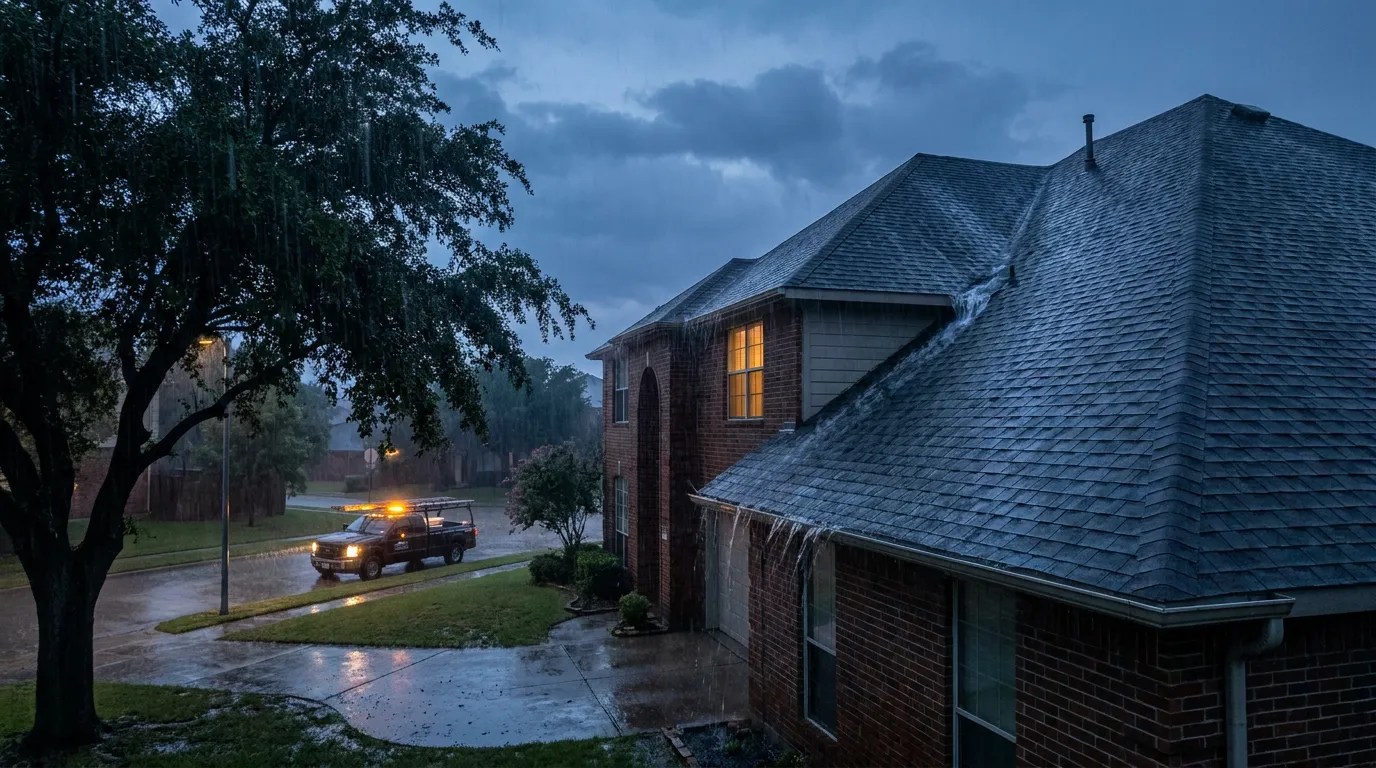
If water is dripping through your ceiling right now in Dallas, do these four things in the next ten minutes: move furniture and electronics out of the drip zone, put a 5-gallon bucket under the active drip, puncture any sagging ceiling bubble with a screwdriver to release trapped water, and photograph everything with a timestamp. Then call us at (214) 326-3106 so we can get a tarp on the roof before the next cell rolls through. That sequence saves you somewhere between $800 and $4,200 in drywall, insulation, and flooring damage versus waiting until morning. The rest of this post walks through why each step matters, what to tell your insurance carrier, and what we actually do when the truck shows up.
the first ten minutes when water comes through the ceiling.
When a homeowner calls our Plano office during an active storm, the conversation goes the same way every time. They want to know what to do before we get there, because Sara routes the dispatch and the truck might be 45 minutes out if we’re already on three other tarp calls. Here’s the order we walk them through.
Move everything out of the splash radius. That means a 6-foot circle around the drip, not 2 feet. Water bounces off the bucket lip and ruins hardwood, rugs, and the back of leather couches. We’ve seen $3,800 sectionals written off because someone left them under what they thought was a slow drip.
Get a bucket and a towel. A 5-gallon bucket from the garage, lined with an old towel to kill the drip noise and reduce splash. If the drip is fast, swap buckets every 20 minutes rather than letting one overflow.
Puncture the ceiling bubble. This is the one most people miss. When drywall starts to bulge or sag in a dome shape, there are gallons of water pooled above the paint layer. Take a screwdriver or a sharp pencil, stab the lowest point of the bubble, and let it drain into the bucket. If you don’t, the whole section collapses at 2 a.m. and you’re looking at insulation, framing, and a much bigger insurance claim.
Document everything before cleanup. Phone photos, timestamps on. Wide shot of the room, close-up of the ceiling, close-up of the bucket, close-up of any damaged furniture. Carriers ask for these later and “I cleaned it up” is the fastest way to get a claim reduced.
why dallas rain leaks are different than what you read online.
Most “roof leak” articles are written for the national average, which means they assume a 1/2-inch-per-hour drizzle. DFW doesn’t work that way. The May 28, 2023 hailstorm dumped 2.3 inches in 40 minutes across east Plano and Richardson. April 9, 2024 brought straight-line winds gusting to 78 mph through Frisco and McKinney. June 17, 2024 produced ping-pong-ball-sized hail across Highland Park and University Park.
What that means for your roof: the leak you’re seeing tonight is rarely a slow-developing problem. It’s a shingle that got lifted by wind, a flashing seam that opened up under hail impact, or a nail pop from the last temperature swing that finally let go. The water finds the path of least resistance, which is almost never directly above the drip. We’ve pulled shingles 14 feet uphill of the ceiling stain before.
| storm event | date | what failed most | what we saw on the truck |
|---|---|---|---|
| east Plano hailstorm | May 28, 2023 | 3-tab shingle granule loss + valleys | 60+ tarp calls in 72 hours |
| north DFW windstorm | April 9, 2024 | ridge caps, lifted shingles, fascia | 40+ tarp calls, mostly Frisco/McKinney |
| central DFW hail | May 23, 2024 | pipe boots, skylight flashing | 35+ leak calls in 48 hours |
| Highland Park hail | June 17, 2024 | high-end architectural shingles, copper valleys | 25+ calls, lots of insurance scope work |
If you live in Dallas, Plano, or Frisco, there’s a good chance the leak you’re chasing tonight started during one of those four storms and just didn’t show up until the next sustained rain.
what we actually do when the truck arrives.
A tarp call is not a repair. It’s a controlled holding pattern to stop water entry until the weather clears and we can do a proper emergency roof repair. Here’s the sequence once we’re on site.
- Walk the attic first. We go up to the attic with a flashlight and trace the water trail back to the entry point on the deck. Drip location on the ceiling is almost never directly under the actual roof penetration.
- Identify the failure. Lifted shingle, blown ridge cap, cracked pipe boot, failed skylight flashing, or a valley that’s overwhelmed. Each one gets a different tarp pattern.
- Tarp the section. We use 12-mil reinforced poly with 1x2 furring strips screwed into the decking, not nailed to shingles. Nail-to-shingle tarps fail in the next gust and you call us back at 4 a.m.
- Photo and report. Every tarp call gets a written field report with photos, the suspected failure point, and a recommended next step. That report goes to your carrier if you’re filing.
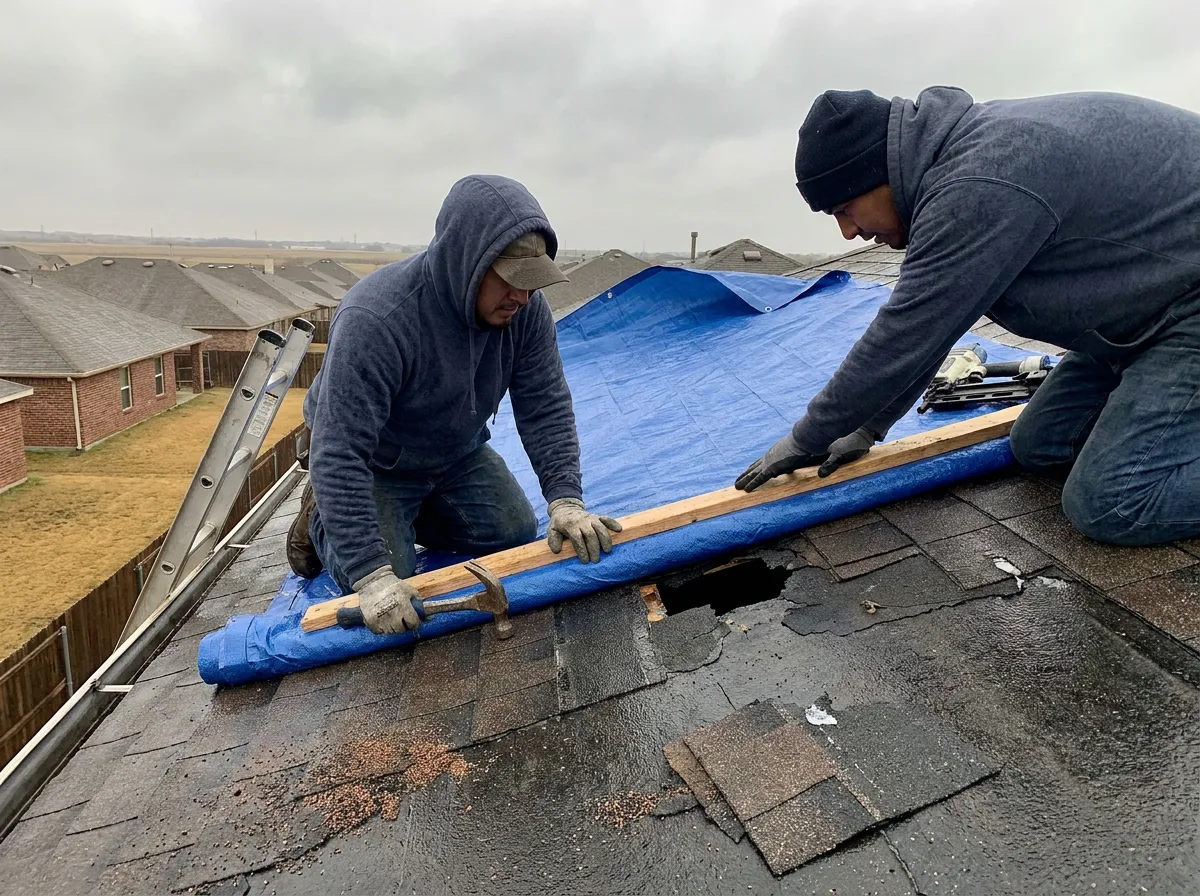
Tarp calls during active weather run $450 to $850 depending on access, pitch, and how much square footage we’re covering. If the leak ties back to a covered peril (wind or hail), most carriers reimburse the tarp cost as part of the claim.
the insurance call: what to say and when.
If the leak is small and the cause is clearly age (curled shingles, a 22-year-old roof, no recent storm), do not file a claim. Pay out of pocket for a roof leak repair in the $400 to $1,800 range and move on. Filing a claim on age-related wear gets denied and stays on your CLUE report for 5 to 7 years.
If the leak ties to a named storm or visible storm damage, here’s the sequence:
- Call your carrier and open a claim. You’ll get a claim number and an adjuster assignment within 24 to 72 hours.
- Document the active leak. Photos and video before you clean up anything.
- Get a tarp on the roof. Carriers expect you to mitigate further damage. If you don’t tarp and the leak runs for three more days, they can deny the interior damage portion.
- Meet the adjuster with a contractor on site. This is the single biggest leverage point in the whole process. Sara coordinates this for every insurance claim we work, and it changes the scope outcome dramatically.
- Review the scope. Adjusters miss things. Pipe boots, drip edge, ice and water shield, code upgrades. A good contractor catches the gaps and writes a supplement to add them back in.
Key terms you’ll hear: ACV is the depreciated value the carrier pays first. RCV is the full replacement cost, paid as the second check after the work is done. Depreciation is the gap between them, and it’s what most homeowners leave on the table when they don’t understand the process.
the five most common dallas leak causes we find.
After running this for four years out of our Plano shop, the leaks we find on rainy-night calls fall into five buckets almost every time.
1. Pipe boot failure. The rubber gasket around plumbing vents cracks after 8 to 12 years in Texas UV. Replacement is $85 to $180. We see this on roofs as young as 6 years if the original boot was builder-grade.
2. Lifted or missing shingles. Wind events lift the leading edge, the sealant strip never reseals, and water tracks under. The April 9, 2024 windstorm produced hundreds of these calls.
3. Cracked or failed skylight flashing. Skylights leak more than any other penetration on the roof. If you have a skylight over the active leak, that’s almost certainly the cause.
4. Valley overflow on low-pitch sections. If your roof has a 4:12 or shallower section feeding a valley, heavy rain can overwhelm the valley and push water sideways under shingles. This is a design issue, not a damage issue, and the fix is usually ice and water shield in the valley during the next roof replacement.
5. Step flashing on chimneys and walls. When the original installer caulked instead of weaving proper step flashing, the caulk fails at year 10 to 14 and you get a leak that shows up inside a wall, not on the ceiling.
what it costs to actually fix it.
Once the storm passes and we can do a real repair, here’s what you’re looking at in DFW pricing as of early 2026.
| repair type | cost range | typical timeline |
|---|---|---|
| pipe boot replacement | $85 to $180 | same day |
| single shingle repair (3-tab) | $250 to $450 | same day |
| single shingle repair (architectural) | $350 to $650 | same day |
| ridge cap rebuild | $400 to $900 | 1 day |
| valley re-flash | $850 to $1,800 | 1 to 2 days |
| skylight re-flash | $650 to $1,400 | 1 day |
| full roof replacement (avg 2,400 sq ft) | $14,000 to $28,000 | 1 to 2 days |
If the repair pushes past $3,500 and you’re not running an insurance claim, we offer an in-house payment plan on qualified projects. A larger upfront deposit gets the work started and the balance is split over flexible terms depending on the size of the project. Details on our payment plans page. Most leak repairs don’t need a payment plan. Most full replacements do.
frequently asked questions.
Will my homeowner’s insurance cover a roof leak during rain? Only if the leak is caused by a covered peril like wind or hail, and only if you mitigate further damage by tarping. Wear-and-tear leaks from an old roof are not covered. Sudden damage from a named storm usually is.
Can you tarp my roof at night during the storm? Yes, if the lightning has passed and our crew can safely access the roof. We don’t put anyone on a roof during active lightning. If the storm is still active, we’ll dispatch as soon as the cell moves through.
How long can I leave a tarp on the roof? A 12-mil reinforced poly tarp installed with furring strips will hold for 60 to 90 days. After that the UV starts breaking down the material. We typically schedule the permanent repair within 2 to 4 weeks.
My ceiling is sagging but not dripping yet. What do I do? Puncture the lowest point of the bubble with a screwdriver and put a bucket under it. The water is already up there, it’s just trapped above the paint. Letting it drain in a controlled way is much cheaper than letting the drywall collapse.
Do you charge for the initial leak inspection? For homeowners filing an insurance claim, our inspection and adjuster meeting are no charge. For non-claim repair work, we charge $0 for the inspection and quote the repair on site. See our work for examples of what we’ve handled.
What’s the difference between a leak repair and storm damage repair? A leak repair fixes the specific failure point. A storm damage repair addresses everything the storm hit, often including sections that aren’t actively leaking yet but will within 6 to 18 months. Insurance claims usually fund the second one.
One caveat before you pay for a second or third leak fix: if the roof is past 18 to 22 years in DFW sun, patches buy months, not years. Compare the honest numbers on our roof replacement page or ballpark your address with the free roof cost calculator before you commit to another repair.
If water is coming through your ceiling right now, stop reading and call us at (214) 326-3106. We dispatch tarp crews across Dallas, Plano, Frisco, McKinney, and the rest of DFW seven days a week, including nights during active storms. Sara answers most after-hours calls personally and she’ll get you a realistic ETA and walk you through the rest of the mitigation steps while the truck is on the way.