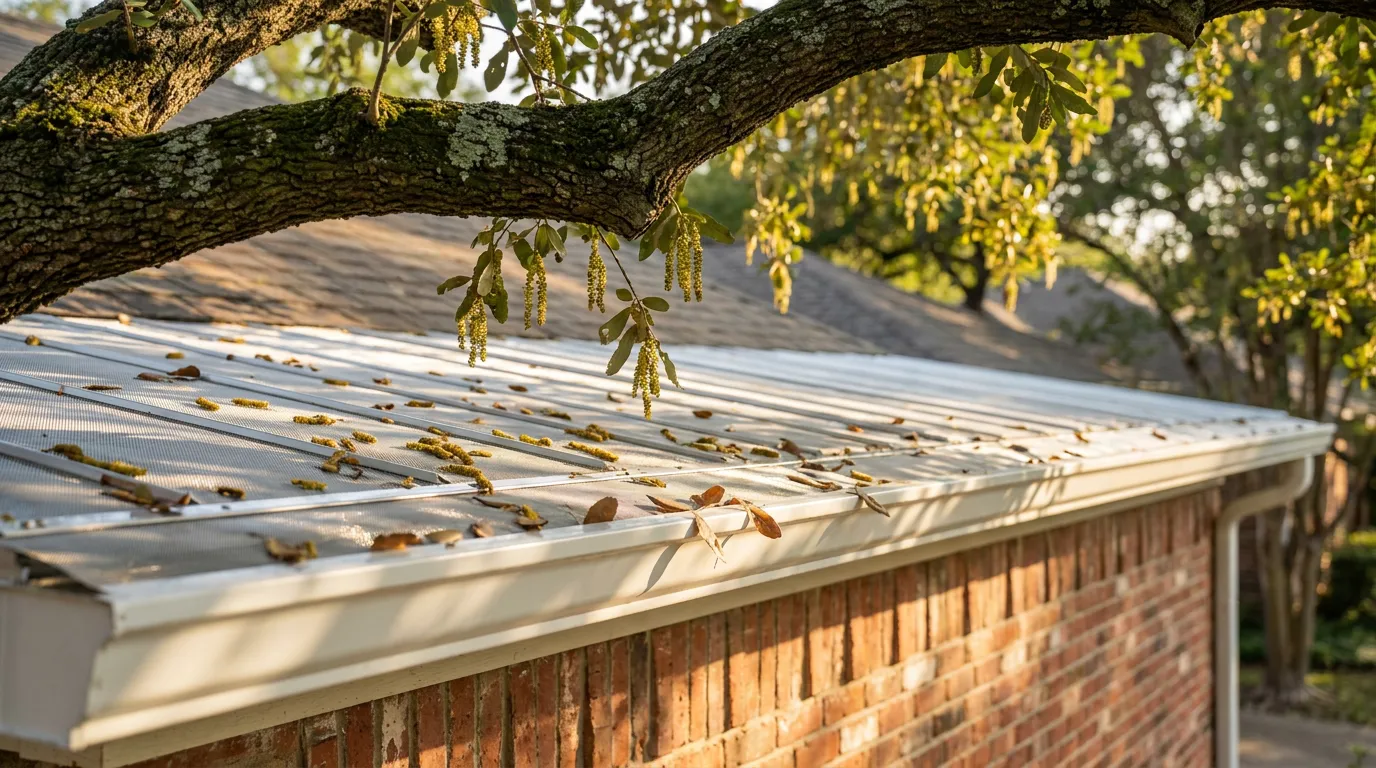
Short answer: gutter guards are worth it in Dallas if you have live oaks, pecans, cottonwoods, or pines within thirty feet of the house, and you buy stainless micro-mesh installed at $8 to $12 per foot. They are not worth it if you have no mature trees, if you buy foam or plastic inserts, or if you are paying a national brand $40 a foot for the same mesh. Here is the verdict by yard, by guard type, and by what DFW rain does to each one.
I’m Sara, co-owner of Roof Raiders. I have written enough gutter guard estimates across Plano, Frisco, McKinney, and Rowlett to know exactly which homes call us back happy and which ones we should have talked out of it.
the dallas debris problem is different.
National gutter guard advice assumes fall leaves. Dallas does not have a fall leaf problem so much as a spring one, and it is worse.
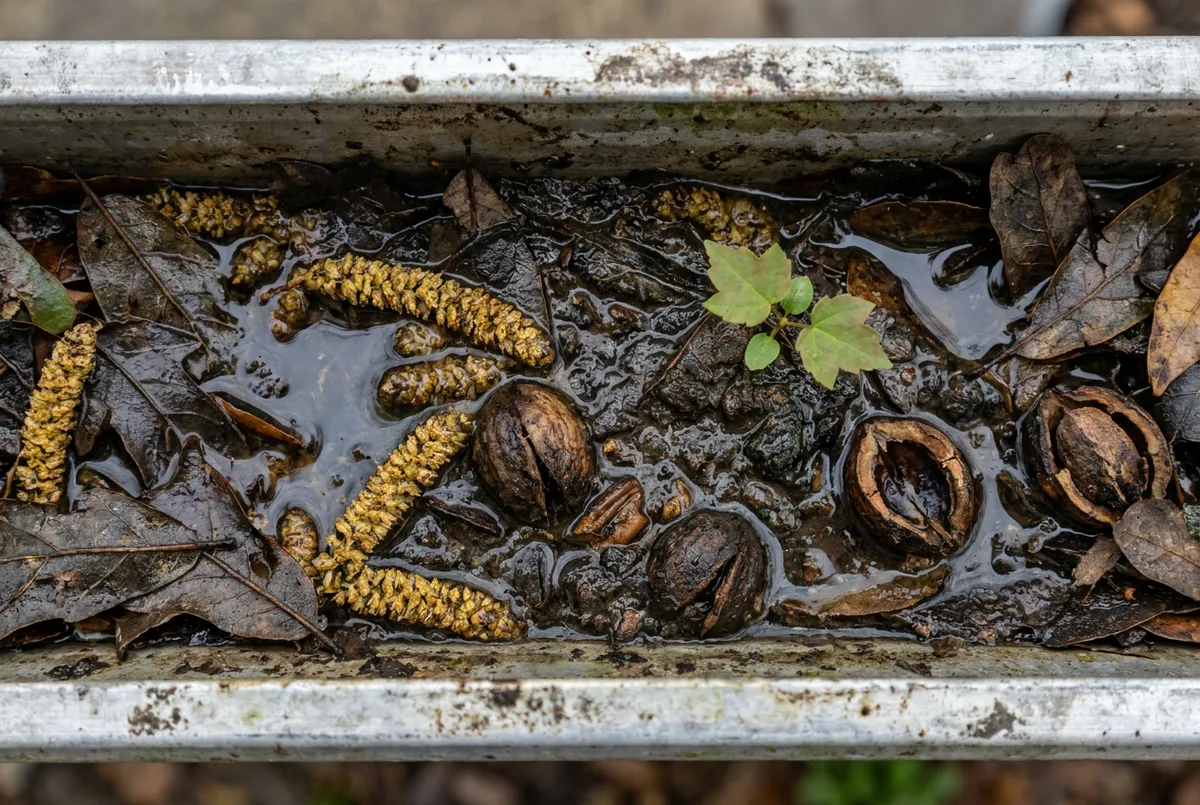
Live oaks, which shade half the older neighborhoods in DFW, drop their old leaves in late winter and early spring and then release catkins and pollen. Per Texas A&M AgriLife Extension, oak trees typically flower and produce their pollen in March and April. Those catkins are the worm-shaped tassels that pile up on driveways. They are small enough to slip past a screen, sticky enough to mat into foam, and light enough to ride water over a reverse-curve guard.
Then pecans drop husks and leaves in fall, cottonwoods shed fluff in early summer, and pine needles fall year-round. A gutter under that mix clogs twice a year without help, and a clogged gutter in a DFW downpour dumps water straight onto the foundation, which is the expensive part of this story.
the verdict by yard.
| Your yard | Verdict | Why |
|---|---|---|
| Live oaks or post oaks over the roof | Worth it, micro-mesh only | Catkins clog everything else |
| Pecans, elms, or hackberries nearby | Worth it, micro-mesh or reverse curve | Leaf and husk load twice a year |
| Cottonwoods or pines within 30 feet | Worth it, micro-mesh only | Fluff and needles pass through screens |
| Crepe myrtles and ornamentals only | Borderline | One cleaning a year may be cheaper |
| New-build subdivision, no mature trees | Not yet | Nothing to keep out, buy them in ten years |
| Roof valleys that dump onto one gutter run | Worth it, mesh with a valley splash guard | That section clogs first and overflows first |
The simplest test: if you are paying someone to clean your gutters twice a year, or you are climbing the ladder yourself, guards pay for themselves. If you have never had to clean them, they will not.
the verdict by guard type.
This is where most of the disappointment comes from. “Gutter guards” covers five products that have almost nothing in common.
| Guard type | Debris performance in DFW | Heavy rain | Lifespan | Installed cost per foot |
|---|---|---|---|---|
| Stainless micro-mesh | Excellent, blocks catkins and needles | Excellent when pitched right | 25 years to lifetime | $8 to $12 |
| Reverse curve (solid hood) | Good on leaves, fails on catkins | Overshoots in downpours | 20 years to lifetime | $4 to $8 |
| Foam inserts | Poor, clogs internally with silt and pollen | Poor, holds water | 2 to 4 years | $1.50 to $3 |
| Brush inserts | Poor, catches needles and holds them | Mediocre | 3 to 5 years | $2 to $4 |
| Plastic or aluminum screen | Poor, debris sits on top and rots | Mediocre | 3 to 7 years | $1 to $3 |
Our recommendation across every DFW yard with real trees is 304 stainless micro-mesh, with a hole size small enough to stop catkins, mounted on its own frame so it does not lift the shingles or screw through the gutter lip. Foam and brush inserts we will not install. They turn a gutter you could clean into a gutter you have to dig out.
This Old House surveyed homeowners who bought guards and found more than 69 percent were very satisfied with the value and nearly 30 percent said they no longer clean their gutters at all. The same article puts professional installation on a 200-foot home at $4,334 to $5,168, with national franchise brands at roughly $40 to $47 per linear foot. That is where our pricing diverges, and it is worth explaining.
what gutter guards actually cost in dallas.
From our gutter guards service page, installed pricing as of this year:
- Stainless micro-mesh: $8 to $12 per linear foot
- Reverse curve: $4 to $8 per linear foot
- Typical 200-foot Plano or Frisco home: $1,600 to $2,400 for micro-mesh, $800 to $1,600 for reverse curve
- Larger 350-foot Highland Park or Southlake home: $2,800 to $4,200 for micro-mesh
- Add $150 to $300 if the existing gutters need re-pitching or new hangers first, which we flag on the inspection, not after we start
The national franchise brands are selling a comparable stainless mesh with a large marketing and financing operation attached to it. The product on the roof is similar. The price per foot is three to four times higher. We install the mesh, water-test every run before we leave, and keep your gutter warranty intact.
The payback math at our pricing: a 200-foot micro-mesh install at about $2,000, against $200 twice a year for cleaning, pays for itself in five years and then runs another twenty for free. Under live oaks, where cleaning is three times a year, it is closer to three.
what heavy rain does to each guard.
This is the DFW-specific failure nobody mentions on the product box. Solid reverse-curve guards work on surface tension: water clings to the curve and drops into the gutter while leaves slide off. In a light rain that works. In a Texas thunderstorm, where an inch or more can fall in an hour, water hits the curve faster than tension can hold it and shoots straight over the edge in a sheet. You have a clean gutter and a flooded flower bed.

Micro-mesh handles volume better because water falls through the mesh instead of clinging to a surface, as long as two things are true: the guard is pitched slightly with the roof so debris sheds, and the mesh is clean. Under a dense live oak, mesh can film over with pollen in March and needs a quick brush-off, which is a sixty-second job from a ladder or a hose from the ground. That is the whole maintenance list.
If your roof has valleys dumping onto one gutter section, or a steep pitch that throws water hard at the eave, we add a splash guard at that spot regardless of guard type.
when guards are a waste of money.
We tell homeowners no in three situations:
- No mature trees. New-build subdivisions in Frisco and McKinney with four-foot saplings do not need guards yet. Save the money and buy them when the trees are over the roof.
- Gutters that are failing anyway. Guards on a sagging, mis-pitched, or rusted gutter just protect a gutter that needs replacing. We look at the gutters first and will say so if gutter replacement is the real job.
- A roof that is about to be replaced. Guards come off during a tear-off. If your roof has two years left, do the roof first and add the guards in the same visit.
the diy question.
Box-store guards run about $1.50 per foot, and the videos make it look like a Saturday project. What the videos skip: four to six hours on a ladder, the fall risk, the fact that most DIY products are the foam and plastic types in the table above, and the voided gutter warranty when screws go through the gutter lip. We redo a lot of DIY guard installs, usually inside two years. That is the most expensive way to buy gutter guards.
frequently asked questions.
What do roofers say about gutter guards? The honest ones say it depends on the guard and the trees. Stainless micro-mesh under live oaks and pecans is worth every dollar. Foam inserts and plastic screens are not worth installing anywhere. Reverse-curve guards work on light leaf loads and fail under DFW downpours and oak catkins.
What are the disadvantages of gutter guards? Up-front cost, the fact that cheap guards make cleaning harder instead of easier, water overshooting solid guards in heavy rain, and voided gutter warranties when guards are screwed through the gutter lip or fastened under shingles. Buying the right type and installing it correctly avoids all four.
How much do gutter guards cost installed in Dallas? Stainless micro-mesh runs $8 to $12 per linear foot installed, and reverse curve runs $4 to $8. A typical 200-foot Plano or Frisco home lands at $1,600 to $2,400 for micro-mesh. National brand franchises often quote $40 or more per foot for a comparable product.
Are there gutter guards that actually work? Yes. Fine stainless steel micro-mesh, with a hole size small enough to stop oak catkins and pine needles, mounted on its own frame and pitched to shed debris. That category handles the DFW debris load without seasonal cleaning. Most of the disappointment online comes from foam, brush, and snap-in plastic products.
Do gutter guards work in heavy rain? Micro-mesh does when it is pitched correctly and the mesh is clean. Solid reverse-curve guards can overshoot in the kind of downpour DFW sees several times a year, sending water over the edge onto foundations and flower beds. If your roof is steep or your valleys dump onto one gutter section, mesh is the safer choice.
Is it cheaper to install gutter guards yourself? The materials are cheaper. Box-store guards run about $1.50 per foot. The problems are the four to six hours on a ladder, the fall risk, and the fact that most DIY products are the foam and plastic types that fail inside two years. We redo a lot of DIY guard jobs, which is the most expensive way to buy gutter guards.
If you want a straight answer for your yard, call (214) 326-3106. We will look at the trees, the gutters, and the roof pitch, and tell you whether guards make sense and which kind. If the answer is “not yet,” you will hear that too. The visit is free and the quote is by the foot, in writing.