For most Dallas commercial flat roofs we touch, TPO wins. The short version: TPO’s white reflective surface drops summer cooling loads 15 to 25 percent in our climate, the heat-welded seams hold up better in 105F August heat than EPDM’s adhesive seams, and the cost gap has nearly closed at $7.50 to $11.50 per square foot installed. EPDM still wins on three specific buildings: roofs with heavy rooftop equipment that needs frequent foot traffic, properties where the owner plans to sell inside 8 years, and the rare warehouse where ponding water is unavoidable. Below is how we actually decide on bid walks across Dallas, Irving, and Fort Worth.
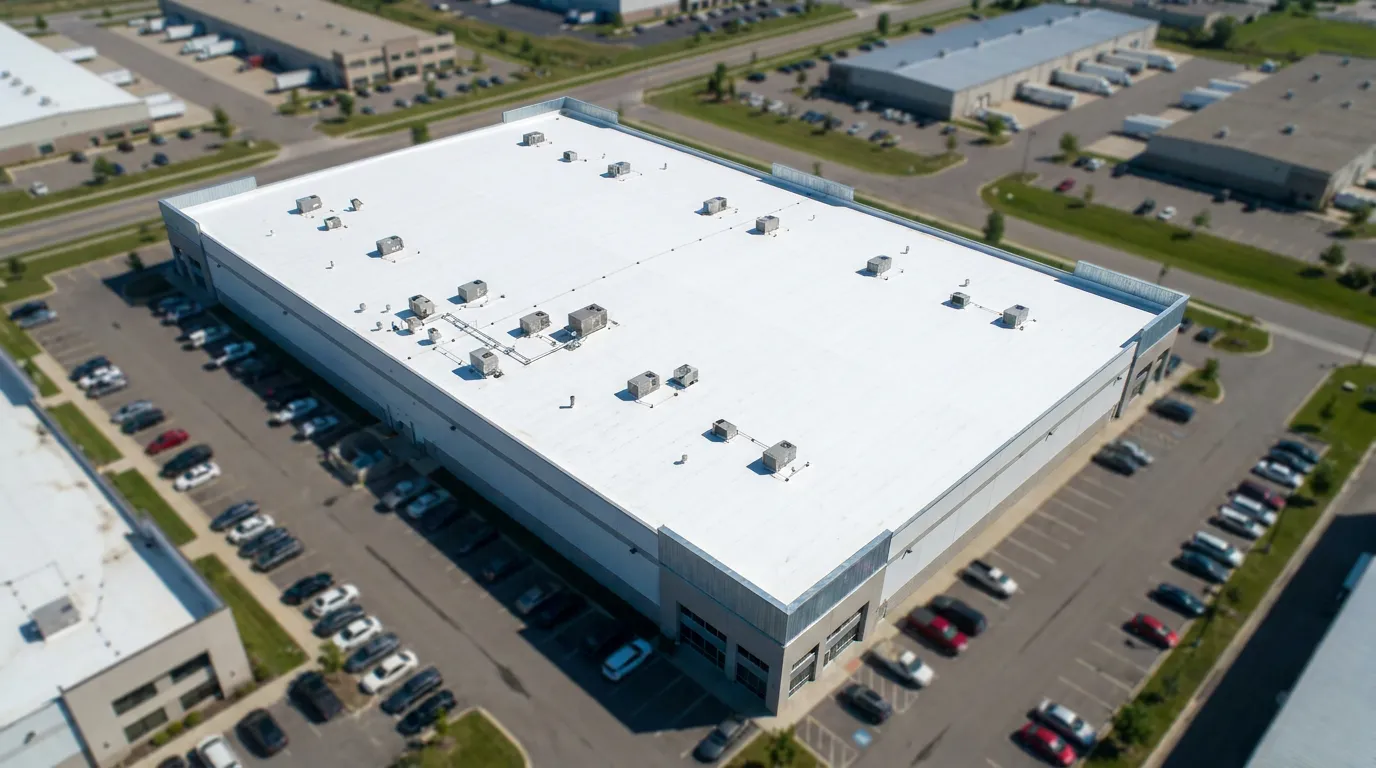 A white TPO membrane on a commercial warehouse reflects heat and helps drop rooftop surface temperatures on hot summer afternoons.
what TPO and EPDM actually are.
Before we get into which one wins where, here’s what you’re actually buying.
TPO stands for thermoplastic polyolefin. It’s a single-ply white membrane, usually 45, 60, or 80 mil thick, with seams that get welded together using a hot-air gun at around 1,100F. Once welded, the seam is the same material as the field of the roof. It cannot delaminate the way a glued seam can. TPO showed up in the US commercial market around 1990 and now sits at roughly 40 percent of new commercial flat roof installs nationally.
EPDM stands for ethylene propylene diene monomer. It’s a black synthetic rubber membrane, usually 45 or 60 mil, with seams joined using either splice tape or liquid adhesive. EPDM has been on US commercial roofs since 1962, so when a building owner tells you they want “the rubber roof their dad used,” they mean EPDM. It still holds about 25 percent of the commercial market.
The simplest way to think about it: TPO is plastic that gets welded, EPDM is rubber that gets glued. That single difference drives most of what follows.
cost per square foot in DFW (2026 numbers).
These are real numbers from our project files, not catalog list prices. Material plus labor, installed by an insured crew with full tear-off of one existing layer.
| System | 60 mil mechanically attached | 60 mil fully adhered | Notes |
|---|---|---|---|
| TPO | $7.50 to $9.25 / sq ft | $9.75 to $11.50 / sq ft | Fleece-backed adds $0.85 / sq ft |
| EPDM | $7.25 to $8.75 / sq ft | $9.50 to $11.00 / sq ft | Ballasted is cheaper but rarely usable in DFW wind zones |
A 20,000 sq ft warehouse roof in Garland or Mesquite typically lands between $150,000 and $230,000 depending on which membrane, insulation R-value, and how rough the existing deck is. We almost always recommend at least R-20 polyiso underneath, which adds $1.80 to $2.40 per sq ft but pays back in energy savings inside 7 years.
If you want to sanity-check a bid you’ve already received from someone else, our free roof cost calculator handles flat roof estimates.
the dallas heat factor.
Here’s where TPO pulls ahead for most buildings.
Dallas hits 100F plus on roughly 45 days per year. On a black EPDM roof, surface temperatures during those days regularly hit 175F to 185F. That heat soaks straight into the building. We’ve metered enough rooftop HVAC units to know what that does to a 25-ton unit running at peak: it short-cycles, the compressors work overtime, and you’re paying for it on the Oncor bill.
White TPO surface temps on the same day stay around 95F to 110F. The Cool Roof Rating Council pegs TPO’s solar reflectance at 0.79 versus EPDM’s 0.06. For a 20,000 sq ft single-story building in Dallas with reasonable insulation, that swing typically saves $1,800 to $3,200 per year on cooling. Over the 20-year life of the roof, that’s a real number.
The exception: buildings where heating cost dominates over cooling, which in DFW basically doesn’t exist. We’re cooling-dominated almost everywhere south of the Red River.
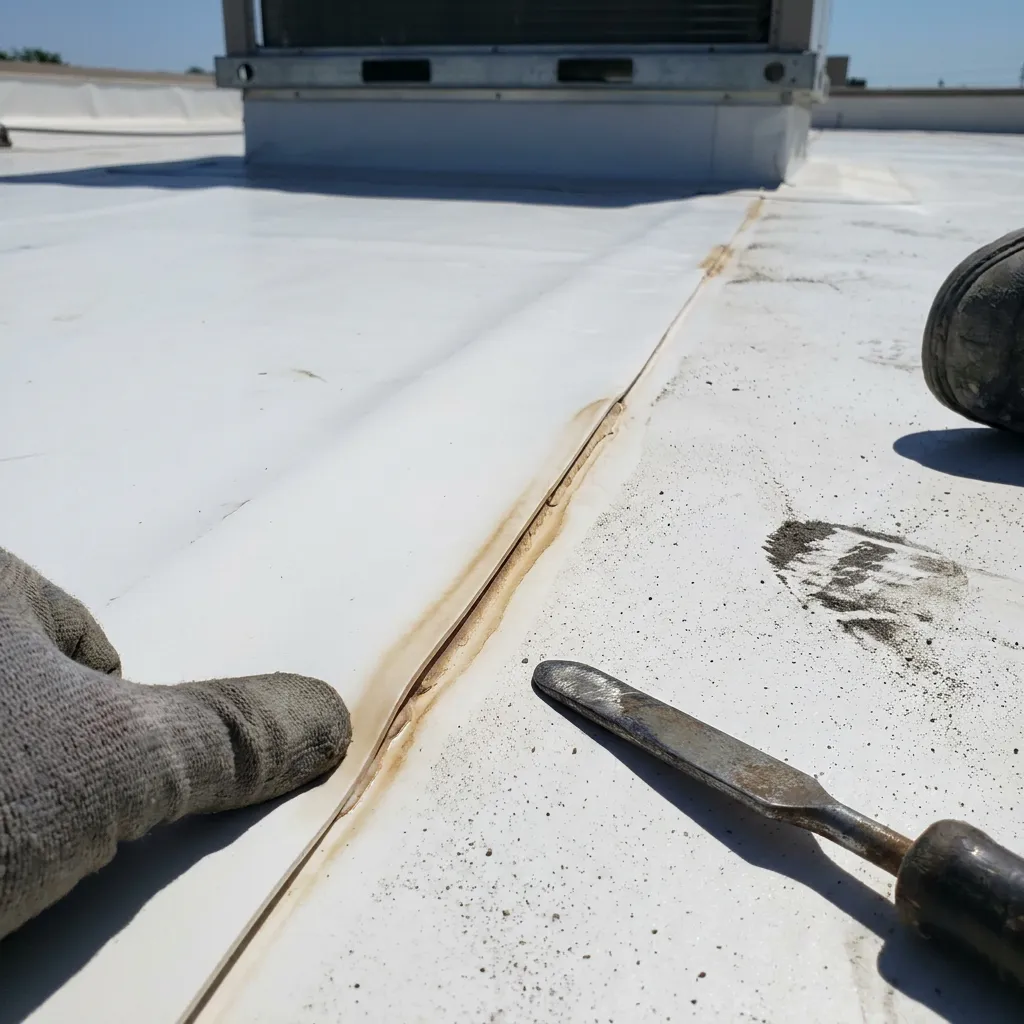 A heat-welded TPO seam becomes monolithic with the roof field once the hot-air weld cures.
hail performance: what actually happens on may 28 2023 and april 9 2024.
This is the question every commercial property owner in Dallas asks us, and the honest answer is: both membranes survive most hail events, both can fail in extreme ones, and the underlying insulation matters more than the membrane itself.
On the May 28 2023 storm that hit east Dallas and Mesquite with 2.5 to 3 inch hail, we inspected 14 commercial flat roofs in the weeks after. The pattern:
- TPO 60 mil over 1-inch polyiso: 3 of 5 roofs had punctures requiring patches. Two had cosmetic dimpling but no membrane breach.
- TPO 60 mil over 2.5-inch polyiso with cover board: 0 of 4 had punctures. The cover board (Dens Deck or similar gypsum) absorbed the impact.
- EPDM 60 mil over 1-inch polyiso: 4 of 5 had splits along seams or fasteners. Rubber stretches, but at 30 mph impact speeds it tears at stress points.
The April 9 2024 storm through Irving and Grand Prairie told the same story. If you’re spending $200,000 on a new roof, the extra $8,000 to $12,000 for a half-inch gypsum cover board is the single best hail-mitigation dollar you can spend. We won’t quote a commercial reroof in DFW without recommending it.
For documenting hail damage after a storm, our hail damage repair page walks through the carrier and adjuster process.
ponding water and slope.
If your existing flat roof holds water in low spots for more than 48 hours after rain stops, that’s “ponding” by the manufacturer’s definition. It’s a warranty issue for both membranes, but they behave differently.
TPO under standing water for long periods can develop microbial growth on the seams and, on lower-quality early-generation product, premature degradation of the heat-stabilizer package. Carlisle and GAF both honor warranties under ponding now if the install used 60 mil or thicker, but you have to document it.
EPDM doesn’t care about standing water. It’s rubber. You can submerge it permanently and it’ll be fine. This is the one scenario where I’d recommend EPDM over TPO without hesitation: an old warehouse in Dallas with a saggy deck where the owner refuses to pay for tapered insulation to fix the slope. EPDM will outlast TPO in that exact situation.
For most buildings, the right answer is to fix the slope with tapered polyiso, not pick a membrane that tolerates the symptom.
rooftop foot traffic and mechanical equipment.
If your roof has 12 RTUs (rooftop units), an HVAC tech walking it weekly, and a kitchen exhaust hood that needs cleaning every quarter, foot traffic matters.
EPDM is more forgiving here. It’s softer, it has give, and a dropped wrench is less likely to puncture it. TPO at 60 mil is harder and slicker, especially when wet. We’ve seen TPO punctures from dropped tools at restaurants in Fort Worth and medical buildings in Irving more often than EPDM punctures in the same scenarios.
The fix on TPO is walk pads: bonded strips of thicker membrane that create permanent walking paths to RTUs and access points. They add about $4 to $7 per linear foot installed. On a building with heavy maintenance traffic, budget for them up front.
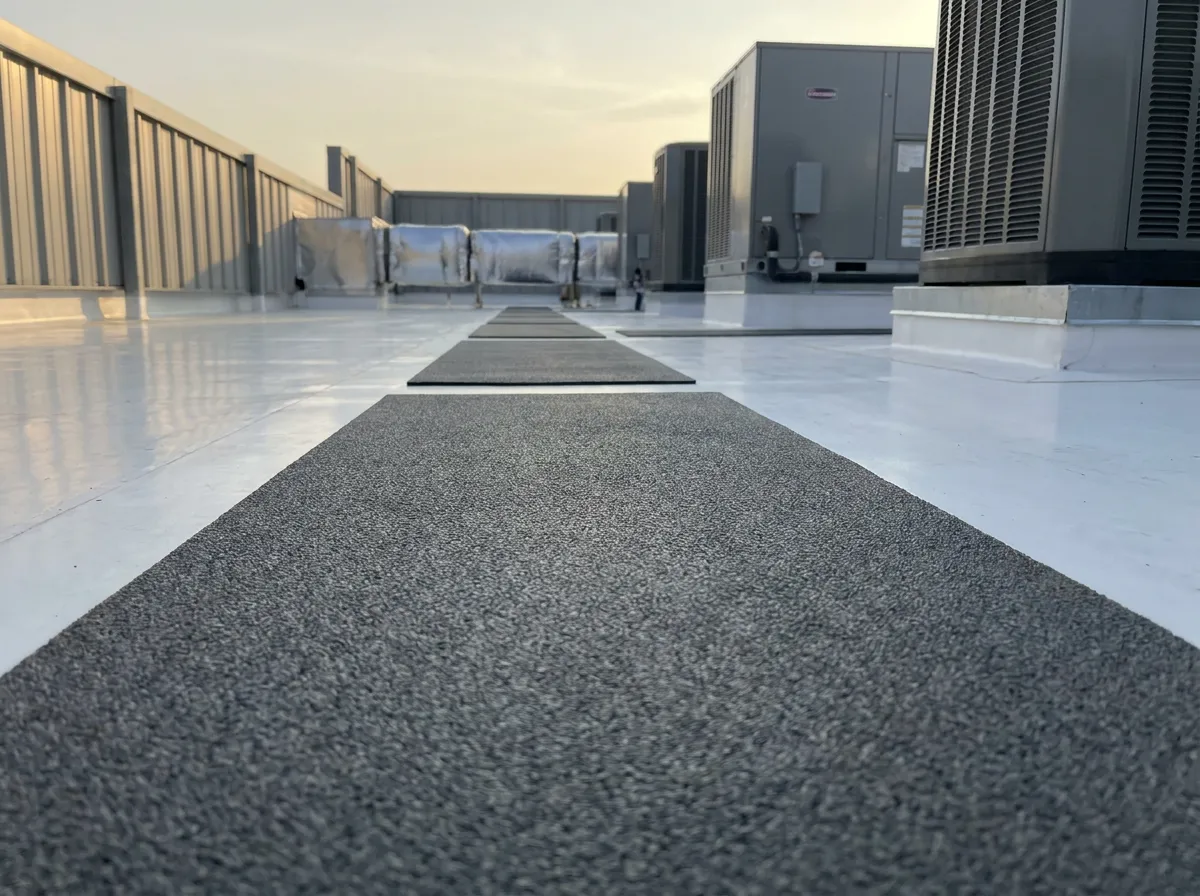 Bonded gray walk pads create permanent walking paths to rooftop HVAC units and keep service techs from puncturing the field membrane.
lifespan and warranty reality.
Manufacturer warranties tell you what the company will cover. Actual lifespan tells you what the roof will do. Here’s both.
| Factor | TPO | EPDM |
|---|---|---|
| Manufacturer warranty (60 mil) | 20 years | 20 years |
| Realistic DFW lifespan | 22 to 28 years | 25 to 35 years |
| First major repair typically needed | Year 12 to 15 (seam touch-ups) | Year 10 to 14 (seam re-glue) |
| UV degradation rate | Moderate, accelerating after year 20 | Low, very stable |
| Cold flexibility | Stiffens below 40F | Stays flexible to -40F |
EPDM genuinely lasts longer. That’s not marketing, that’s 60 years of US installations. The catch is that EPDM’s seams need attention earlier and more often. A 25-year EPDM roof in Dallas will probably need its seams re-glued or taped twice. A 25-year TPO roof will need maybe one round of seam touch-ups at year 15.
For owner-occupied buildings where you’ll hold the property 15 years or longer, lifespan math favors EPDM slightly. For buildings you might sell inside 10 years, TPO’s lower energy costs and cleaner appearance at resale tend to win.
when EPDM is the right call.
I want to be specific here because EPDM gets dismissed too quickly. Pick EPDM when:
- The deck has unfixable ponding. Old warehouses where tapered insulation isn’t in the budget.
- The owner plans to keep the building 20-plus years. Lifespan math compounds.
- The roof has heavy daily foot traffic. Restaurant rooftops, food processing facilities.
- The building is in a heavily treed area. Falling branches puncture TPO more readily.
- The owner has had a bad TPO experience. Some early-2000s TPO product was genuinely bad. Owners burned by it sometimes never come back, and that’s a fair call.
If any two of those apply, I’ll recommend EPDM. If only one applies, TPO with the right cover board usually still wins.
when TPO is the right call.
The default for most Dallas commercial buildings:
- Cooling-dominated energy load. Almost every DFW building.
- Reasonable slope (quarter-inch per foot or better). Standard for buildings built after 1990.
- Light to moderate foot traffic with walk pads. Most offices, retail, light industrial.
- Hold period of 5 to 15 years. Most commercial owners.
- Aesthetic matters. TPO looks clean from upper-floor windows of neighboring buildings, EPDM looks like a tire.
For the full TPO specification we use on Dallas projects, including thickness, insulation, and cover board recommendations, see our TPO roofing page.
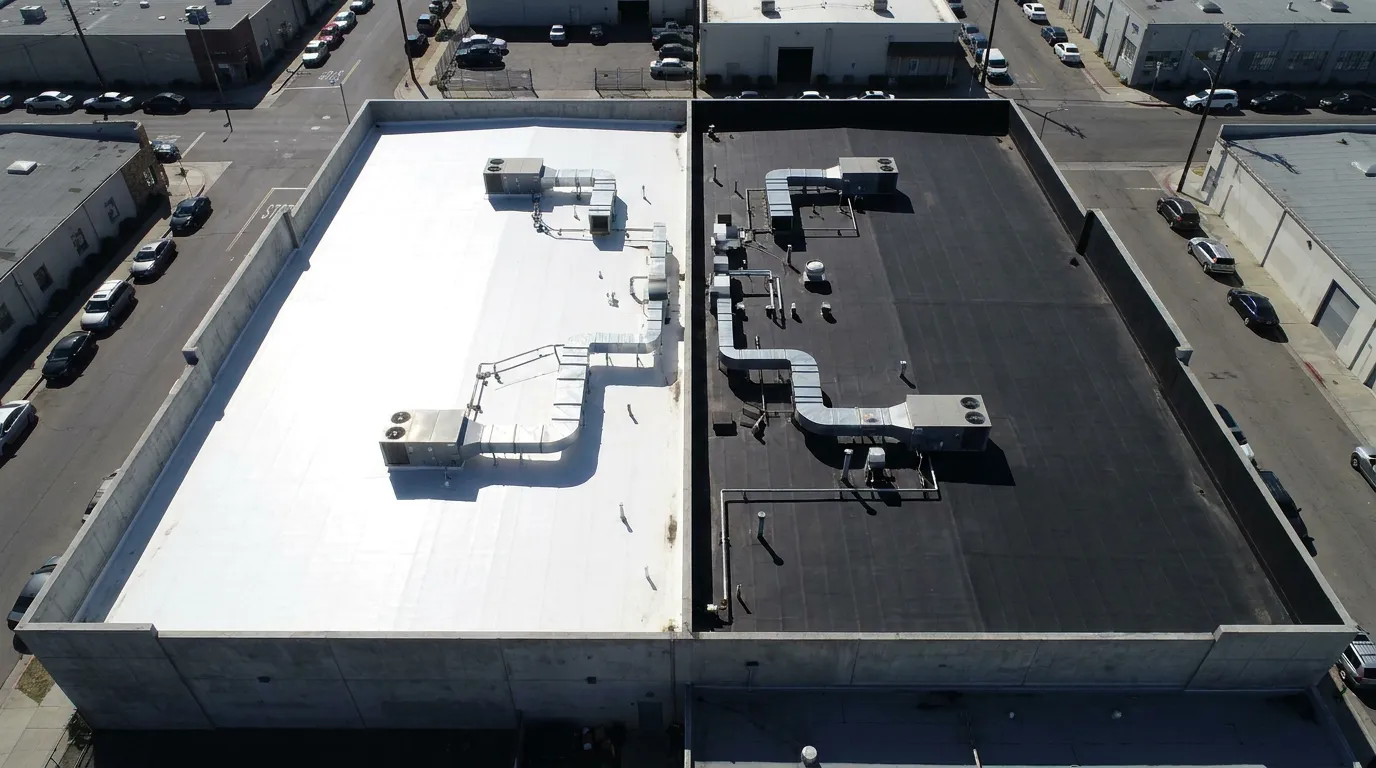 A white TPO roof beside a black EPDM roof shows the difference in reflective surface between the two membranes.
installation timeline and crew size.
For a 20,000 sq ft commercial reroof in DFW:
- TPO: 8 to 12 working days with a 6 to 8 person crew. Weather sensitive because heat welders don’t work in rain. We schedule around the forecast and pull tarps if a pop-up cell rolls in.
- EPDM: 10 to 14 working days with the same crew size. Adhesive cure times slow the work, especially below 50F or above 95F.
Both systems require the existing roof to be torn off down to the deck for full reroofs, unless we’re doing an overlay on a single-layer existing roof in good shape. Overlays save 15 to 20 percent but limit your warranty options.
If you need flat-roof work that’s smaller than a full reroof, like patches, drain replacements, or scupper repairs, our flat roof repair service covers it.
frequently asked questions.
Is TPO better than EPDM for hail? About the same at the membrane level. Both are more vulnerable to hail than the insulation underneath them. The single biggest hail-mitigation upgrade for either system is a gypsum cover board between the insulation and the membrane. It adds about 5 percent to the project cost and dramatically reduces puncture risk in 2-inch-plus hail.
How long does a TPO roof last in Dallas? With 60-mil membrane, proper insulation, and a cover board, expect 22 to 28 years of useful life in DFW. The 20-year manufacturer warranty is conservative. The UV intensity here is harder on TPO than the same membrane would see in Chicago or Boston, so we recommend 60 mil minimum, never 45.
Does EPDM still make sense for new construction? Sometimes. For a tilt-wall warehouse with no rooftop equipment and a 25-year-plus hold period, EPDM’s lower long-term maintenance is attractive. For office, retail, medical, or anything with HVAC density, TPO usually wins on energy savings alone.
Can I put TPO over my existing EPDM? Technically yes with a slip sheet, but I don’t recommend it. You’re trapping moisture between two impermeable membranes and the warranty options shrink to almost nothing. Tear off the EPDM, evaluate the insulation, replace what’s wet, and start clean.
What does a commercial roof inspection cost? For commercial buildings in DFW, we charge $450 to $850 depending on size and access. That includes a written report with photos, moisture scan if needed, and remaining-life estimate. Insurance claim documentation is a separate scope. More on what we cover at our about page and the commercial roofing service page.
Does insurance cover TPO or EPDM replacement after hail? If the membrane is punctured or the seams are compromised by impact, yes, under most commercial property policies. Carriers will sometimes try to scope a repair when a full replacement is justified, which is where supplements and proper documentation matter. We handle the carrier conversation as part of every storm claim.
If your Dallas, Irving, or Fort Worth commercial roof is 15-plus years old or you’ve taken hail in the last two storm seasons, get a real inspection before you commit to either system. Call us at (214) 326-3106 and we’ll do a roof walk, pull moisture readings, and give you a straight answer on whether TPO or EPDM fits your building. No pressure, no upsell. Mahmoud or Sara will be the one who picks up.